
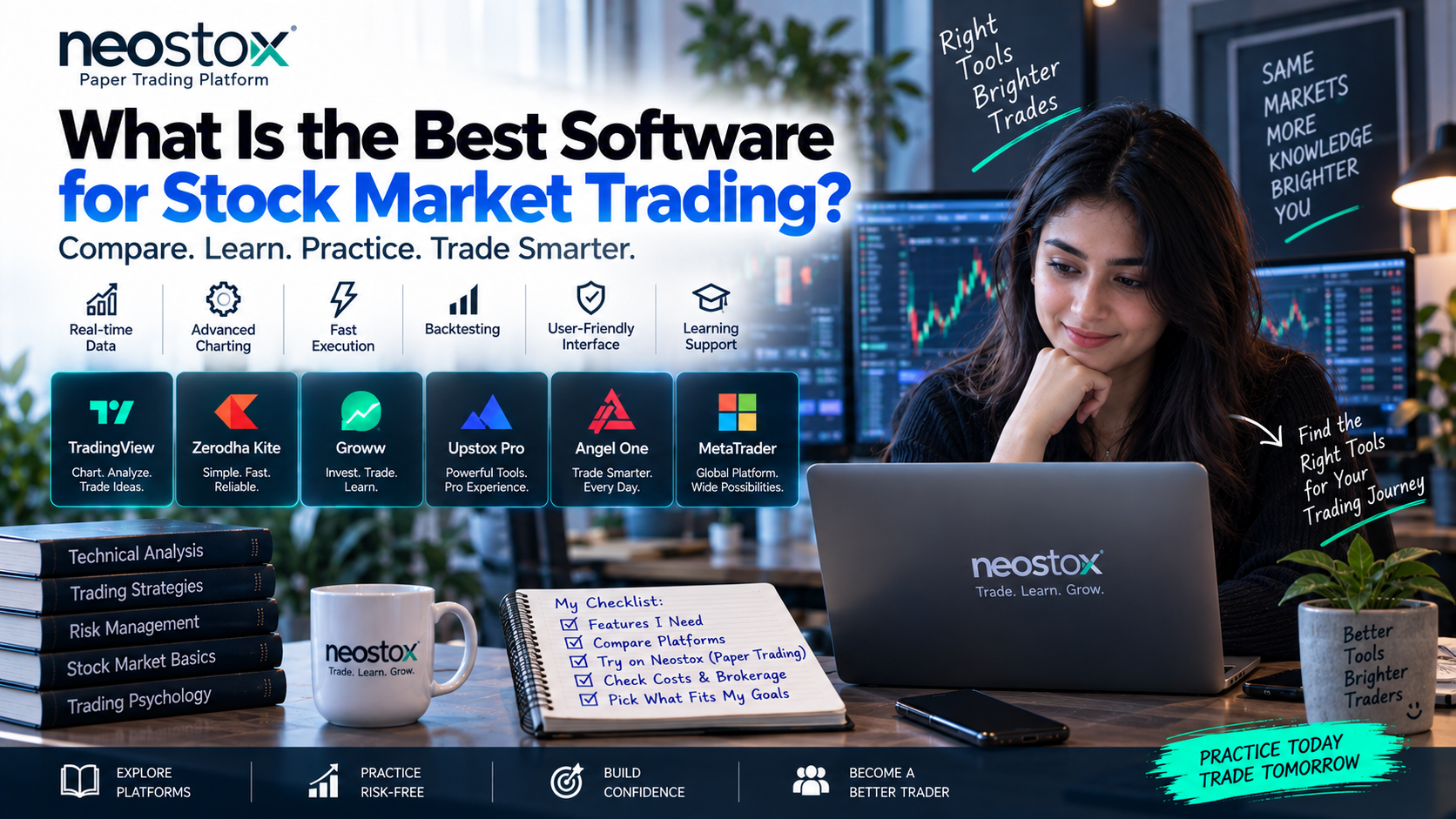
The short answer
There is no single best stock market trading software. The right choice depends on what you need: order execution, charting, scanning, options analysis, paper trading or journaling.
For real-money trades, use a reliable platform offered by a regulated broker. For learning and testing strategies without risking capital, a virtual trading platform such as Neostox can be useful.
What should good trading software offer?
- Reliable execution: Orders should be easy to place, modify and track.
- Useful charts: Look for suitable time frames, indicators and drawing tools.
- Clear costs: Check brokerage, platform fees and data charges.
- Risk controls: Stop-loss orders, position tracking and margin visibility matter.
- Stable performance: Frequent delays or outages can be costly for active traders.
- Strong security: Prefer secure login controls and never share account credentials.
Choose software based on your trading style
For beginners
Prioritise a simple interface, educational tools and paper trading. Avoid paying for advanced features you do not yet understand.
For swing traders
Focus on end-of-day charts, watchlists, alerts and scanners. Ultra-fast execution is usually less important than disciplined trade planning.
For futures and options traders
Look for option-chain data, strategy-building tools, payoff views, margin estimates and fast order management. Because derivatives involve leverage, test the strategy before using real money.
Where Neostox fits
Neostox is designed for virtual trading and strategy practice. Traders can use it to understand order placement, test options ideas and review decisions without putting real capital at risk. Simulated results, however, do not guarantee similar performance in live markets.
Bottom line
The best software is not the one with the longest feature list. It is the platform that matches your trading style, remains reliable and helps you control risk. Test the workflow first, then commit money or pay for premium features.