
BLOG
30-Day Learning Plan for Beginners Using a Stock Market Simulator Before Investing Real Money

30-Day Learning Plan for Beginners Using a Stock Market Simulator Before Investing Real Money

5 views

Lays out a structured 30-day plan for beginners to learn trading on a simulator before risking real money, moving week by week from basic mechanics to strategy testing to focused day-trading practice to full portfolio management. Sets realistic expectations upfront, offers a 30-minutes-a-day version for time-constrained readers, and closes with common mistakes plus Neostox as the platform to run the whole plan on live NSE/BSE conditions.

Read More
I Have $100,000 in Virtual Money in a Stock Market Simulator. How Should I Use It to Learn Portfolio Diversification and Risk Management?

I Have $100,000 in Virtual Money in a Stock Market Simulator. How Should I Use It to Learn Portfolio Diversification and Risk Management?

6 views

Learn how to actually use a $100,000 virtual simulator account to learn diversification and risk management, not just rack up a big number. Walks through practical rules: holding 8-15 positions, capping risk per trade at 1-2%, applying the 3-5-7 risk framework, and diversifying by correlation across sectors rather than just stock count. Debunks unrealistic expectations along the way (turning $5,000 into $1 million, daily income targets) and positions Neostox as the platform to practice these habits on real NSE/BSE price data before real capital is involved.

Read More
Why Am I Consistently Profitable in a Stock Market Simulator But Struggling When I Trade With Real Money?

Why Am I Consistently Profitable in a Stock Market Simulator But Struggling When I Trade With Real Money?

5 views

Why traders profit in a simulator but struggle with real money: it's the missing real order fills, real transaction costs, and psychological pressure, not a flawed strategy. Backs this with verified SEBI data (93% of F&O traders and 70%+ of intraday traders lost money recently, costs eating up to 57% of losses) and debunks viral "trader made millions" stories as outliers, not benchmarks. Closes with practical fixes, manual cost adjustments, minimum-size live trading, matching journal discipline, and positions Neostox as a simulator built on live NSE/BSE conditions to narrow that gap.

Read More
What Are the Biggest Mistakes Beginners Make When Practicing With a Stock Trading Simulator?

What Are the Biggest Mistakes Beginners Make When Practicing With a Stock Trading Simulator?

8 views

This blog breaks down the biggest mistakes beginners make when practicing with virtual money on a stock trading simulator, arguing that most people fail not because the simulator is flawed but because they treat the practice too casually, using an unrealistic virtual balance, overtrading since nothing feels at stake, skipping the trade journal, clicking through trades without a defined strategy, ignoring real transaction costs and slippage, overreacting to short winning or losing streaks, rushing into options and futures before mastering equity basics, and mistaking a profitable simulated account for real trading skill. It backs this up with SEBI's verified finding that loss-making intraday traders paid transaction costs equal to 57% of their losses in FY23, then offers a practical fix for each mistake, a section on what actually separates good traders from beginners (consistency, defined risk, disciplined review), an embedded before-and-after discipline checklist readers can use directly, and an honest answer to whether simulators like Investopedia's are safe to use (financially yes, though realism varies by platform), before closing with Neostox positioned as a simulator built on live NSE/BSE market conditions across equities, futures, and options for readers who want their practice habits to actually transfer to real trading.

Read More
How Can I Use a Stock Market Simulator to Test Whether My Trading Strategy Actually Works?

How Can I Use a Stock Market Simulator to Test Whether My Trading Strategy Actually Works?

11 views

This guide explains the exact method for validating a trading strategy on a stock market simulator before risking real capital. It covers writing testable entry/exit rules in advance, committing to a sample size of 30 to 50 trades before starting. Following rules without discretionary overrides, tracking metrics beyond simple profit and loss (win rate, reward-to-risk ratio, maximum drawdown, market condition), and manually adjusting simulated results for real transaction costs and slippage since simulators don't model these by default. It cites SEBI's verified finding that loss-making intraday traders paid costs equal to 57% of their losses in FY23, and profitable traders gave up 19% of gains to costs. It closes with a three-point check for whether a strategy has a genuine edge (positive expectancy, tolerable drawdown, consistency across market conditions) and covers common failure modes: cherry-picking, overfitting, undersized samples, and inconsistent position sizing. Neostox is featured as the platform for running this test, covering equities, futures, and options with live market conditions, a trade log, NeoScreener, and options chain analysis.

Read More
I'm New to Investing and Don't Want to Risk Money Yet. What's the Best Stock Market Simulator?

I'm New to Investing and Don't Want to Risk Money Yet. What's the Best Stock Market Simulator?

12 views

This is a user-journey guide for people brand new to investing who want to practice trading before risking real capital. It segments readers into three starting points (no trading knowledge, basic knowledge but fear of loss, has a strategy to test), then walks through why simulators work, five criteria that make a simulator genuinely useful, a concrete first-week walkthrough, what skills transfer to live trading versus what doesn't (psychology, slippage, hesitation), common beginner mistakes, and signals for when to move to real money. Neostox is featured as the recommended simulator, covering live NSE/BSE market conditions, equities/futures/options, no brokerage account required to start, charting, NeoScreener, and options chain analysis.

Read More
Paper Trading in India: How It Works, What It Teaches, and When to Go Live

Paper Trading in India: How It Works, What It Teaches, and When to Go Live

11 views

Paper trading lets traders practice buying and selling stocks, futures, and options using virtual money while prices track real NSE/BSE markets, with no real capital at risk. This article explains how paper trading works step by step, whether it's free (most platforms are, but real-time NSE/BSE data usually isn't), its legal status in India per SEBI's 2024 advisories on unauthorized virtual trading platforms, and why Neostox's demo mode uses dummy data rather than live prices.

Read More
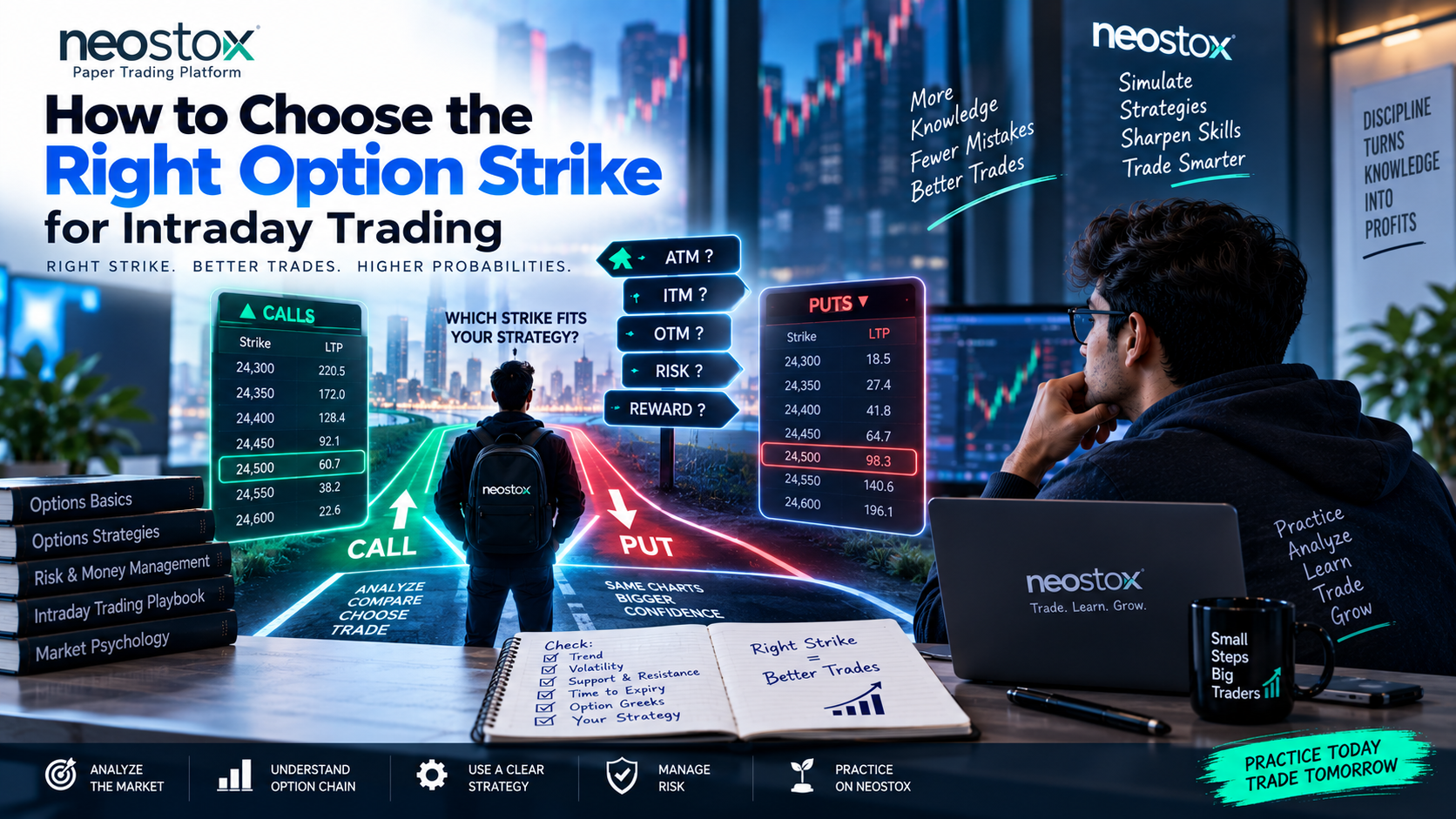
How to Choose the Right Option Strike for Intraday Trading

How to Choose the Right Option Strike for Intraday Trading

50 views

Choosing the market direction is only one part of an options trade. This article explains why different strikes can behave differently even when the underlying moves as expected, what traders should consider before buying a Call or Put, and how Neostox can help identify options that are moving in line with their underlying stock or index.

Read More
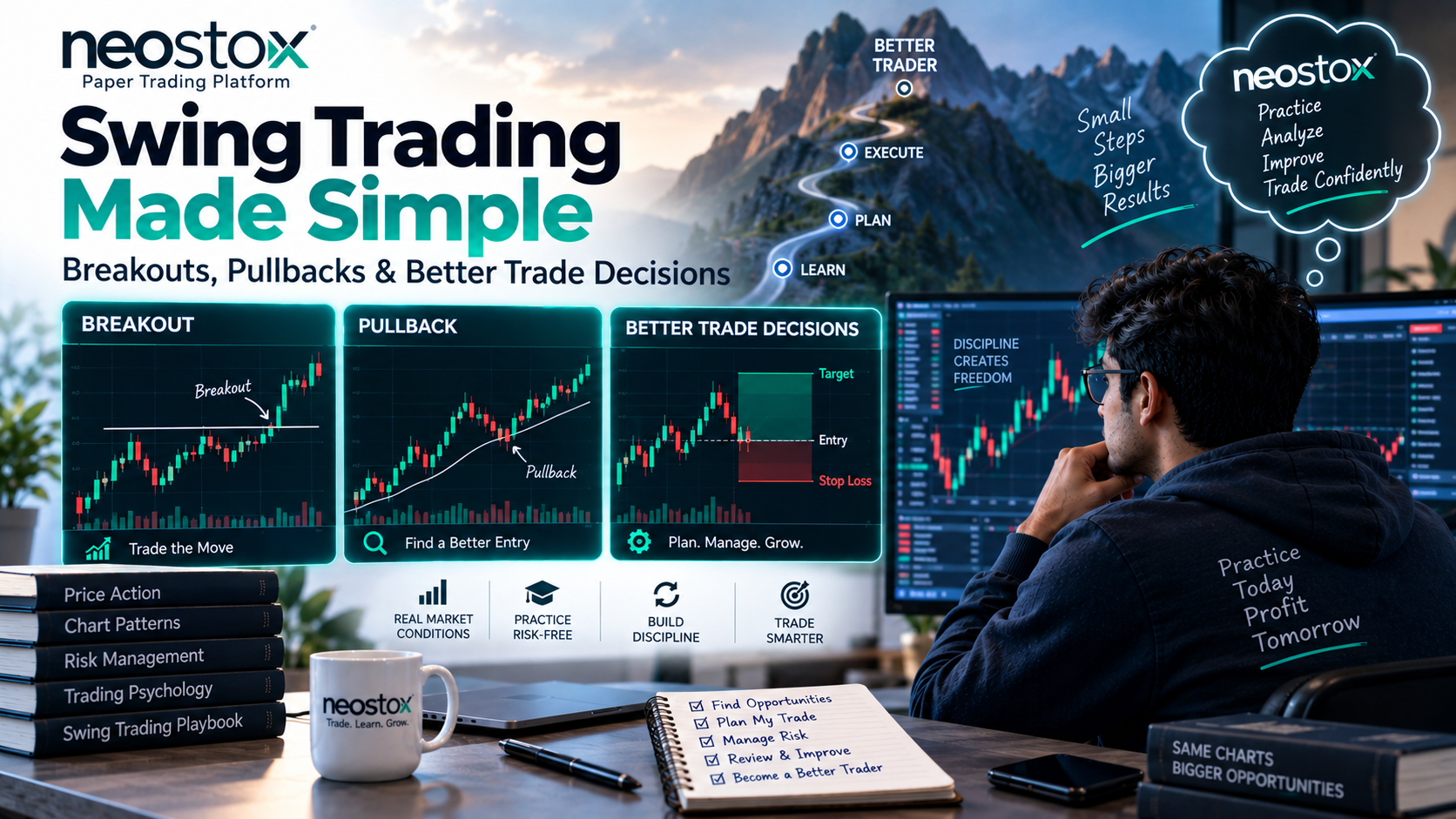
Swing Trading Made Simple: Breakouts, Pullbacks & Better Trade Decisions

Swing Trading Made Simple: Breakouts, Pullbacks & Better Trade Decisions

30 views

This blog post explains two practical swing trading strategies—trading healthy pullbacks and trading breakouts—while highlighting the mindset and risk-management principles needed to use them effectively. It also covers stop-losses, position sizing, trading discipline, patience, FOMO, and why mastering a few setups can be more valuable than constantly searching for new strategies.

Read More