
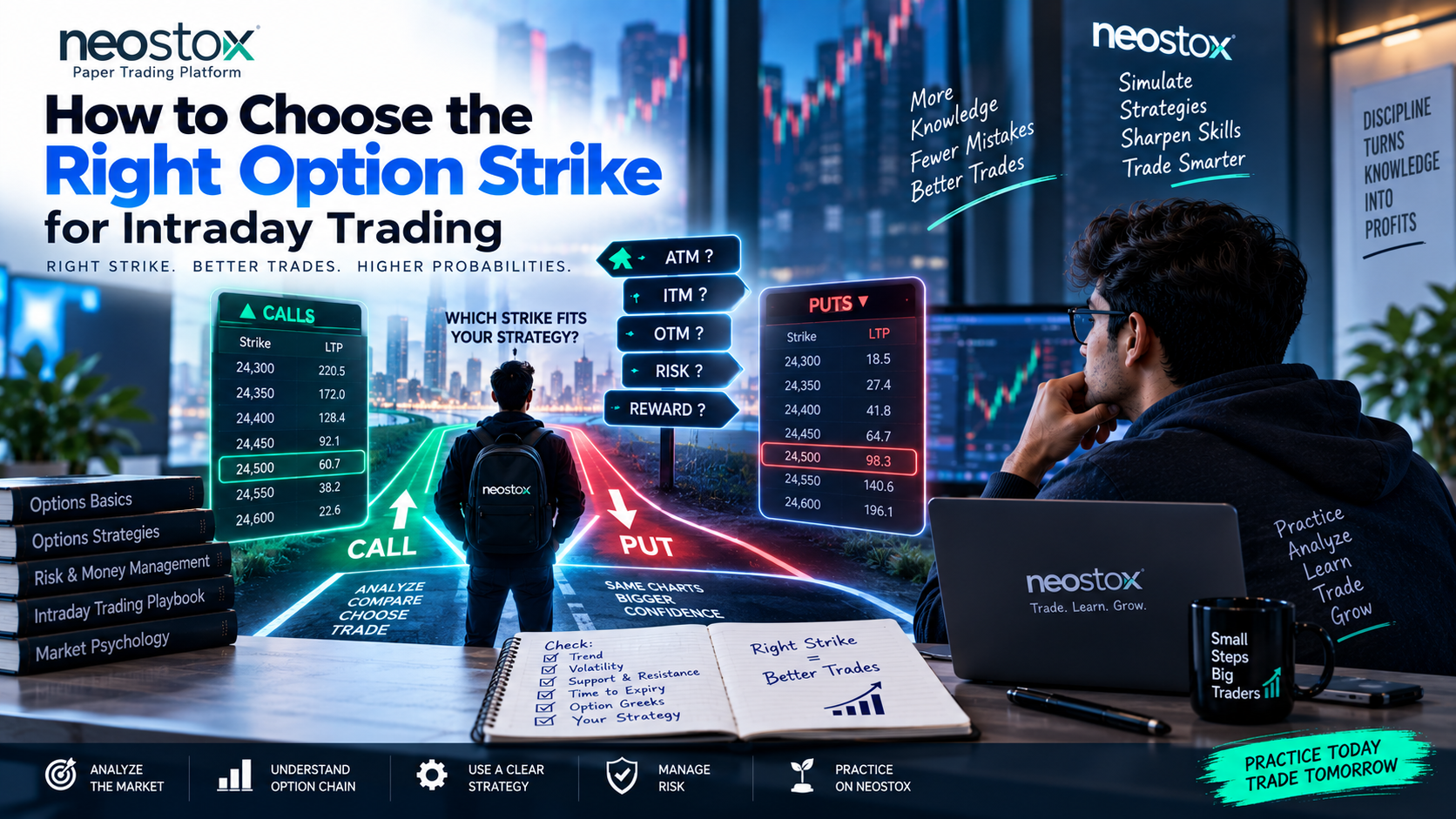
You Got the Direction Right. But Did You Buy the Right Option?
You analyzed the chart.
Nifty looks bullish.
The breakout looks convincing.
You expect the index to move higher, so you buy a Call option.
Nifty moves up exactly as you expected.
But your Call barely moves.
Or worse, it moves for a few minutes, pulls back sharply, hits your stop-loss—and then starts rising again.
This is one of the more frustrating situations in options trading.
Your view on the market may have been right. Your option selection may not have been.
And that raises an important question:
Once you have decided whether the underlying stock or index is likely to move up or down, how do you decide which option to trade?
For traders who primarily buy options, this question can be just as important as predicting market direction.
Buying an Option Is Easy. Selecting the Right One Isn't.
Many retail traders do not have the capital or margin required to short options comfortably.
So the simpler route is often option buying:
- Expecting the index to rise? Buy a Call.
- Expecting the index to fall? Buy a Put.
Simple enough.
But then comes the difficult part.
Which Call?
Suppose Nifty has several strikes available around the current market price.
You could buy:
- an ITM Call,
- an ATM Call,
- a slightly OTM Call,
- or a much further OTM Call.
They are all Call options on the same underlying.
They all have the same basic directional expectation.
Yet they can behave very differently.
That is where option selection becomes important.
Being Right About Nifty Does Not Mean Every Nifty Call Will Behave the Same Way
A common assumption among newer options traders is:
"If Nifty goes up, my Call should go up."
Broadly, yes.
But how much it moves, how quickly it moves, and how consistently it responds to Nifty can differ considerably from one strike to another.
An option premium is affected by more than just the movement of its underlying asset.
Factors can include:
- Strike price
- Distance from the underlying price
- Delta
- Gamma
- Implied volatility
- Time remaining until expiry
- Liquidity
- Bid-ask spread
- Demand and supply in that particular contract
That means two Calls on the same index can react very differently to the exact same move in Nifty.
Imagine This Situation
Suppose Nifty is trading around 25,000.
You are bullish.
You have three Calls in front of you:
- 24,900 CE
- 25,000 CE
- 25,200 CE
Nifty rises 50 points.
All three options may rise—but they don't necessarily rise by the same percentage, at the same speed, or with the same price behavior.
The 24,900 CE may respond relatively closely to the movement in Nifty.
The 25,000 CE may respond differently.
The 25,200 CE may appear attractive because its premium is cheaper, but its response to a small movement in Nifty could be much weaker.
And under different volatility conditions, those relationships can change again.
This is why choosing an option simply because "the premium is affordable" can be a mistake.
The Cheapest Option Is Not Necessarily the Best Option to Buy
Far OTM options often look tempting.
Instead of paying ₹200 for an option, you may find another strike available for ₹50.
The ₹50 option feels attractive because:
- you can buy more quantity,
- the absolute capital required is lower,
- and a ₹20 move looks like a huge percentage return.
But there is a catch.
The option may be less sensitive to small movements in the underlying.
You might correctly predict a 30- or 40-point movement in the index and still find that the option premium has not moved enough to produce the trade you expected.
Cheap premium and good trade are not the same thing.
The Opposite Problem Can Also Occur
Now consider an option whose premium is moving extremely aggressively.
That may sound ideal.
After all, if you expect Nifty to rise, wouldn't you want the Call that is rising the fastest?
Not necessarily.
A premium that is moving very aggressively can also move rapidly against you.
For an intraday trader using a relatively tight stop-loss, excessive movement or unstable price behavior can lead to an early exit even when the broader market view eventually proves correct.
So the objective isn't simply:
Find the option moving the most.
A more useful question is:
Which option is responding appropriately and consistently to the movement of the underlying asset?
That is a very different way of looking at option selection.
The Relationship With the Parent Matters
When buying an option based on the directional movement of a stock or index, you are essentially expecting the option to respond to its parent, or underlying asset.
For example:
Nifty moving up → Call premium expected to strengthen
Nifty moving down → Put premium expected to strengthen
If your trading decision originates from the Nifty chart, it makes sense to understand how closely the option you are considering is actually responding to Nifty.
Similarly, if you are trading Reliance options based on the Reliance chart, you would want to understand how the relevant Call or Put is behaving relative to Reliance.
This sounds obvious.
But in practice, many traders don't check it.
How Do Traders Normally Find This?
You can do it manually.
Suppose you want to buy a Nifty Call.
You could open the charts of several strikes:
- ATM
- One strike ITM
- Two strikes ITM
- One strike OTM
- Two strikes OTM
- Perhaps a few more
Then compare those charts with Nifty.
You could examine:
- which options are responding to Nifty's movement,
- which appear sluggish,
- which are moving erratically,
- which have sufficient volume,
- which have a reasonable bid-ask spread,
- and which appear most suitable for the trade you are planning.
There is nothing wrong with doing this.
In fact, it can be a useful exercise.
The problem is time.
Intraday Traders Don't Always Have Five Minutes to Compare Ten Charts
Markets can move quickly.
A breakout happens.
The index starts moving.
You identify the trade.
Now you have to decide which strike to take.
If you then start opening several option charts and comparing their behavior manually, the opportunity may already have changed by the time you finish.
This becomes even more relevant for traders dealing with short-duration intraday setups.
Option selection itself can become a bottleneck between identifying an opportunity and acting on it.
And this is an area where technology can help.
Neostox Can Help You Identify Options Moving With Their Parent
Neostox analyzes available options and helps identify contracts that are moving in line with their underlying stock or index.
Instead of manually opening chart after chart simply to understand which strike is responding to the parent, you can use this information as part of your option-selection process.
There are two useful places to see this in Neostox.
1. Neostox Options Trader
The Options Trader can help identify suitable options based on their relationship with the underlying asset.
So once you have selected the stock or index and expiry, you don't necessarily have to start your analysis by manually checking every available strike.
Neostox can help narrow down the available choices.
Importantly, this does not mean that an option identified by the system is guaranteed to make money.
It simply solves an important information problem:
Which option is currently behaving in line with the underlying asset I am analyzing?
The final trading decision remains yours.
2. Neostox Options Chain
The Neostox Options Chain also makes this information easier to see.
Along with the regular information traders expect from an options chain—such as:
- Open Interest
- Volume
- Implied Volatility
- Bid Price
- Ask Price
- Bid Quantity
- Ask Quantity
- LTP
- Change %
—you can also identify options that are moving with the parent.
This gives you another useful dimension when comparing strikes.
Instead of looking at strike price and premium alone, you can ask:
Is this option actually responding properly to what the underlying is doing?
That can be valuable information whether you ultimately trade the option or not.
This Is Useful Even If You Don't Trade Through Neostox
This is an important distinction.
You don't necessarily have to look at Neostox only as a place to execute simulated trades.
It can also be used as a market-analysis and options-selection tool.
You may already trade through your broker.
You may already have your own trading setup.
You may already know exactly when you want to enter.
But before choosing the contract, you may still want to know:
- Which Calls are responding well to the underlying?
- Which Puts are responding well?
- Which strikes have sufficient liquidity?
- How are different premiums behaving?
- What does the options chain look like?
- Which option appears most aligned with the movement you are trying to trade?
That information itself can be useful.
A Better Way to Think About Option Buying
Instead of asking only:
"Will Nifty go up or down?"
an option buyer should consider a second question:
"If my view is correct, which option is most appropriate for expressing that view?"
The first question is about market direction.
The second is about instrument selection.
They are related—but they are not the same decision.
A trader can get the first one right and still make a poor trade because of the second.
Don't Select an Option Just Because You Can Afford It
This is probably the biggest takeaway.
Suppose you have decided to buy a Call.
Don't immediately choose the premium that fits your available capital.
Look at the option itself.
Ask:
- How is it moving relative to the underlying?
- Is there sufficient volume?
- Is the bid-ask spread reasonable?
- Is it too far OTM for the move I am expecting?
- How much time remains until expiry?
- Is implied volatility unusually high or low?
- Is the premium behaving smoothly or erratically?
And most importantly:
Does this option appear to be responding to the market movement that forms the basis of my trade?
That one question can change the way you approach option buying.
Direction Is Only Half the Decision
Options trading often appears simple from the outside.
Bullish? Buy a Call.
Bearish? Buy a Put.
But anyone who has traded options for some time knows there is another layer.
Which Call?
Which Put?
Which strike?
Which premium?
And that is exactly why option selection deserves attention.
You can analyze the underlying correctly and still end up with an option that doesn't behave the way you expected.
So before your next options trade, don't just analyze where the index or stock might go.
Take a moment to analyze the instrument you are actually going to buy.
Because ultimately, you are not trading the index chart. You are trading the option premium.
How Neostox Fits Into This
Neostox can help reduce the effort involved in this process by highlighting options that are moving along with their parent stock or index through its Options Trader and Options Chain.
Use it to study different strikes.
Compare their behavior.
Understand how option premiums react when the underlying moves.
And whether you ultimately take the trade or decide to stay away, you make that decision with more information in front of you.
That is the real objective:
Not to find a magical strike price—but to make a more informed option-selection decision.
Options involve significant risk, and option premiums can change rapidly. The examples in this article are for educational purposes and should not be interpreted as investment advice or a recommendation to buy or sell any security.