
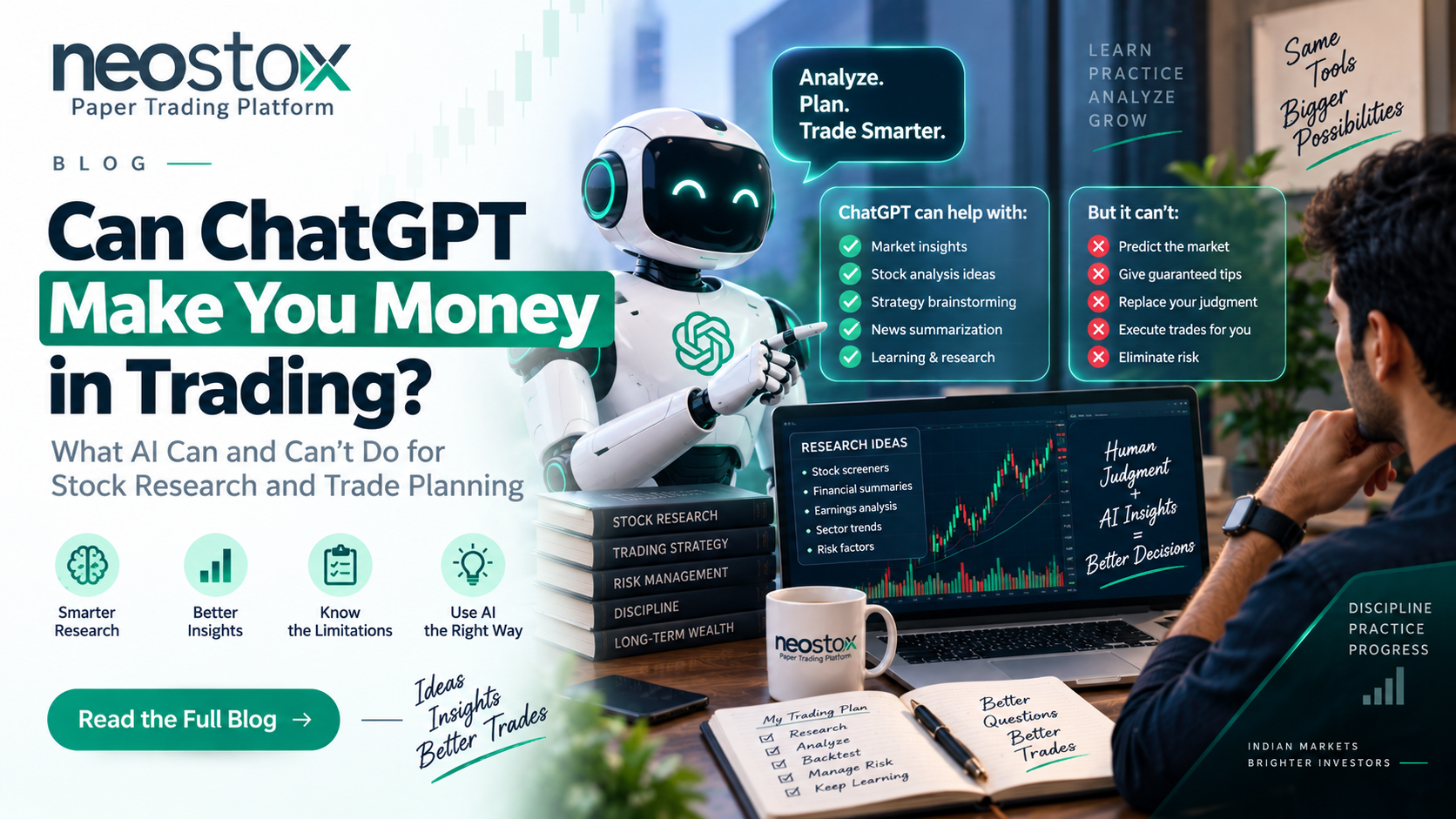
Can ChatGPT actually make money trading stocks?
No, not by itself, and there's a pretty simple reason why. ChatGPT doesn't have live access to real-time market data by default, can't execute trades, isn't registered with SEBI to give investment advice, and has no accountability if it gets something wrong. Even setting all that aside, no tool, AI or otherwise, can guarantee trading profit, since markets respond to constantly shifting conditions no model has ever fully captured.
What ChatGPT can do is make you a more organized, better-informed trader around the actual decisions you make. That's a real, meaningful difference from "make you money," even if it sounds less exciting.
What is ChatGPT actually good at for trading and stock research?
Quite a lot, honestly, just not the flashy part. Explaining concepts is probably its single best use here, ask it to explain what a stop-loss order does, how options time decay works, or the difference between a call and a put, and you'll get a clear, patient explanation without judgment for asking something basic.
Organizing research comes next. Paste in a company's earnings summary, a news article, or your own scattered notes, and ask it to pull out the key points, it's genuinely good at this kind of structuring work. Scenario analysis is another solid use, walking through "what would happen to my position if this event occurs" as a thinking exercise, not a prediction, helps you plan for outcomes before they happen rather than reacting in the moment.
Beyond that: building checklists, a pre-trade checklist, a due-diligence list of questions to ask about a stock before buying, journaling support, helping you structure a trading journal template or spot patterns in notes you've already written, and code ideation, if you're building a backtesting script in Python, it can help draft and explain code, genuinely useful for the more technical side of strategy testing covered elsewhere in trading education.
Can I use ChatGPT to find stocks to buy?
Sort of, with real limits worth knowing. It can help you think through screening criteria, what characteristics might define a "value" stock, what ratios matter for a specific sector, but it doesn't have live market data by default, so it can't actually scan current prices and hand you a fresh, accurate list of matching stocks the way a dedicated screener does.
There's also a real risk of it simply getting specific numbers wrong, more on that below. Use it to sharpen your criteria and your thinking, then verify any actual stock data through a proper screener or your broker's platform, not through the chat window alone.
Can ChatGPT predict stock prices?
No, and it's worth being direct about why. Stock prices move based on constantly shifting conditions, earnings, sentiment, macro events, other traders' behavior, that no model, AI or otherwise, can fully anticipate. Anything that looks like a "prediction" from ChatGPT is really a pattern completion based on its training data, not genuine foresight into what a stock will actually do tomorrow.
Treat any specific price prediction it gives you the same way you'd treat a stranger's confident guess, mildly interesting, definitely not something to bet money on.
Can AI create an intraday trading strategy?
It can help you articulate one, that's a genuinely different thing from creating one that actually works. Ask it to help draft entry rules, exit rules, and risk parameters for a breakout strategy, and you'll get something coherent and well-structured. What it can't do is validate whether that strategy is actually profitable, since that requires real backtesting against real historical data, not just logical consistency in how the rules read.
A strategy that sounds smart is not the same as a strategy that's been tested across 30 to 50 trades and multiple market conditions. Use ChatGPT for the drafting stage, then test the result properly before trusting it with anything.
Should I trust AI-generated buy and sell signals?
No, not blindly, regardless of how confident the output sounds. AI-generated signals, from ChatGPT or any other tool, carry the same fundamental uncertainty manually generated ones do, and language models specifically have a well-documented tendency to state things with total confidence even when they're wrong, a behavior often called hallucination.
Treat any AI-generated signal as one input requiring independent verification, real data, your own analysis, a second opinion, never as a finished decision you act on directly.
How can traders use ChatGPT safely?
Keep it in the "assistant," not "decision-maker," category. Use it to explain concepts you're fuzzy on, organize research you've already gathered, draft checklists, and think through scenarios, then verify anything factual, prices, financial figures, specific company data, against a real, current source before acting on it.
Never paste in sensitive account details or credentials, and treat any specific number it gives you, a stock price, a financial ratio, an earnings figure, as something to double-check, not something to trust outright, since it may be outdated or simply wrong.
Can ChatGPT replace a financial adviser or trading platform?
No, on both counts, for fairly concrete reasons. A financial adviser offering specific investment advice in India needs to be a SEBI-registered investment adviser, carrying real regulatory accountability if something goes wrong. ChatGPT isn't registered, doesn't carry that accountability, and explicitly isn't positioned as investment advice.
It's not a trading platform either, it can't execute trades, doesn't hold your positions, and doesn't have live access to your brokerage account. It's a research and thinking tool that sits alongside a real trading platform and, where relevant, real professional advice, not a replacement for either.
The honest limitations, in one place
- No reliable real-time data by default. Without specific live tool access, its knowledge has a training cutoff and it doesn't inherently know today's price or news.
- Hallucination risk. It can state incorrect facts, numbers, or company details with total confidence, a known limitation of language models generally, not a bug specific to any one version.
- No regulatory accountability. It isn't a SEBI-registered adviser, and there's no recourse if its output leads you astray the way there would be with a licensed professional.
- No genuine prediction capability. Markets are shaped by constantly shifting conditions that no model has fully captured, so anything resembling a price prediction is pattern completion, not foresight.
Use ChatGPT for what it's actually good at, explaining concepts, organizing research, drafting checklists and strategy logic, then bring the result to somewhere you can actually test it. Neostox's paper trading runs on live NSE and BSE market conditions across equities, futures, and options, so any strategy or idea you've worked through with AI assistance gets a real, virtual-money test before it ever touches actual capital.