
Day trading means opening and closing a position during the same trading session. You do not carry it overnight.
The holding period may be three minutes or three hours. That does not change the classification. What matters is that you close the position before the session ends, or before your broker’s intraday square off time.
The attraction is obvious. You can trade short price moves without taking overnight gap risk. The difficulty is less obvious until real money is involved: repeated decisions, transaction costs and leverage can punish small mistakes very quickly.
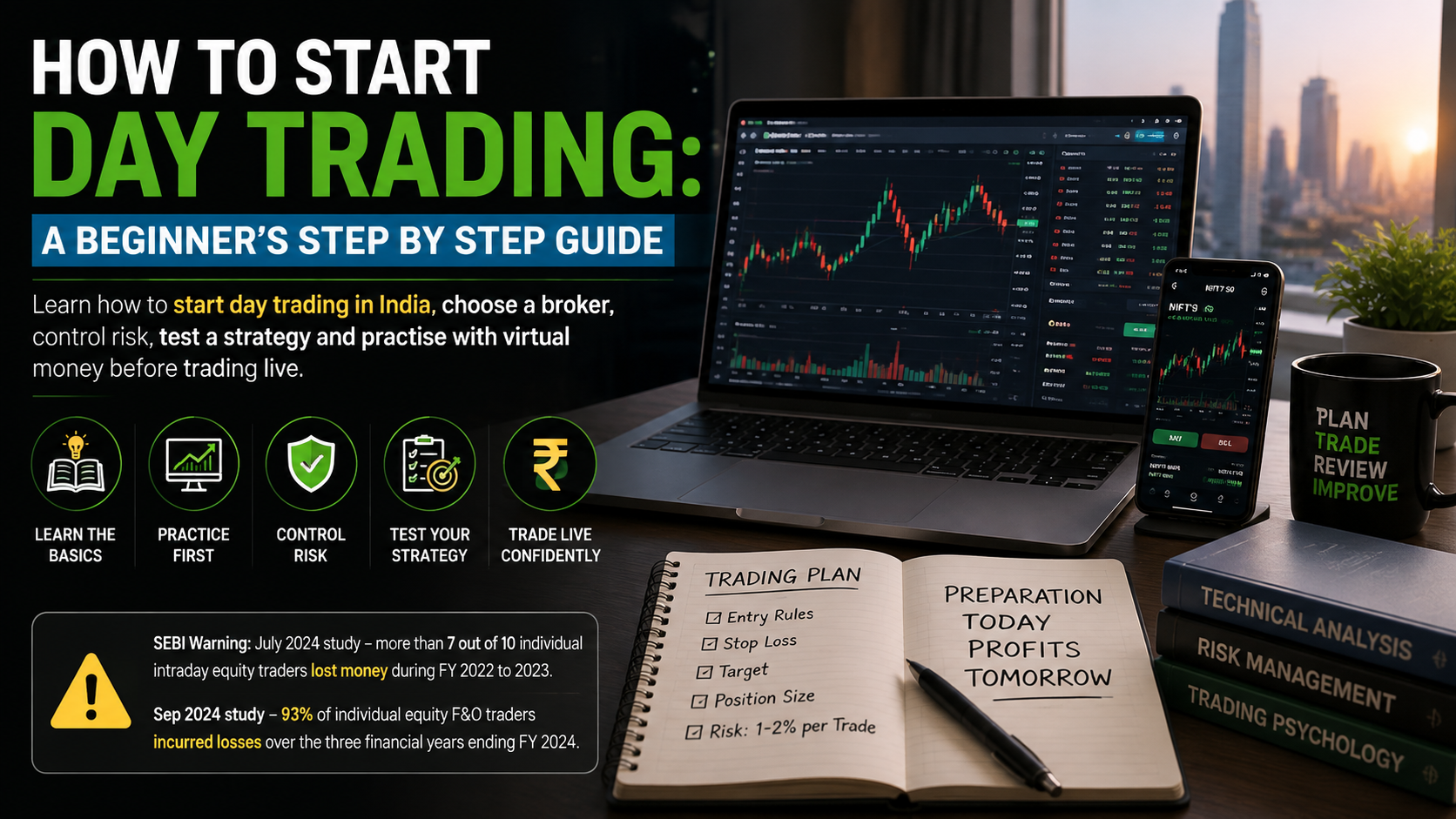
SEBI’s data gives beginners a blunt warning. Its July 2024 study found that more than seven out of ten individual intraday equity traders lost money during FY 2022 to 2023. In a separate study published in September 2024, SEBI reported that 93% of individual equity F&O traders incurred losses over the three financial years ending FY 2024.
Preparation does not guarantee a profit. It does stop several avoidable errors.
What you should know before placing a trade
You will usually need a trading account and demat account with a SEBI registered broker. You also need capital that can take a loss without affecting rent, loan payments or household savings.
Write your trading rules before using real money. Those rules should state what permits an entry, where you will exit if wrong and how much capital you may lose.
Risk control deserves more attention than indicator selection. A stop loss, sensible position size and daily loss ceiling keep one bad session from damaging your account beyond repair.
Practise first. A simulator lets you test order entry and trade management without paying for beginner mistakes, though it cannot recreate the emotional pressure or execution quality of a live trade.
What day trading involves
A day trader attempts to profit from price movements that occur within one session. The instrument may be an equity share, index future or option contract.
Suppose a stock moves above a clearly marked resistance level after an increase in traded volume. A breakout trader may buy it, place a stop below the breakout area and exit at a preset target. If the setup fails, the stop closes the trade.
Every position has to end that day. NSE’s regular equity market runs between 9:15 a.m. and 3:30 p.m., though brokers may close intraday positions before the exchange session ends. Check your broker’s square off policy because late closure can attract extra charges.
Closing positions on the same day removes overnight exposure to earnings announcements and news released after market hours. Intraday trading still carries price risk, slippage and execution risk. A sudden move may fill your stop at a worse price than the one shown on the order.
How to start day trading in India
Step-1: Learn order mechanics
Start with the trading terminal.
You should know what happens when you place a market order, limit order or stop loss order. Learn how bid and ask prices affect your fill. Check the lot size before trading derivatives, since one mistaken futures or options order can create a much larger position than intended.
Candlestick charts also require basic familiarity. You do not need to memorise dozens of patterns. You should be able to read the open, high, low and close of each candle, then compare price movement with volume.
Spend time watching orders execute in a simulator. A strategy is useless if you enter the wrong quantity or place the stop on the wrong side of the market.
Read this also: 30-Day Learning Plan for Beginners Using a Stock Market Simulator Before Investing Real Money
Step-2: Choose a registered broker
Verify the broker’s SEBI registration and exchange membership rather than trusting an advertisement or social media account.
Compare brokerage, statutory charges and the stability of the trading platform. Order execution and customer support matter more than a long list of indicators. A platform failure during an open leveraged position can be expensive.
Read the intraday square off rules as well. Brokers may close positions at different times, and some charge for automatic square offs. Check whether the broker offers bracket orders, alerts and downloadable trade records if you expect to use them.
A demat account stores shares delivered to you. The trading account handles your orders and funds. Brokers commonly open both together, although pure derivatives activity does not involve holding the contract in a demat account.
Step-3: Decide how much capital you can lose
Do not use emergency savings, borrowed money or funds required in the next few months.
There is no regulatory minimum account size that makes day trading safe. A very small account creates its own problem: brokerage and other charges consume more of each gain, while sensible position sizing may leave you with trades too small to execute properly.
Treat your initial capital as training capital. The first objective is to follow the process without taking a large account loss.
I would keep the risk per trade below the often quoted 1% to 2% range while learning. Risking around 0.25% to 0.5% gives a beginner more room to make mistakes and collect enough trades for a useful review.
Take an account of ₹2 lakh. A 0.5% risk ceiling leaves roughly ₹1,000 for the planned loss on one trade. If you buy a share near ₹500 and place the stop at ₹496, the ₹4 price risk caps the theoretical quantity at 250 shares. In practice, use fewer because slippage and charges can push the final loss above ₹1,000.
Step-4: Write one testable setup
“Buy when the stock looks strong” cannot be tested. It also gives you permission to invent a reason after entering.
A usable setup states the market, trading time, entry condition, stop placement and exit rule. You should be able to hand those instructions to another trader and get roughly the same trades.
A beginner might test an opening range breakout with these rules:
- Mark the high and low formed during the first fifteen minutes.
- Enter only after a candle closes outside that range with higher volume than recent candles.
- Put the stop inside the range and reject the trade if the distance makes the position too large for your risk limit.
This is an illustration, not a recommendation. The setup still needs testing on the instrument and time frame you plan to trade.
Momentum and range trading are other common approaches. Scalping is harder for a beginner because frequent orders magnify costs and leave little time to correct an execution error.
Pick one setup. Changing methods after every loss produces no useful sample because you never collect enough comparable trades.
Step-5: Set the stop and position size before entry
Your stop should sit at the price that invalidates the trade idea. It should not move farther away because you hope the market will reverse.
Position size comes after stop placement. If the correct technical stop produces more rupee risk than your limit allows, reduce the quantity or skip the trade. Do not squeeze the stop closer merely to buy more shares.
Set a daily loss ceiling too. With the earlier ₹2 lakh account, a beginner might stop after losing around ₹3,000 in one session. That amount is roughly 1.5% of the account and allows three full risk losses at ₹1,000 each. A smaller ceiling is reasonable.
Once the limit is reached, close the terminal. Trying to recover the loss during the same session often leads to larger size, weaker entries and more brokerage.
Step-6: Practise under live market conditions
Paper trading is useful when you treat it as trading rather than entertainment.
Use the same virtual account size that you expect to fund. Place every stop. Record costs where the simulator permits, and do not assume that every order fills at the best visible price.
Thirty to fifty simulated trades provide an initial sample, but the trade count alone proves very little. Those trades should include quiet sessions and volatile ones. Ten profitable trades during a strong trend do not tell you how the setup behaves when the market becomes choppy.
Neostox lets you practise equities, futures and options using live NSE and BSE market conditions. Its trade log can help you review entries, exits and rule violations before you put real capital at risk.
Simulation has limits. A virtual loss does not create the same reaction as a real ₹1,000 loss, and actual fills may differ. Move to live trading with smaller size than your simulated results appear to support.
Step-7: Record every live trade
A trade journal needs facts, not a long story.
Record the instrument, entry price and quantity. Add the stop, exit price and total charges. Then note whether the trade followed your written setup.
Screenshots help because memory becomes unreliable after the session. Save one at entry and another at exit when possible.
Review rule following separately from profit. A losing trade that followed the plan may be valid. A profitable trade taken outside the plan is still a process error, since repeating it can produce a loss you never budgeted for.
After twenty or thirty comparable trades, check whether losses came from the strategy or your execution. Do not change the rules after one bad afternoon.
Indicators worth learning
A clean chart is usually enough.
Moving averages can help you judge short term direction. RSI measures recent price strength, but an overbought reading does not automatically mean the price will fall. Strong stocks can remain overbought for longer than a short seller expects.
Volume deserves close attention because it shows participation behind a move. A breakout on thin volume may fail, though high volume offers no guarantee either.
Use two or three tools that have a defined purpose. If one indicator says buy while another says sell, adding a third rarely settles the decision. It usually gives you another reason to delay or rationalise a trade.
Price, volume and a clearly marked level are sufficient for many intraday setups.
The costs beginners underestimate
Brokerage is only one line in the contract note. Intraday trades may also incur Securities Transaction Tax, exchange transaction charges, GST, stamp duty and SEBI turnover fees. Bid and ask spreads plus slippage add another cost, even though they do not appear as a separate tax.
Frequent trading makes the problem worse.
SEBI’s July 2024 intraday equity study found that loss making traders spent an amount equal to another 57% of their trading losses on transaction costs during FY 2023. Profitable traders lost 19% of their trading profits to costs. A setup that earns a small amount before charges can therefore lose money after the contract notes are counted.
Suppose your average winning trade makes ₹600 and the losing trade costs ₹500. That appears workable until charges and slippage remove ₹100 or more from repeated entries and exits. The exact cost depends on your broker, turnover and instrument, so test with contract note figures rather than estimates from memory.
Options add another complication. You can predict the market direction correctly and still lose because the option premium changes with time decay and implied volatility. Beginners often see a low premium and mistake it for low risk, yet the percentage loss can reach 100% when an option expires worthless.
Risk differs between equity, futures and options
Cash market intraday trading lets you buy or sell shares for the session, subject to the broker’s product rules and available margin. Losses arise when the share moves against your position.
Futures create a much larger exposure relative to the margin posted. Mark to market losses can accumulate quickly, and lot sizes prevent you from reducing quantity one share at a time.
Option buyers have limited loss up to the premium paid, but frequent premium losses can still damage an account. Option sellers face a different risk profile and may lose far more than the premium received. Margin requirements do not tell you the maximum possible loss.
Beginners often move to derivatives because the visible capital requirement appears lower. The position exposure matters more than the amount blocked as margin.
Tax treatment in India
Tax rules depend on what you trade.
Profits and losses from intraday equity trading are generally treated as speculative business income. Equity futures and options traded on recognised exchanges are generally treated as non speculative business income, subject to the conditions in the Income Tax Act.
This distinction affects loss set off rules, turnover calculations and return filing. Business income is taxed at the slab rate applicable to you, after allowable expenses and other tax adjustments.
Keep broker statements, contract notes and a ledger of charges throughout the year. Turnover for tax purposes does not always mean the full value of every share bought and sold, particularly in derivatives. A chartered accountant who handles trading accounts can calculate it correctly for your records.
Beginner errors that cause avoidable losses
Trading without a fixed exit
A position can move faster than you expect. Decide the exit before entry and place the order where possible.
A mental stop is easy to ignore. Traders often wait for one more candle, then move the exit again when that candle closes badly.
Taking too many trades
Boredom is not a setup.
Every extra trade carries costs and creates another chance to break your rules. Set a limit on the number of trades if you tend to enter impulsively. Three planned attempts are easier to review than fourteen unrelated ones.
Increasing size after a loss
A larger position may recover the previous loss, but it can also turn a manageable session into a damaging one. Keep the risk amount stable throughout the day.
Never calculate the next position based on how much money you want to win back.
Ignoring execution costs
Backtests and paper trades can assume fills that were not available in the live order book. Add reasonable slippage and all statutory charges before judging a setup.
Review the contract note. Your bank balance alone does not show where the money went.
Changing the setup too early
No strategy wins on every trade. A handful of losses does not establish that the rules have failed.
Collect a consistent sample, separate valid trades from rule violations and change one variable at a time. Otherwise, you will not know which adjustment caused the result.