
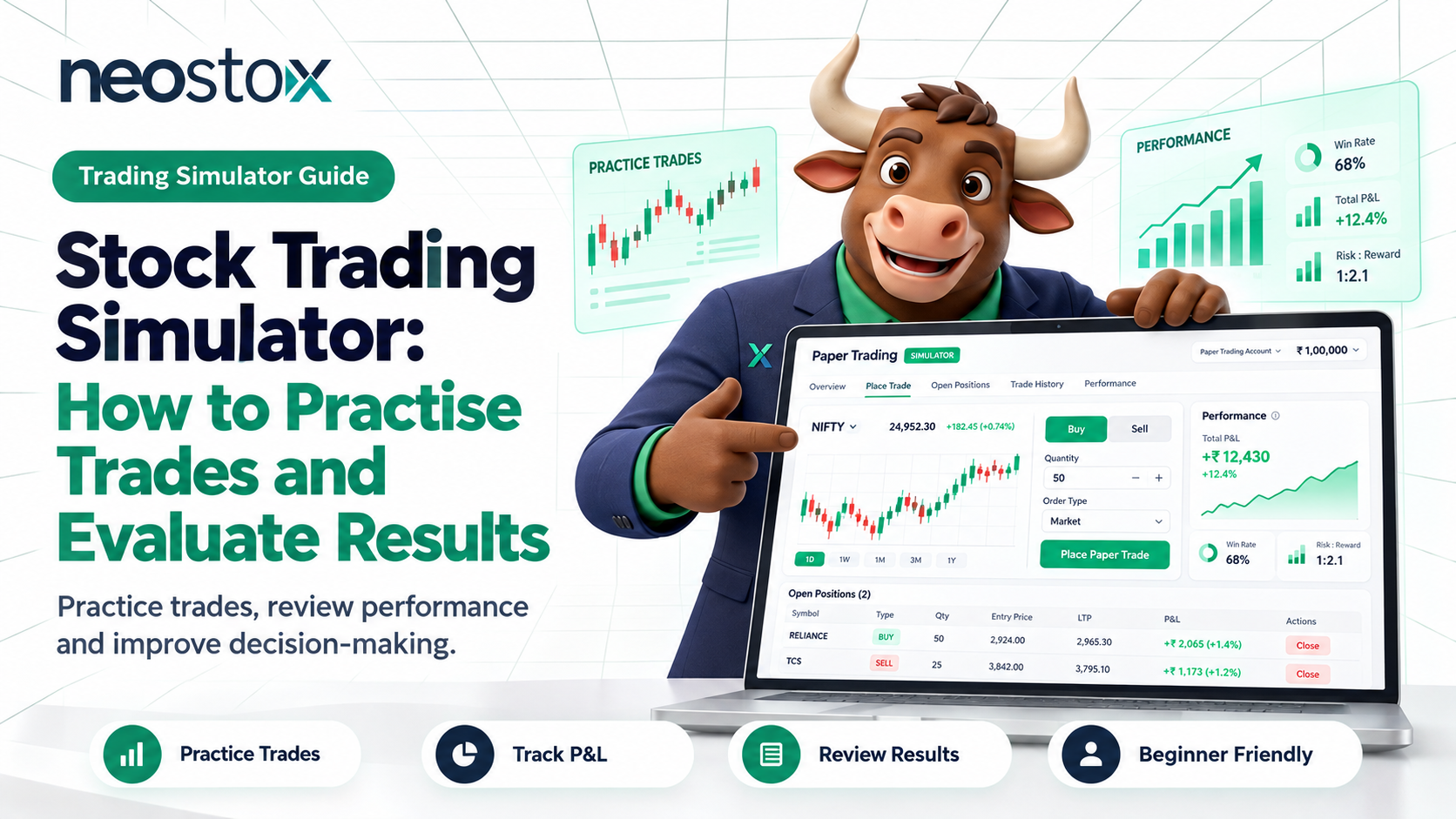
Does a simulator actually build skill? It can. The catch is you have to run it like practice, not a game. Set up an account at a size matching your real plan. Write down every trade, what you entered at, what you exited at, why. Work out your results once costs and slippage come off, not the raw price move sitting on screen. One more piece worth keeping in mind: simulated numbers build mechanics and build discipline. They don't tell you what happens the day real money, and the nerves that come with it, show up in the room.
How can a stock trading simulator help you practise?
Put a trade on. Watch what happens. Guess wrong, and all you've spent is a few minutes of your day, nothing else. Few other ways to learn this stuff come that cheap.
A lot of what makes trading hard isn't the theory, it's the doing. Clicking the right order type under pressure. Reading a chart while it's still moving. Sitting with a position that's going the wrong way without panicking. None of that comes from a book. It comes from doing it badly a few dozen times first, which a simulator lets you do for free.
One warning worth giving early: this only works if you're paying attention. Open random positions because a stock caught your eye, close them whenever, and you'll finish the week knowing roughly nothing more than when you started. Write your rules down first. Keep a record of what you did and why. That's the difference between a tool and a toy.
How do you set up a realistic practice account?
Most simulators hand you an absurd starting balance, ₹50 lakh or more, which sounds fun but quietly ruins the exercise. If you'll be trading with ₹2 lakh once you go live, practice with ₹2 lakh. A trade that feels small against ₹50 lakh can feel like a lot against your real number, and that difference in how it feels is exactly the thing you're trying to train for.
Live data matters too, delayed quotes teach you to react to old news. And decide your risk per trade, 1 to 2% of capital is the usual range, covered in more depth in the companion risk guide, before you've placed anything. Working that number out mid-trade is how discipline quietly disappears.
How do you create and record simulated trades?
This is the step most people skip. It's also the one that matters most. A trade you don't record teaches you almost nothing, since you won't remember the actual reasoning a week later. Just how it turned out.
Record six things, every single trade. The entry price, and why you took it, what you actually saw that made you act. The stop-loss, set before entry, never after. The exit price, and the reason, target hit, stop hit, or a judgment call. The gross result, the raw price move. The costs, covered below. And one honest line on what you'd do differently, if anything.
A simple journal table works well here.
| Date | Stock | Entry price | Stop-loss | Exit price | Reasoning | Gross P&L | Costs | Net P&L | Notes |
|---|
Fill it in for every trade. Not just the wins. Honestly recorded losses usually teach you more than wins ever do.
How do you measure results after costs and slippage?
Gross P&L is just a starting point, not the real answer. Subtract realistic costs, brokerage both sides, taxes, exchange charges, the full breakdown sits in the companion charges guide. Factor in slippage too, the gap between the price you expected and what you'd likely actually get live.
Here's a quick, illustrative example. A simulated trade shows a ₹500 gross gain, 100 shares, a ₹5 move. Apply realistic round-trip costs, brokerage, taxes, exchange charges, roughly ₹65 to ₹75 illustratively. Net result lands closer to ₹425 to ₹435. Not ₹500. Do this for every trade in your journal, not just the big wins, and your numbers start reflecting something real.
What are common simulation mistakes?
A few patterns show up again and again. Worth knowing early, rather than repeating them for weeks.
Ignoring costs entirely tops the list. Tracking only gross P&L makes a strategy look far better than it is, since real costs hit every trade, win or lose.
Position sizing that doesn't match reality comes next. Trading huge, consequence-free positions in a simulator teaches you nothing about how it actually feels at the size you'd genuinely use with real money.
Not recording trades at all is probably the biggest one. Without a journal, you're relying on memory. And memory reliably favors the wins, quietly forgetting the losses. That's not evaluation. That's just a story you like telling yourself.
Testing too few trades trips people up too. Five or ten simulated trades tells you almost nothing reliable. A real sample, 30 to 50 trades minimum, the same threshold from the companion backtesting guide, is what actually starts showing whether something's real or just noise.
And treating a lucky streak as proof of skill. A short winning run can happen purely by chance, even with a genuinely weak approach. Judge the process. Not a handful of recent outcomes.
What can paper trading results not prove?
Worth being honest here, since this is exactly where people get overconfident. Simulated results can't fully show how you'd behave with real money on the line, and the real stress that comes with it. Psychological pressure changes decisions in ways a risk-free simulator just can't replicate. No matter how seriously you take the practice.
They can't fully replicate real execution either. Even good slippage modeling is an approximation. Not an exact match for how a fast market actually fills your orders. And a small batch of simulated trades, even a genuinely strong month, doesn't prove a strategy has a real edge. That takes a proper sample, and ideally out-of-sample testing, covered in the companion backtesting guide, before you'd trust it with real money.
What paper trading reliably builds is mechanics, discipline, and an honest record to learn from. That's genuinely useful. It's just not the final word on whether you, or your strategy, are actually ready.
Practice evaluation checklist
| Step | What to do |
|---|---|
| Set realistic capital | Match your practice account to your actual real-money plan |
| Record every trade | Entry, stop, exit, reasoning, outcome, wins and losses alike |
| Calculate net results | Subtract realistic costs and slippage, not just gross price moves |
| Build a real sample | Aim for 30 to 50 trades before drawing conclusions |
| Review honestly | Look for patterns in mistakes, not just a tally of wins |
Reading about a practice process is a start. Actually running it, with real record-keeping and honest review, is what makes paper trading worth the time. Neostox's paper trading runs on live NSE and BSE data, across equities, futures, and options, giving you a realistic place to build this exact process with virtual money, before any of it touches real capital.