
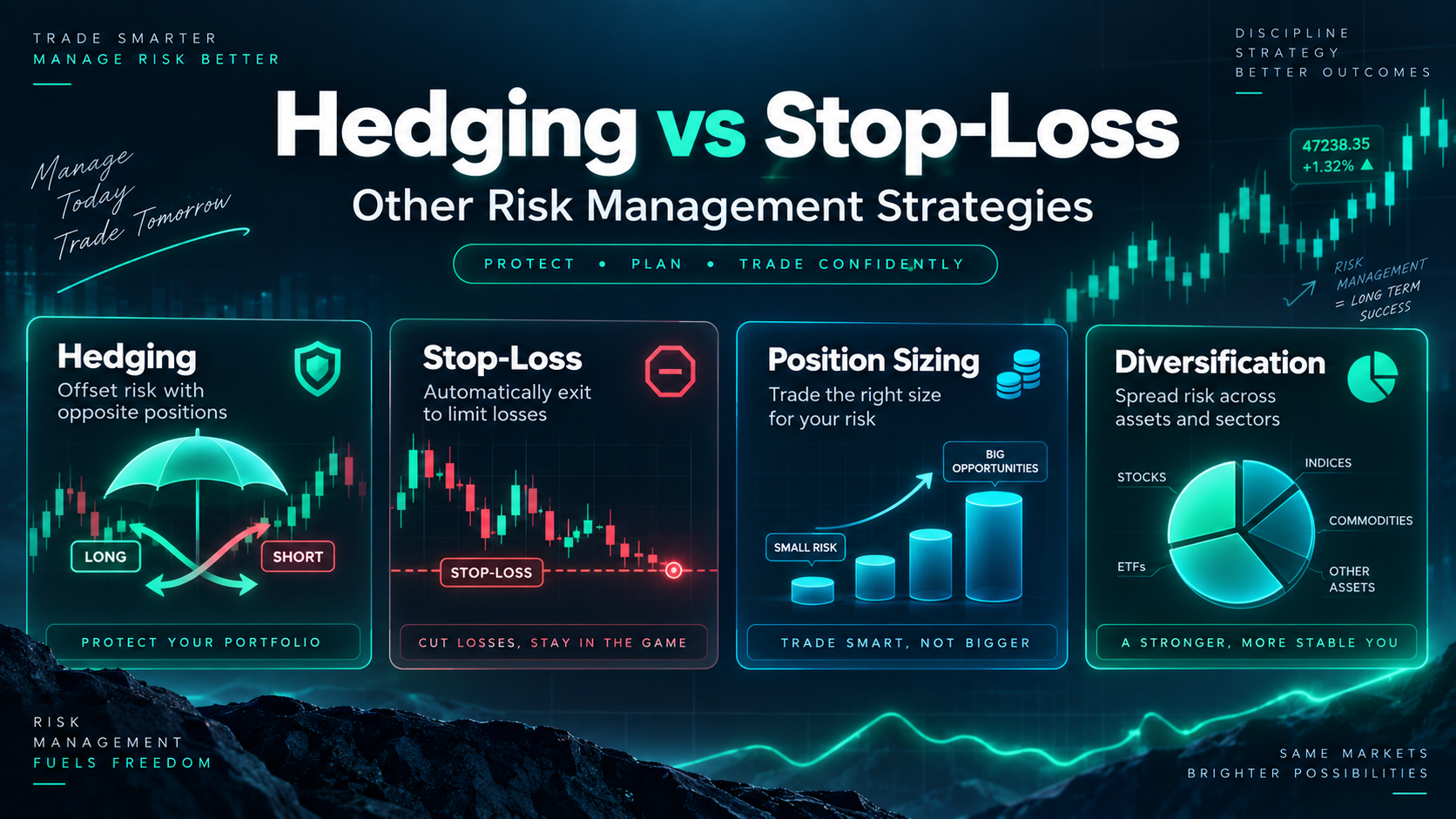
What's the actual difference between hedging and a stop-loss?
A stop-loss is about as blunt as trading tools get, in a good way. You set a price, and if the market hits it, you're out. No debate, no second-guessing in the moment, since you already made that decision earlier when your head was clear. It costs nothing beyond whatever you paid for the trade itself, which is part of why it's usually the first risk tool anyone learns.
Hedging asks more of you and gives you something different back. Instead of exiting, you add a second position that works against your first one, so if things go badly, the pain gets cushioned rather than avoided outright. You're not leaving the trade. You're paying, usually a premium of some kind, to stick around with a bit more protection than you'd have on your own. That distinction, exit versus stay-but-insured, is really the whole ballgame here.
Don't Miss it: When Should You Hedge a Trade
Hedging vs stop-loss: side-by-side comparison
| Stop-Loss | Hedging | |
|---|---|---|
| Cost | Free, beyond the trade itself | Costs a premium or margin |
| Stays in the position? | No, exits automatically | Yes, position stays open |
| Protection type | Full, defined exit point | Partial, offsetting position |
| Complexity | Simple, one order | More complex, requires a second instrument |
| Best for | Routine trades with a clear exit plan | Positions you want to hold through a specific risk |
Neither one wins outright, and honestly, treating this like a competition misses the point a bit. They're built for different situations, and a lot of traders end up reaching for both, just at different moments, on different positions.
When to use a stop-loss instead of a hedge
For most of what you'll actually trade day to day, a stop-loss is simply the right call, and there's not much complicated reasoning needed to get there. It costs nothing. It's simple to set up. And if you don't have any particular reason to stick around in a losing position, why would you pay for insurance on a trade you're perfectly happy to walk away from?
It also just fits naturally into the standard stuff you're probably already doing, risking 1% to 2% of your capital per trade, since your stop-loss is literally what defines where that risk gets capped. Make it your default. Reach for something fancier only when there's an actual reason to.
See Also: What Is Hedging in Trading? A Beginner's Guide to How It Works
When to use a hedge instead of a stop-loss
Hedging earns its cost when you specifically want to stay in a position through some known risk rather than duck out of it. Maybe there's an earnings call coming, or a policy announcement, or you're just choosing to hold through a stretch of market uncertainty instead of stepping aside for it.
There's also the case where exiting simply isn't practical or wanted, a big unrealized gain you're not ready to lock in yet for tax or conviction reasons, a chunky position that would move the price if you tried to sell it all at once, shares you're holding onto for reasons that have nothing to do with today's price action. A stop-loss would just kick you out of all that. A hedge lets you keep it while still doing something about the risk sitting underneath it.
Other risk management strategies worth knowing
Hedging and stop-losses get most of the attention, but they're not the whole picture, not even close.
Position sizing comes first, honestly, before either of the other two even enters the conversation. It's just deciding how much you're willing to risk on any single trade, commonly 1% to 2%, and it matters more than people give it credit for, since it caps the damage no matter what else you do right or wrong.
Diversification is the loose, broad cousin of hedging, spreading your money across things that don't all move together so one bad event can't take down the whole account at once. Trailing stop-losses are worth knowing too, they work like a regular stop-loss except they climb along with a winning position, locking in gains without cutting the trade off too early.
Then there's the 3-5-7 rule, a framework more than a hard law, that a lot of traders lean on: no more than 3% risked on any one trade, no more than 5% sitting in a single sector, no more than 7% at risk across everything you're holding at once. And don't underestimate just sitting on some cash. Not deploying every rupee you've got gives you room to breathe, and it quietly limits how bad any one stretch can get.
Useful Resource: How to Choose a Trading Course
Can you use hedging and stop-losses together?
Yes, and a lot of people do exactly this without thinking twice about it. Hedge the core holding you're not planning to touch, run stop-losses on the shorter-term stuff you're fine walking away from. They're not fighting for the same job.
Where people trip up is treating them as interchangeable, using a stop-loss when what they actually wanted was to stay in the trade, or paying for a hedge on some routine position they'd have happily closed out anyway. That's just wasted money either way.
Building a simple risk management stack
Start with position sizing, that's your foundation, decided before anything else. Lean on stop-losses as your default for most trades, since they're free and they work. Save hedging for the specific situations where staying in genuinely matters more than the cost of protecting it. And let diversification and a cash cushion do their quiet work at the portfolio level, in the background, without you having to think about them every single day.
None of these tools are trying to replace each other. Stack them right and each one covers a gap the others just don't.
Neostox lets you actually practice this whole stack together, position sizing, stop-loss orders, hedging tools, options chain analysis, on live NSE and BSE market conditions across equities, futures, and options. Test how these pieces work together with virtual money first, and you'll have a much better feel for combining them once real capital's actually on the line.