
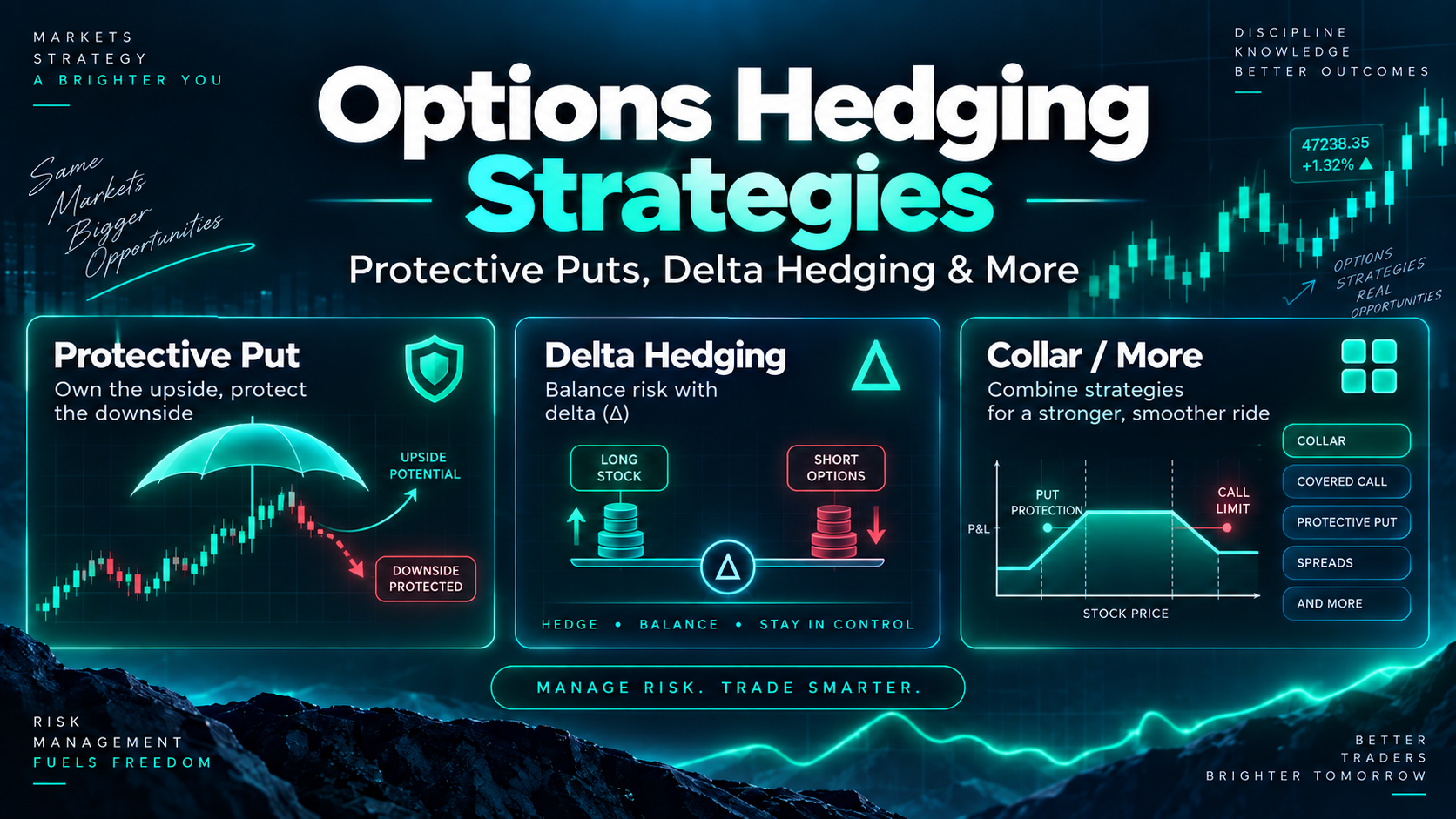
This guide walks through the options hedging strategies that actually matter for someone holding real positions, protective puts, collars, delta hedging, and a few others worth knowing, along with what they cost and where people tend to get them wrong.
What are options hedging strategies, and why use options for this at all?
Because they let you define your risk with a level of precision that's hard to get anywhere else. A stop-loss protects you from a certain price down, sure, but it also kicks you out of the trade entirely the moment it triggers. An option, on the other hand, can protect a specific slice of your downside while letting you stay exactly where you are, holding the same shares, watching the same trade play out, just with a cushion built in underneath it.
That flexibility is really the whole appeal. You're not choosing between protected and exposed anymore. You can dial in exactly how much protection you want, and exactly what you're willing to pay for it, which is a genuinely different kind of control than most other risk tools offer.
Protective put, sometimes called a married put
Here's the simplest one, and probably the one most retail traders actually reach for first. You own a stock. You buy a put option on that same stock, at a strike price somewhere below where it's currently trading, and hang onto it for however long you need the protection.
Say the stock drops hard. Your shares lose value, sure, but the put option gains value right alongside that drop, offsetting a good chunk of the loss. If the stock doesn't drop, and honestly most of the time it won't, your only cost was the premium you paid for the put, which just expires worthless. Your break-even point on the whole position effectively shifts down by that premium amount, which is worth keeping in mind since people sometimes forget the hedge itself has a real cost baked into the math.
Check Related: When Should You Hedge a Trade?
Collar strategy
A collar takes the protective put and adds one more piece to help pay for it. You buy your protective put like normal, but you also sell a call option above the current price, and the premium you collect from that call helps offset, sometimes almost entirely, what you paid for the put.
The tradeoff is real, though, nothing here is free. In exchange for that cheaper, or sometimes near-zero-cost, protection, you're capping your upside at the strike price of the call you sold. If the stock rockets past that level, you don't get to keep riding it, the call gets exercised against you and caps your gain right there. A collar suits someone who wants solid downside protection and is genuinely fine giving up some upside to get it cheap.
Delta hedging
This one's a step up in complexity, and honestly it's more common among options sellers, market makers, and fairly advanced traders than someone just protecting a single stock position. Delta measures how much an option's price moves for every one-point move in the underlying stock. A delta of 0.5, for instance, means the option's price moves roughly half a rupee for every one-rupee move in the stock.
Delta hedging means holding an offsetting position in the underlying stock, or in other options, sized specifically to cancel out that delta, so your overall position barely reacts to small moves in the stock price either way. The catch is that delta itself isn't fixed, it shifts as the stock price moves and as time passes, so a genuinely delta-hedged position needs regular rebalancing to stay that way. This isn't really a "set it and forget it" strategy. It's closer to ongoing portfolio management than a one-time trade.
See Also: What Is Hedging in Trading? A Beginner's Guide to How It Works
Other options-based hedges worth knowing
A bear put spread works like a cheaper, capped version of the plain protective put. You buy a put at one strike and sell a put at a lower strike, and the premium from the put you sold offsets part of what you paid, at the cost of capping how much protection you actually get below that lower strike. Good for someone who wants downside protection but doesn't want to pay full price for unlimited coverage they probably won't need anyway.
Straddles and strangles get used around big known events, earnings, a major announcement, where you're less sure about direction and more sure that something big is about to happen either way. These sit a bit closer to speculation than pure hedging, worth being honest about that, but traders sometimes use them as a form of event-risk protection when they're not certain which way things will break.
And for anyone holding a broad, diversified equity portfolio rather than just one or two stocks, buying index puts, say on the Nifty, can hedge the whole portfolio at once instead of hedging each individual holding separately. It's rarely a perfect match to your specific portfolio, there's basis risk involved since your holdings won't move in exact lockstep with the index, but it's a lot more practical than trying to hedge fifteen different stocks one by one.
How much does an options hedge actually cost, and what decides that?
A few things drive the premium, and it's worth understanding roughly how they push cost up or down. Implied volatility matters a lot, higher expected volatility means a pricier option, since there's more perceived chance of a big move happening. Time to expiry matters too, more time left generally means more premium, since there's simply more time for something to happen.
And how far the strike sits from the current price matters just as much. A put close to the current price, sometimes called closer to at-the-money, costs more than one sitting well below it, since it kicks in sooner and covers more of the immediate downside. Cheaper, further out-of-the-money puts exist, but they only protect you once the stock has already fallen a fair bit, which brings us to one of the more common mistakes people make here.
Common mistakes with options hedging
- Buying deep out-of-the-money puts purely because they're cheap, without really registering how little protection they actually provide until the stock's already dropped a lot. Cheap isn't the same as effective, and it's worth checking exactly where your protection actually kicks in before assuming you're covered.
- Forgetting that time decay works against a hedge you're holding. If the event you were worried about doesn't happen, and often it won't, your put loses value simply from time passing, quietly draining the cost of protection you never ended up needing.
- Setting up a delta hedge and never touching it again. Delta shifts as the market moves, so a hedge that was neutral last week might not be neutral today, and skipping the rebalancing defeats a good chunk of the purpose.
- And reaching for something like a collar or a spread without really understanding the mechanics first. These strategies involve multiple moving parts, and getting one leg wrong can leave you with a different risk profile than you thought you'd built.
Neostox's options chain analysis, AI options assistant, and pre-built options strategies give you the tools to actually construct and study these hedges properly, and paper trading lets you practice protective puts, collars, and spreads on live NSE and BSE market conditions before any real premium is on the line. Getting the mechanics right with virtual money first is a lot cheaper than learning them mid-trade.