
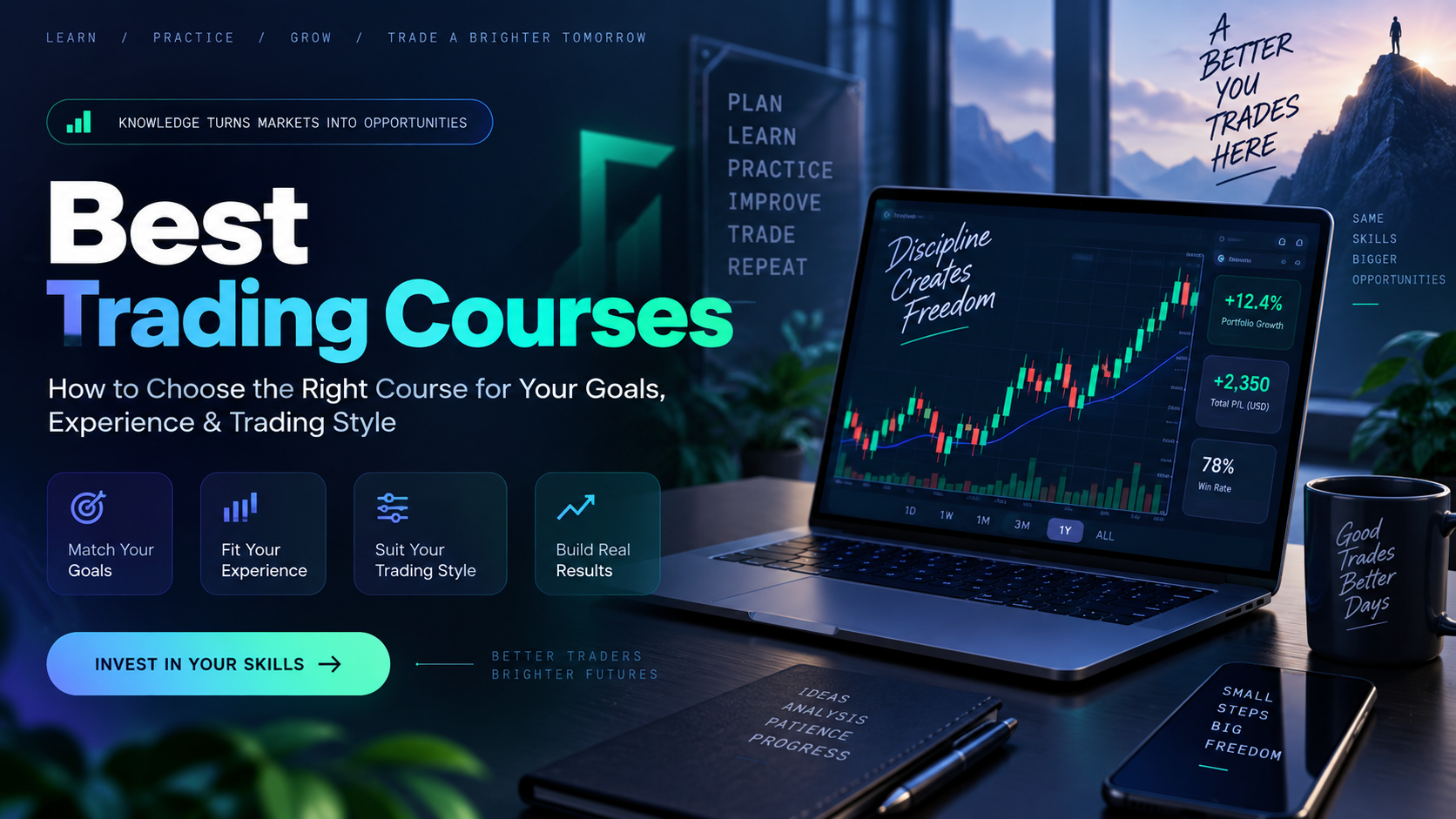
Most people pick a course the way they pick a restaurant off a review score, whoever's got the loudest marketing wins. That's backwards. Here's a better way to actually think about it.
What actually makes a trading course worth your money?
A handful of things separate a course that'll genuinely help from one that's mostly just selling a dream.
It teaches process, not predictions. A course worth paying for walks you through how to think, risk management, position sizing, building and testing a strategy, rather than handing you a list of stock tips to follow blindly. Tips expire. Process doesn't.
It doesn't promise a fixed return. Anything guaranteeing a specific percentage per month is a red flag, full stop, since no legitimate approach to markets can promise that. Markets don't work that way, and any instructor who tells you otherwise either doesn't understand risk or is hoping you don't.
The people behind it are actually verifiable. Can you find who's teaching it? Are they registered with SEBI if they're offering advice, not just education? A course from someone you can't independently verify deserves a lot more scepticism than one from someone whose background you can actually check.
There's a practice component, not just videos. Watching someone explain a strategy is one thing. Actually applying it, ideally somewhere you can't lose real money while you're still fumbling through it, is what turns theory into an actual skill.
🚀 Want to learn more? Don't miss: How to Choose the Right Option Strike for Intraday Trading
Match the course to your goal
Ask yourself what you're actually trying to get out of this before you enroll in anything.
- Learning the basics from zero: If you've never placed a trade, you need something that starts with order types, chart basics, and how the market mechanically works, not a course that jumps straight into advanced options strategies assuming you already know what a limit order is.
- Building one specific, repeatable strategy: Maybe you already understand the fundamentals and want to develop, say, a breakout strategy you can trust. Here you're looking for something narrower and deeper, not another beginner overview you've already outgrown.
- Trading as a serious, structured pursuit: If the goal is eventually trading full-time or close to it, you need a course that covers not just entries and exits but capital management, psychology under real pressure, and how to build a repeatable daily process, since that's what actually separates people who last from people who burn out in six months.
- Learning a specific instrument, like options or futures: General trading education doesn't automatically cover the added complexity of derivatives, expiry, time decay, leverage. If that's your goal, look specifically for a course built around that instrument, not a broad course with one chapter tacked on.
Match the course to your experience level
A course pitched at the wrong level is frustrating no matter how good the content is, either you're bored and lost in jargon, or you're drowning trying to keep up.
If you're a true beginner, look for something that assumes nothing. Order types explained from scratch, basic chart reading, what a demat account actually is. If a course starts with candlestick pattern psychology before covering how to place an order, that's probably not built for you yet.
If you've got some experience already, maybe you've placed a hundred trades and have a rough sense of what works, you want something focused on refinement. Risk management depth, strategy testing methodology, reviewing your own data properly, not another "introduction to the stock market" module you could teach yourself at this point.
If you're advanced and looking at quantitative or systematic approaches, you need something with real technical depth, backtesting methodology, statistical validation, maybe even some coding. Most general trading courses won't get you there, and that's fine, it's a specialised niche.
Check This: How Can I Use Pre-Market Nifty Movement to Understand the Likely Market Trend
Match the course to your trading style
Day trading, swing trading, and long-term investing genuinely aren't the same skill, even though a lot of course marketing blurs them together like they are.
A day trading course needs to cover fast decision-making, intraday risk limits, and ideally give you a way to practice with live market data, since the whole game is speed and discipline under real-time pressure. A course that's mostly recorded lectures with no live practice component is missing the part that actually matters most for this style.
Swing trading courses can lean more into chart analysis and multi-day setups, since the pace is slower and there's more room to think between decisions. Long-term investing education looks different again, valuation, fundamentals, patience, the stuff that matters over years rather than hours.
Pick a course built around your actual style, not one that happens to be popular but teaches a completely different rhythm of trading than the one you actually want to do.
Red flags to avoid when picking a course
Guaranteed or fixed returns advertised anywhere in the marketing. This one's non-negotiable, walk away.
Pressure to enrol immediately, countdown timers, "only 3 seats left" urgency tactics. Genuine education doesn't need to manufacture scarcity to get you to sign up.
No visible curriculum, just testimonials and screenshots of profits. If you can't see what you're actually going to learn, module by module, before paying, that's a problem.
Zero practice component. A course that's purely lecture, with nowhere to actually apply what you're learning, leaves the hardest part of the job, execution under pressure, completely untested until you're doing it with real money.
An instructor whose track record you genuinely can't verify anywhere outside their own course materials. Trust, but check.
A simple checklist before you enrol
- Does it match my actual goal, not just what's trending right now?
- Is it pitched at my actual experience level, not too basic, not too advanced?
- Does it fit my trading style, day trading, swing trading, or longer-term?
- Does it teach process and risk management, not just entries and predictions?
- Can I verify who's teaching it and whether they're registered where relevant?
- Is there a real curriculum I can review before paying, not just marketing?
- Is there somewhere to actually practice what I'm learning?
If you're answering no to more than one or two of these, keep looking.
Neostox's own trading course is built around exactly this checklist, structured lessons that cover the fundamentals properly, paired directly with paper trading on live NSE and BSE market conditions so what you learn doesn't stay theoretical. You get the education and somewhere to actually apply it with virtual money, across equities, futures, and options, before a single rupee of real capital is on the line.