
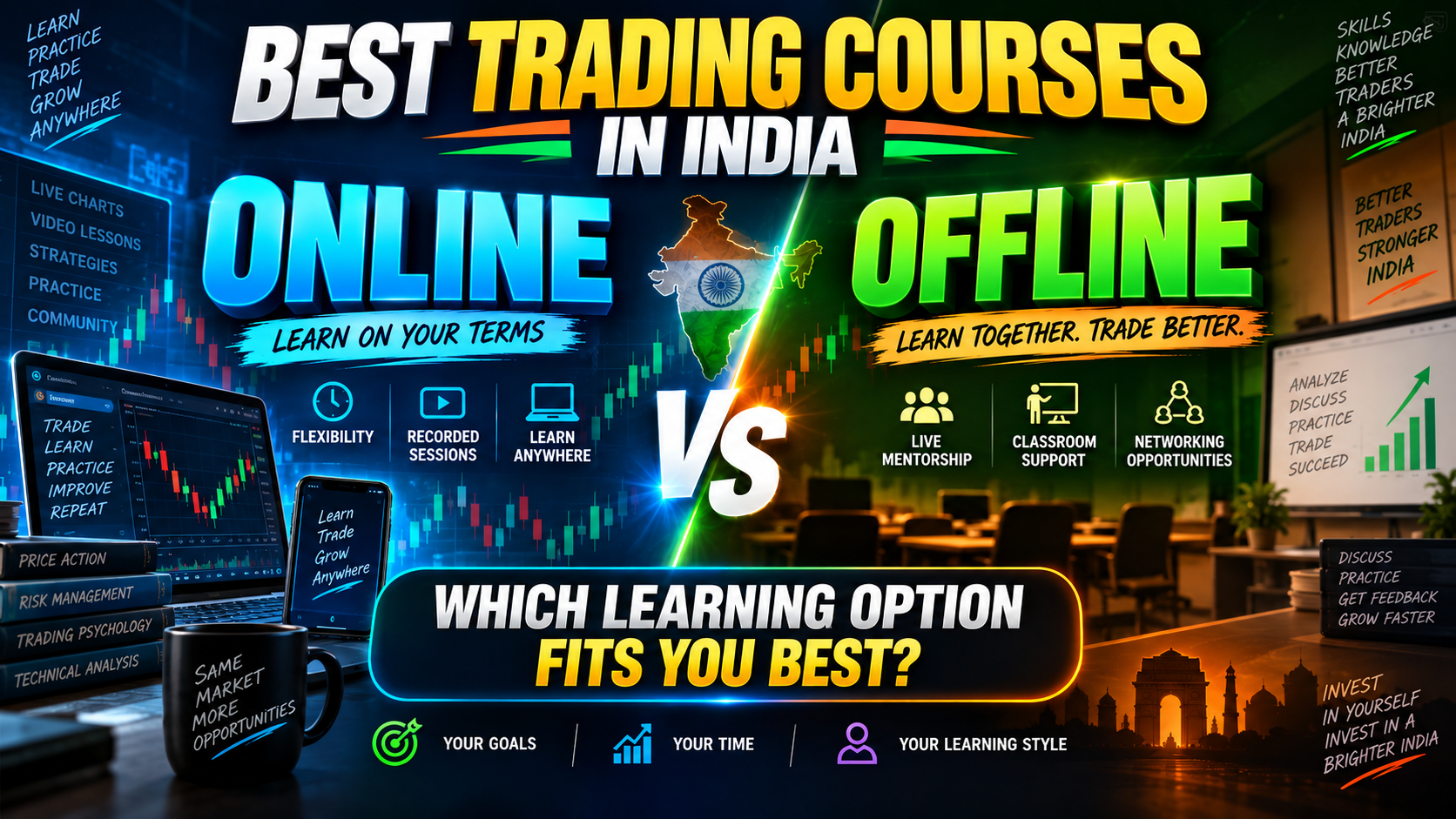
A lot of people pick a course based on whichever ad they saw first. Honestly, that's not a great method. There's real time and money on the line here, so it's worth doing better.
What's actually different between online and offline trading courses?
Online courses deliver content through video, live calls, or app-based lessons. You work through them on your own schedule. Some are fully self-paced. Others run on a fixed timetable with live instructor sessions. Either way, you're never in a physical room with anyone.
Offline courses put you in an actual classroom. Usually a local coaching institute runs it, with an instructor teaching in person and other students around you. There's a fixed schedule you show up for. The whole thing is built around being physically present.
Neither format changes what good trading education needs to cover. Risk management. Process. Real practice. What changes is how that gets delivered to you. And that difference matters more for some people than others.
Advantages of online trading courses
- You're not limited by geography. An instructor two states away is just as accessible as one across the street. That matters a lot if your city doesn't have a strong local trading education scene.
- You get real flexibility. Working full-time and want to learn trading in the evenings? Online courses, especially self-paced or recorded ones, fit around your life. They don't demand you rearrange it.
- It's usually cheaper. Online courses skip the physical overhead, rent, in-person staff, that offline institutes carry. So they often cost less. This varies by provider, though.
- You can review material as many times as you need. Recorded lessons let you rewatch a confusing concept again and again. A live classroom session doesn't give you that option once the moment's passed.
- It pairs naturally with practice tools. Most online trading education today gets built alongside apps and simulators. So the jump from watching a lesson to actually trying it with virtual money is often just one click away.
Advantages of offline trading courses
You get direct, immediate feedback. Ask a confusing question in a classroom and someone answers right there. No waiting on a forum reply or a scheduled call. For some concepts, that back-and-forth speeds things up a lot.
There's built-in accountability. A class you've physically committed to is harder to skip than a video sitting in your course library. Some people genuinely need that outside structure to actually finish what they start.
You get real peer interaction. Sitting next to other traders, beginners or experienced, creates a kind of informal network. That's harder to build through a screen.
There are fewer distractions during the session itself. It's simply easier to stay focused in a classroom than at home, phone buzzing, family around, a dozen browser tabs open.
The real limitations of each
Best Online courses demand a lot of self-discipline. Nobody's checking whether you actually watched this week's module. The same flexibility that makes online learning appealing also makes it easy to abandon halfway through.
Offline courses hit a hard geographic ceiling. If there's no strong institute near you, or the good ones sit in a handful of major cities, your options shrink fast. Doesn't matter how motivated you are.
Offline usually costs more and demands a fixed schedule. That structure helps some people stay accountable. But it's exactly what locks out someone working irregular hours, or living far from any coaching centre.
Online can lack real-time interaction. Recorded content especially leaves you on your own when something doesn't click, unless the course specifically includes live Q&A or an active community.
Which one is actually right for you?
Ask yourself honestly: do you finish things you start on your own? Or do you need someone checking in on you? If you're genuinely self-motivated, and a fixed classroom time doesn't fit your schedule, go online. The flexibility will work for you, not against you.
Maybe you learn better with direct interaction. Maybe self-paced content tends to sit unfinished. If there's a credible offline option near you, the extra cost and rigidity might be worth it. No shame in knowing you need that accountability.
A hybrid works well too. Take a structured online course for the core content. Pair it with a local trading community or study group for accountability and discussion. You get a lot of both worlds without fully committing to either extreme.
What matters more than the format itself
Whichever you pick, online or offline, the real quality checklist stays the same. Does it teach process and risk management, not just predictions? Can you verify who's actually teaching it? Is there a real curriculum, not just marketing? And is there somewhere to practice what you're learning with virtual money, before real capital's involved?
A polished offline course that skips risk management is still a bad course. A cheap online course with a genuine curriculum and a real practice component can easily beat an expensive one that's mostly hype. Format doesn't decide that, quality does.
Neostox's trading course is fully online, built to work around your schedule instead of the other way round. It's paired directly with paper trading on live NSE and BSE market conditions, across equities, futures, and options. You're not just watching lessons. You've got somewhere to actually apply them with virtual money, wherever you happen to be in India. No local institute required.