
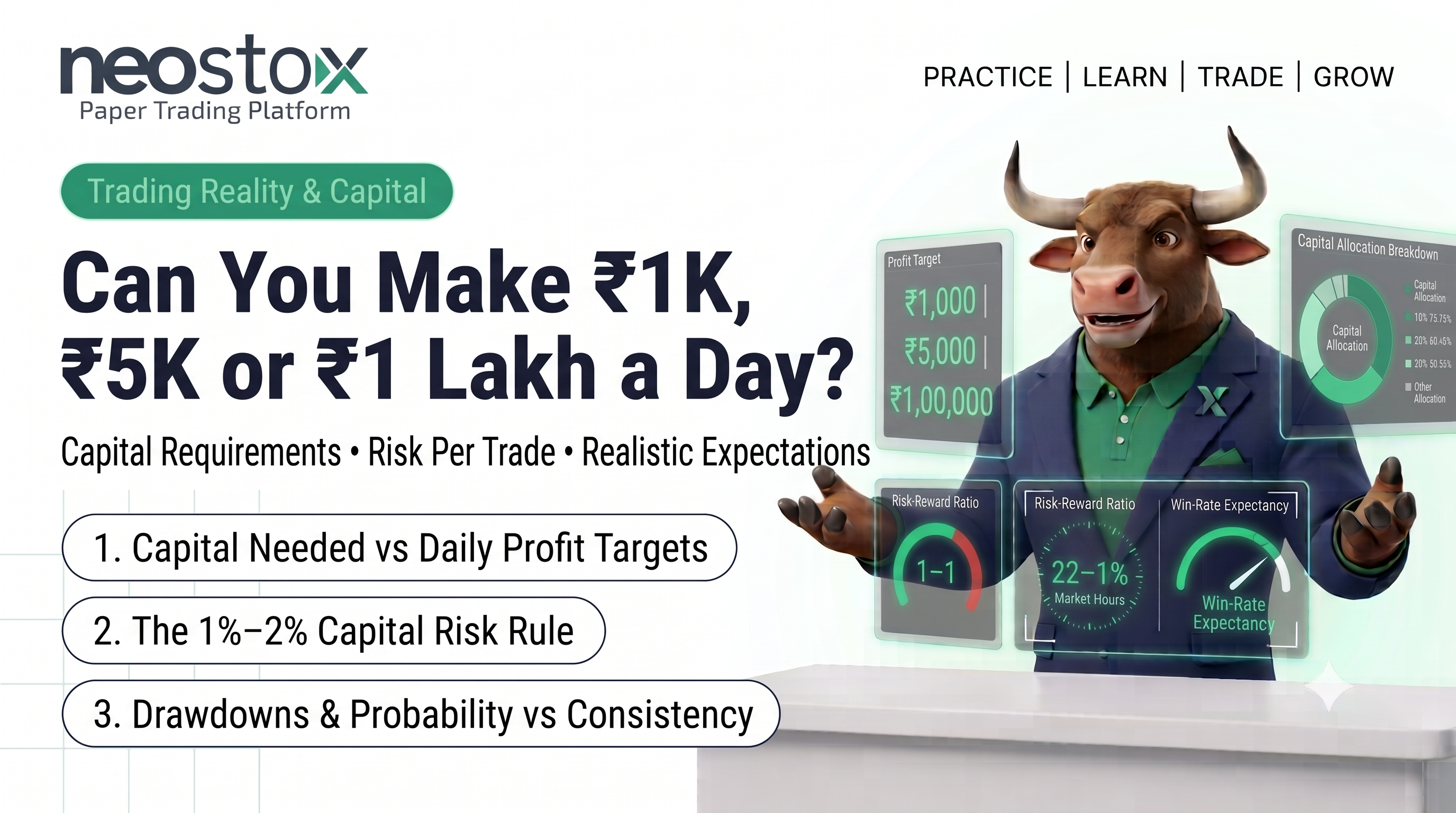
No fixed daily number, ₹1,000, ₹5,000, ₹1 lakh, works the same for everyone. It depends entirely on your capital, your risk per trade, and whether you actually have an edge at all. SEBI's own research found that most individual traders in India lose money, not just occasionally, but consistently, across multiple years studied. Trading can genuinely build wealth over time. It rarely does it the way daily-target claims suggest.
Can you make ₹1,000, ₹5,000 or ₹1 lakh a day?
Depends entirely on your capital. That's the honest, slightly unsatisfying answer.
A fixed rupee target skips the one number that actually matters. Your account size.
Making ₹1,000 a day on a ₹50,000 account means a 2% daily return. Keep that up consistently and you'd be beating nearly every professional fund manager alive. Now make ₹1,000 a day on a ₹20 lakh account instead. That's a tiny, unremarkable 0.05% move. Same rupee number. Wildly different difficulty.
₹1 lakh a day drifts even further from reality for most retail traders. On a ₹10 lakh account, that's a 10% daily return. Sustained, day after day. No credible, risk-managed strategy pulls that off consistently. None.
Are fixed daily or pip targets realistic?
Not really. Here's why.
A fixed target, "I need to make ₹2,000 today," has nothing to do with what the market is actually offering that day. Some days genuinely hand you that much opportunity. Plenty just don't.
Chase a fixed number on a quiet day, and you end up forcing trades that don't meet your own criteria. Just to hit the target. That's backwards. The target should follow your edge and the day's conditions, not the other way around. A steadier approach ties risk and reward to your actual capital and strategy. A percentage of account size per trade works. A flat rupee number chosen because it sounds achievable doesn't.
What does SEBI's data actually show?
Worth looking at directly, rather than relying on vague "most traders lose" claims floating around online.
A SEBI study from September 2024 found 93% of individual futures and options traders lost money across FY22 to FY24. Aggregate losses crossed ₹1.8 lakh crore over that period. A separate SEBI study, from July 2024, found over 70% of individual intraday equity traders lost money in FY22 to FY23.
Costs make it worse. Loss-making intraday traders paid transaction costs equal to roughly 57% of their actual losses in FY23. Even the winners gave up close to 19% of their gains to costs. Trading isn't free to attempt. The costs hit hardest exactly when a trader can least afford them.
Can trading make someone rich?
It can, genuinely, over time, for a small number of people. It's just not the fast, guaranteed path a lot of marketing around trading makes it sound like.
Survivorship bias does a lot of the work here. Traders who made real money get talked about, screenshotted, held up as proof of what's possible. The much larger group who lost money quietly, and simply stopped, don't make for compelling content. So they're barely visible. That skews the public sense of how common real success actually is. Badly.
Where real wealth from trading does happen, it tends to look like a slow, disciplined compounding process. Not a lucky string of big wins. Consistent, modest, risk-managed gains, stacked over years. Not one explosive month.
Why do most traders lose?
A handful of reasons show up again and again, and they're not mysterious.
- Undercapitalization: Trading with money that can't absorb a normal losing streak pushes traders into desperate, oversized decisions.
- No real risk management: Position sizing not tied to an actual stop-loss distance, risking more than 1 to 2% per trade, no predefined invalidation level at all.
- No genuine edge: Many traders never test whether their strategy actually works before risking real capital on it, covered in full in a companion guide on backtesting.
- Revenge trading: Trying to immediately win back a loss, usually by abandoning every rule that was in place minutes earlier.
- Overtrading: Taking trades that don't meet real criteria, just because sitting still feels unproductive.
- Costs: Brokerage, STT, and other charges quietly erode returns, especially for high-frequency intraday strategies, a drag that's easy to underestimate until you actually add it up.
Is day trading gambling or skill?
Genuinely both, in different proportions depending on how it's actually practiced. That's a more honest answer than picking one side.
Random, undisciplined trading looks a lot like gambling in practice. No plan, no risk management, chasing targets, reacting emotionally. Even if it doesn't feel that way to the person doing it. The outcome is dominated by chance, not skill, simply because there's no real process generating an edge in the first place.
Structured, risk-managed trading is a different activity entirely. Defined entry and exit rules, tested beforehand, position sizing tied to real risk. Closer to running a small, probability-based business than placing a bet. The skill lives in the discipline, not in predicting any single trade's outcome. Most traders sit somewhere between these two poles. That's exactly why outcomes vary so widely.
What are the golden rules of successful trading?
Nothing exotic here. The same handful of principles show up across most genuinely risk-managed approaches.
- Risk a small, fixed percentage of capital per trade, commonly 1 to 2%, not a number that feels exciting.
- Always define your stop-loss, the exact invalidation point, before entering, not after.
- Size your position from your risk budget and stop distance, never from a gut feeling about conviction.
- Test any strategy on historical data, with a real sample size, before trusting it with meaningful capital.
- Journal every trade, wins, losses, and skipped setups alike, and review it honestly.
- Treat every single trade as one data point in a long series, not a referendum on your skill.
None of this guarantees profit. It's what separates a managed, repeatable process from a guess dressed up as a strategy.
What is the 3-5-7 risk rule?
An informal position-sizing convention, not a formally standardized rule enforced anywhere. Roughly: risk no more than 3% of capital on any single trade, no more than 5% across related or correlated trades at once, and aim to keep total portfolio risk around 7% at any given time.
Useful as a rough discipline check. Worth knowing, for that reason alone. Not a rule every trading community agrees on identically though, some use entirely different numbers built around the same basic idea, capping single-trade risk, capping correlated exposure, capping total risk. Treat it as one reasonable framework. Not gospel.
How should traders handle losses and overconfidence?
Both deserve real attention, and ironically, they tend to cause similar damage from opposite directions.
After a loss, the dangerous move is trying to win it back immediately. Bigger size. No plan. Pure emotion steering the decision. A loss inside your predefined risk budget isn't a crisis, though. It's an expected, planned-for outcome of a probabilistic process. Step back. Stick to the process. Resist the urge to force the next trade.
After a win, or a streak of them, overconfidence creeps in just as easily. Position sizes drift up. Stop-losses get skipped because "this one feels different." Confidence is useful, sure. Confidence that abandons your own risk rules is exactly how a good month turns into a bad quarter. Treat both extremes the same way. Return to the process. Not the emotion.
How can beginners build a sustainable process?
Slowly, and with structure, rather than jumping straight into live capital.
Start with paper trading. Practice entries, exits, and risk management with virtual money first, before any of it touches real capital. Write down your actual rules, entry criteria, risk per trade, exit approach, before your first real trade. Not after a few costly lessons teach you the hard way. When you do go live, size small. Treat early real-money trading as part of the learning curve, not the moment you expect steady income.
Journal everything. Review it honestly, on a fixed schedule, not just when something goes wrong. Expect a real learning curve here. Early losses are the cost of that education, the same way almost any skill-based pursuit costs something before it pays off. Not proof the whole thing doesn't work.
Reality check at a glance
| Claim | What the evidence actually supports |
|---|---|
| "Make ₹1,000 a day guaranteed" | Depends entirely on capital size and risk per trade; no fixed number applies to everyone |
| "Most traders are profitable" | SEBI data shows the opposite: 93% of individual F&O traders lost money, FY22 to FY24 |
| "Trading is free to attempt" | Costs ate roughly 57% of losses for losing intraday traders in FY23, and 19% of gains for winners |
| "Trading is pure gambling" | Partly true for undisciplined trading; structured, risk-managed trading is a different activity |
| "The 3-5-7 rule is standard" | A useful, informal convention, not a universally enforced rule |
Realistic expectations come from practicing with real market conditions before real money is on the line. Neostox's paper trading lets you test your own process, risk management included, against live NSE and BSE conditions with virtual capital, building genuine evidence about your own trading before any of it touches real money.