
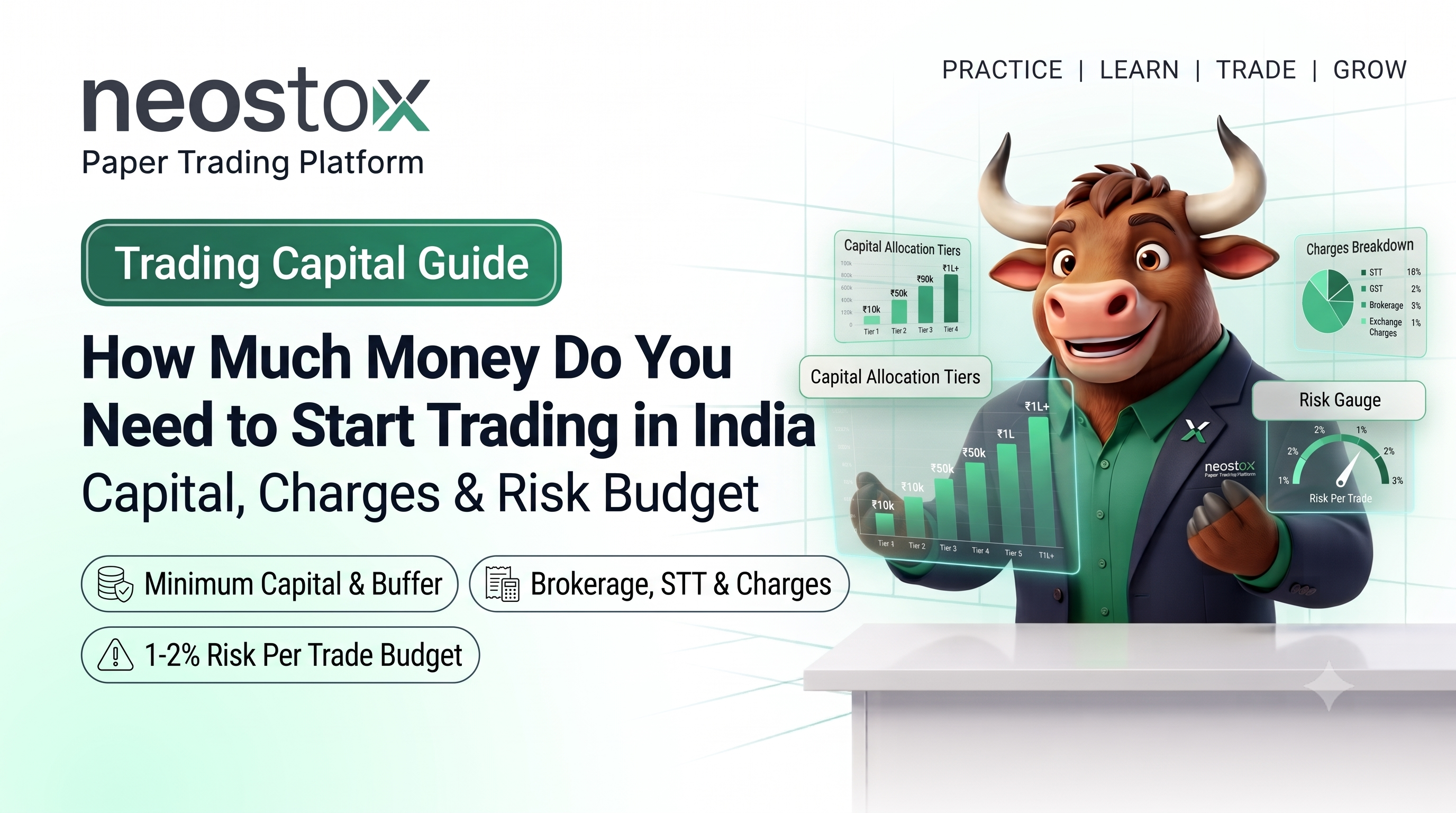
This guide covers both clearly, plus the distinction between investment and trading capital, why emergency savings should never fund either, and the actual math behind position sizing and risk per trade.
Is there a legal minimum amount to start trading in India?
No, there's no legally mandated minimum amount required to open a demat and trading account or to buy equity shares, you could technically purchase a single share for whatever its market price happens to be. The "minimum" that actually matters is practical, not legal, driven by what your chosen instrument and strategy realistically require, not any regulatory floor.
How much money does a beginner need to start trading in India? Can I start with a small amount?
Yes, you can genuinely start with a small amount for plain equity investing, buying a few shares of a reasonably priced stock. Where the practical minimum climbs is with leveraged instruments, F&O contracts carry margin requirements that can run considerably higher, and intraday strategies generally need enough capital that your position sizing, covered below, still produces trades worth taking after costs.
Be honest with yourself about what small capital actually limits you to. A small account can absolutely be used to learn mechanics and build discipline, but generating meaningful rupee returns from a very small amount requires either a very long time horizon for compounding or a level of risk that isn't advisable while you're still learning.
Investment capital vs trading capital?
These deserve to be treated as genuinely separate pools of money, not one blended account. Investment capital is money meant for a longer time horizon, years, held through a company's fundamentals rather than short-term price swings, generally able to absorb temporary volatility without real financial strain. Trading capital is money specifically set aside for active trading, capital you've accepted could be lost, given trading's genuinely higher risk profile, and shouldn't be capital you're also counting on for a near-term financial goal.
Mixing the two makes both worse. Trading capital treated like patient investment capital leads to holding losing trades too long, hoping they recover like a long-term holding would. Investment capital treated like trading capital leads to panic selling a genuinely sound long-term holding during ordinary volatility.
Should emergency savings be used for trading?
No, without exception. Emergency savings exist specifically to stay liquid and safe, covering genuine, unpredictable financial needs, a job loss, a medical situation, without depending on market conditions at that exact moment. Trading with emergency funds does two things badly at once, it exposes money you can't afford to lose to real market risk, and it adds a layer of psychological pressure to your trading decisions that actively makes you a worse trader, since decision-making measurably changes for the worse when the capital on the line is money you can't genuinely afford to lose.
Keep emergency savings entirely separate, in something safe and liquid, before allocating any capital specifically to trading.
What costs reduce returns? What are brokerage and statutory charges?
Brokerage, charged by your broker per trade, varies by broker and plan. Statutory charges apply regardless of broker, Securities Transaction Tax, exchange transaction charges, stamp duty, and GST on brokerage, all set by the exchange or government. DP charges apply specifically when you sell shares, and annual maintenance charges apply to your demat account regardless of trading activity. A companion guide on choosing a broker covers this full breakdown in more depth, worth reading before assuming your total cost is just the advertised brokerage rate.
What is position sizing? What is risk per trade?
Position sizing means calculating how many shares or contracts to trade based on a fixed risk budget, not based on how much capital you have available or how confident a setup feels. The core formula: position size equals your intended risk budget divided by your stop-loss distance per share. Risk per trade is that budget itself, commonly 1% to 2% of your total trading capital, decided before you enter, capping exactly how much a single wrong trade can cost you.
A companion guide on risk management walks through this formula with a full worked example, genuinely worth understanding properly, since it's the single calculation that most directly protects your account from one bad trade doing outsized damage.
How much capital should be risked on one trade?
Most risk-management frameworks suggest 1% to 2% of your total trading capital per trade. On a ₹1,00,000 account, that's ₹1,000 to ₹2,000 at risk on any single position, sized using the position sizing formula above based on your specific stop-loss distance for that trade.
Why is leverage dangerous for a small account?
Because the same percentage loss represents a proportionally larger hit to a small account's total capital, and small accounts generally have less buffer to absorb a bad stretch before facing a margin call or losing a meaningful share of total capital in a single move. Leverage amplifies whatever risk is already present in a trade, and on a small account, there's less room for that amplified risk to play out before it becomes a genuinely serious problem for the account as a whole, compared to a well-capitalized account where the same percentage move affects a smaller share of overall trading funds.
This is exactly why growing a small account safely usually means focusing on position sizing discipline and unleveraged instruments first, rather than reaching for leverage to compensate for limited starting capital.
Building genuine trading skill doesn't actually require capital at all, the mechanics, position sizing, risk management, all of it, can be practiced with virtual money first. Neostox's paper trading runs on live NSE and BSE market conditions across equities, futures, and options, letting you build real skill and discipline while you're still saving toward whatever starting capital you eventually plan to trade with.