
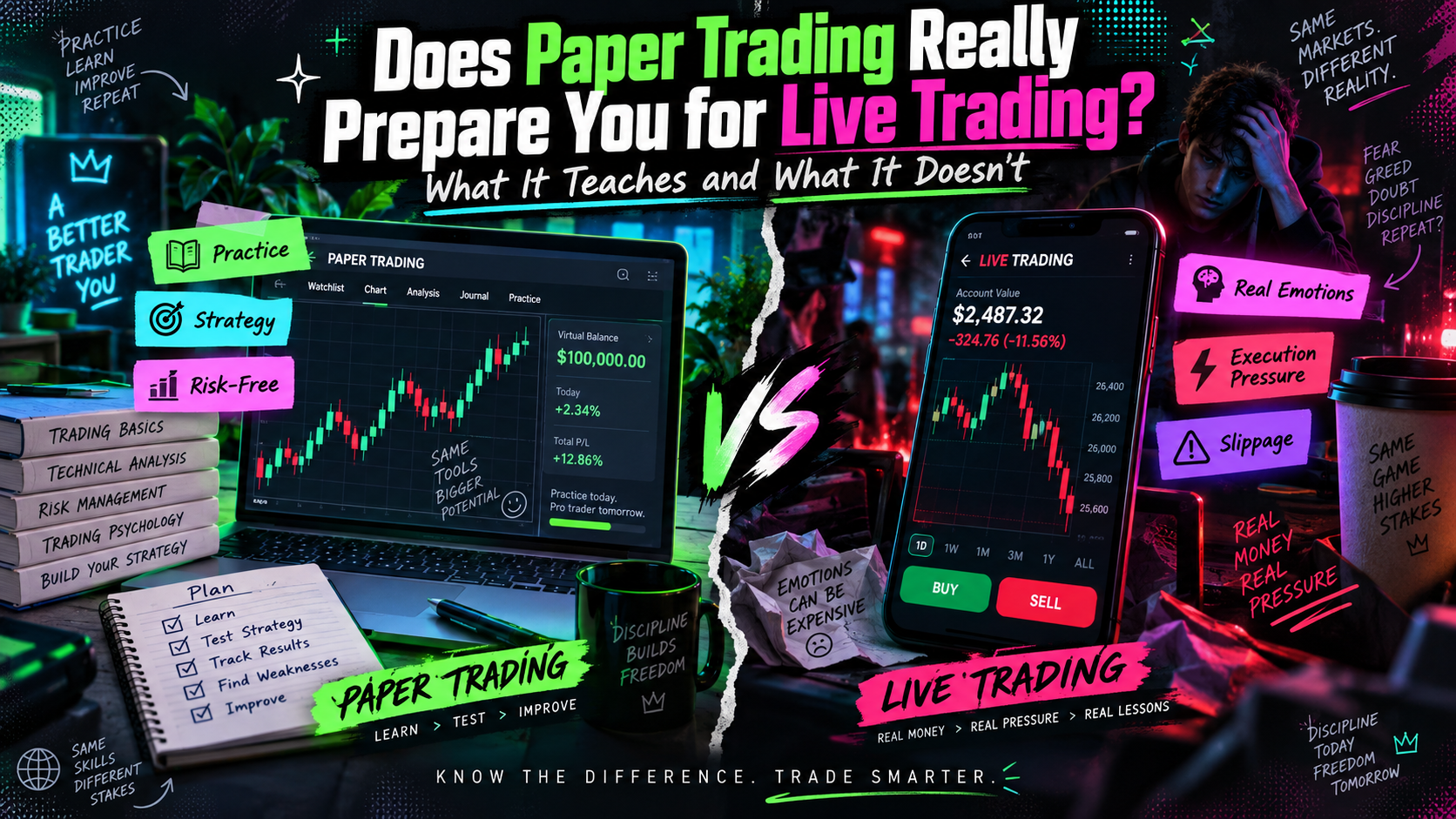
The honest answer-it prepares you for some things, not others
Paper trading works well as a mechanics simulator and works poorly as a psychology simulator. That's really the whole answer compressed into one sentence, and almost everything else in this article is just unpacking what that actually means in practice.
If your goal is learning how orders work, how to size a position, how a strategy performs across different market conditions, paper trading does that job properly. If your goal is knowing how you'll actually behave once losing money is genuinely painful, paper trading can't get you there, no matter how many simulated trades you run. Both things are true at once, which is exactly why the "does it work" question doesn't have a clean yes or no.
What paper trading actually teaches well
Order mechanics come first, and honestly this alone is worth a lot. Knowing the difference between a market order and a limit order, understanding what a stop-loss actually does, getting comfortable with the interface, all of this transfers cleanly to live trading because the mechanics genuinely don't change once real money enters the picture.
Position sizing math transfers too. Figuring out how many shares to buy given a fixed risk percentage and a stop-loss level is pure arithmetic, and arithmetic doesn't care whether the money is real or virtual. Same with strategy testing across different market conditions, trending, choppy, volatile, since price behavior in a simulator tracking live data is genuinely the same price behavior you'd see trading for real. And the journaling habit, logging entries, exits, and reasoning, builds real discipline regardless of the stakes, since the habit itself is what matters, not what's riding on each entry.
What paper trading doesn't prepare you for
Here's where things get honest in a less comfortable way. The single biggest gap is psychological, and it shows up specifically around loss. Behavioral economics has a well-documented concept called loss aversion, the finding that people feel the pain of a loss roughly twice as intensely as the pleasure of an equivalent gain. That asymmetry barely exists in a simulator, since a simulated loss doesn't actually hurt the way a real one does, which means paper trading simply can't train the exact reaction it would be most useful to prepare you for.
Slippage is another one. Simulators tend to assume you get filled at the price you saw, more or less, while live trading, especially in options or thinner stocks, regularly hands you a worse fill than expected. Transaction costs get skipped too, unless you're deliberately subtracting them yourself, brokerage, taxes, exchange fees, all invisible in most simulated results but very real once you're actually trading. And then there's the subtler stuff, hesitating on a trade you'd have taken instantly in practice, closing a winner early out of nerves, holding a loser past your stop because some part of you is hoping it turns around. None of that shows up until real money makes it show up.
Why does this gap exist in the first place?
Because a simulated loss and a real loss are processed completely differently by your brain, even when the numbers on screen look identical. There's no actual threat response triggered by watching a virtual number go down, since nothing real is actually at stake, so your decision-making stays calm in a way it simply won't once genuine financial consequences are involved.
This isn't a flaw in any specific simulator or platform. It's a structural limit that applies to literally any kind of practice without real stakes, whether that's trading, public speaking rehearsal, or anything else where the emotional weight of the real version is part of what makes it hard. You can't fully fake the stakes, and pretending otherwise sets people up for a rough surprise the first time real money starts moving against them.
What the numbers actually say about live trading outcomes
SEBI's own research gives some sense of how often this plays out badly for retail traders. A September 2024 SEBI study found that 93% of individual F&O traders in India lost money between FY22 and FY24, with aggregate losses exceeding ₹1.8 lakh crore over three years. A separate July 2024 study found more than 70% of individual intraday equity traders lost money in FY 2022-23.
These figures don't exist purely because of the psychology gap, cost drag plays a huge role too, loss-making intraday traders paid transaction costs equal to an additional 57% of their losses in FY23, according to the same research. But the psychology piece is real and compounds everything else. A trader who paper traded successfully, built real confidence in a strategy, and then found that confidence didn't survive contact with actual financial risk is a genuinely common story, not an edge case.
How to actually use paper trading so more of it transfers
Match your virtual balance to what you'll realistically trade with for real, not some inflated number that makes position sizing decisions feel different than they will later. Manually subtract a rough estimate of brokerage, taxes, and slippage from every simulated result, so your numbers aren't quietly overstating how well a strategy actually performs.
Judge yourself on rule-following, not on profit, since a profitable paper record built by bending your own rules teaches you nothing useful. And when you do go live, start at the smallest possible position size specifically so you can observe how your decision-making changes under real pressure, while any mistakes stay small enough to be informative rather than damaging. That transition phase is arguably more important than the paper trading itself, since it's the only place where you actually get to see the gap in action and correct for it gradually.
So, is paper trading actually worth doing?
Yes, with a specific caveat worth being honest about: it's necessary, but it isn't sufficient on its own. Skipping it entirely and jumping straight to live trading with untested mechanics and an unproven strategy is clearly worse. But treating a solid paper trading record as proof you're ready, without accounting for the psychological gap, sets up exactly the kind of disappointment that shows up in trader forums constantly.
Use it for what it's actually good at, mechanics, strategy testing, building the journaling habit, and go into live trading knowing that the last, hardest part of the learning curve only starts once real money is involved.
Neostox's paper trading course runs on live NSE and BSE market conditions, across equities, futures, and options, so the mechanics and strategy-testing side of your practice is as realistic as it can be before real capital enters the picture. It won't close the psychological gap, nothing fully can, but a proper trade log and realistic practice give you the strongest possible foundation before that gap becomes something you have to manage directly.