
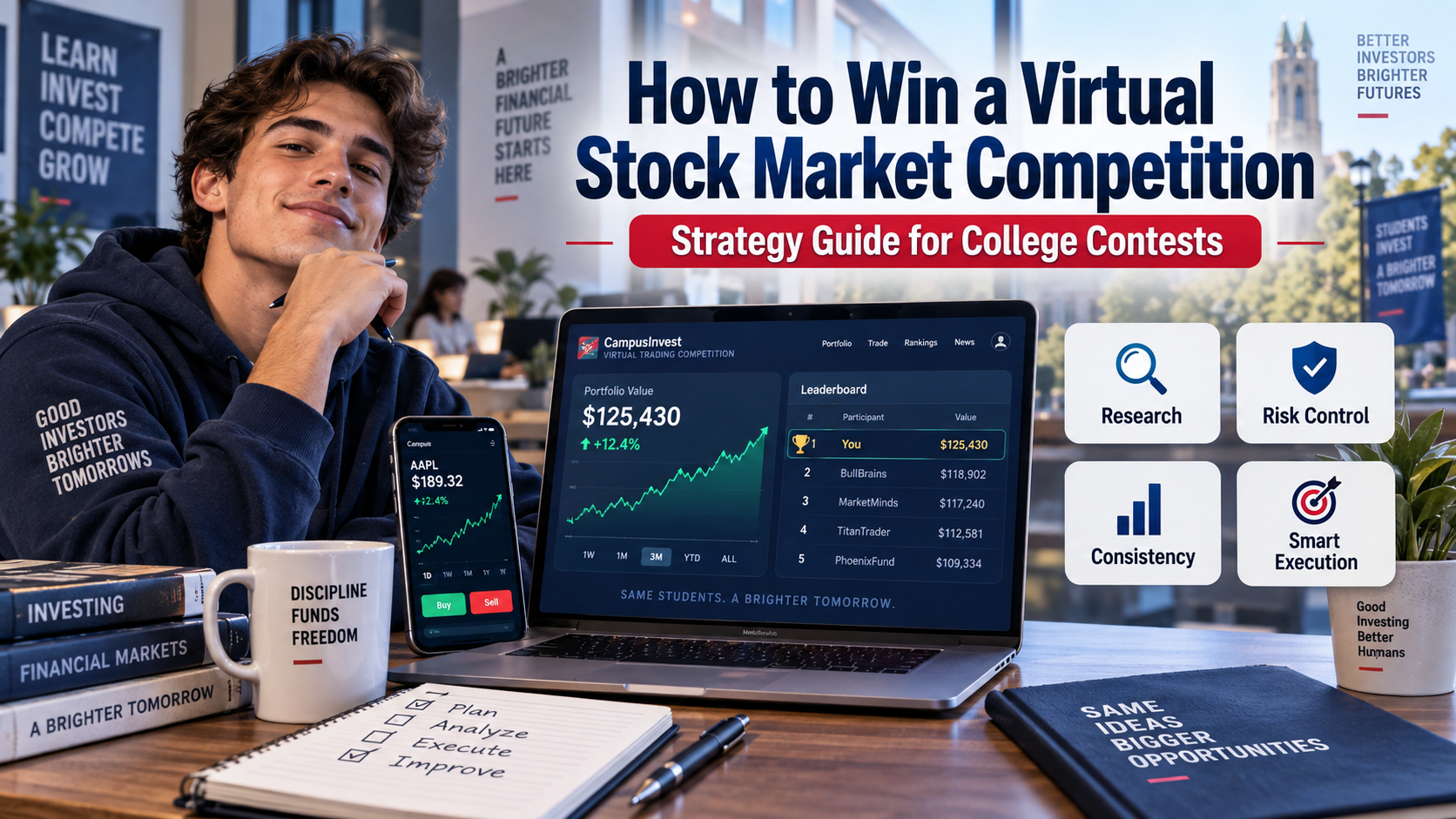
Why contest strategy is different from real trading strategy
Real trading rewards steady, repeatable process, small risk per trade, diversification, protecting capital so you're still around next month. Contests reward something narrower: being at the top of a leaderboard when the clock runs out, and that's a ranking problem, not a profitability problem.
This creates what's sometimes called a tournament effect, something that shows up in fund manager behavior too, not just student contests. Someone sitting comfortably in first place with a few days left has every incentive to play it safe and protect the lead. Someone sitting in twentieth place has the opposite incentive, small, cautious gains won't close the gap, so a rational contest player in that position often swings harder, concentrating into a handful of volatile bets that could realistically move them up the board. Neither behavior would make sense with real money on the line, but inside a contest, both are actually rational given what's being rewarded.
What's the best strategy to win a stock market competition?
It depends heavily on where you stand and how much time is left, which is really the core insight most contest guides skip entirely. Early in a contest, or if you're already near the top, a moderate approach, a handful of stocks with decent momentum, sized reasonably, tends to work fine and keeps you in contention without unnecessary blow-up risk.
Late in a short contest, if you're sitting well behind the leaders, the math changes. Small, safe gains won't close a meaningful gap in two or three remaining days, so concentrating into fewer, higher-volatility positions, ones that could realistically move 5 to 10% in the contest window, gives you an actual shot at climbing. This is precisely the kind of decision that would be reckless with real savings and is a reasonably sound tactical call inside a scored, time-boxed contest.
Helpful Resource: How to Learn Stock Market Trading as a College Student: A 90-Day Beginner Roadmap
Should you take more risk in a virtual trading contest?
Generally yes, more than you'd ever take with real capital, and there's a clean reason why. There's no real money on the line, and the payoff structure is rank-based, not proportional to your actual return, so a contest where you finish anywhere below first often looks the same on your resume or bragging rights as one where you finish dead last.
That said, "more risk" doesn't mean reckless or random. Taking on volatility in instruments you actually understand mechanically, higher-beta stocks, or options if the contest rules allow them, is different from just throwing capital at whatever's moved the most that morning without any read on why. Check the contest's specific rules too, some restrict leverage, shorting, or derivatives entirely, and building a strategy around tools you're not actually allowed to use is a wasted afternoon.
How should you build a portfolio for a 7-day or 30-day contest?
These call for genuinely different approaches, since the time horizon changes what's actually achievable. A 7-day contest gives you almost no room for a slow strategy to play out, so look specifically for stocks with a scheduled catalyst inside that exact window, an earnings date, a major expected announcement, since you need something to actually happen while the clock's still running, not sometime after the contest ends.
A 30-day contest gives you more room to work with. You can afford to rotate into sector momentum as it develops, rebalance if an early pick stalls out, and recover from one bad week without it deciding the whole outcome. Concentration still matters more than it would in real investing, spreading virtual capital across fifteen safe, boring stocks is a strategy built for steady real-world compounding, not for climbing a 30-day leaderboard.
Picking stocks that actually move during the contest window
Look for higher-beta stocks, ones that historically swing more than the broader market, since a stock that barely moves gives you nothing to actually capture even if you picked the right direction. Check for anything with a scheduled event landing inside your specific contest dates, earnings, a product launch, an expected policy announcement, since a catalyst you can actually see coming is worth more than a random guess on direction.
Sector momentum matters too. If a particular sector's been running hot the past couple weeks, contest-length moves tend to have more follow-through than in a sector that's been dead flat. And if the contest allows futures or options, understand that these amplify moves in both directions, useful for closing a gap late in a contest, genuinely dangerous if you don't understand the mechanics first.
Helpful for Learn: Best Stock Market Simulators for Students in India: Free & Realistic Platforms Compared
Common mistakes in stock market contests
Diversifying like you're managing real retirement savings. Fifteen stable, boring positions might be the right call for your actual portfolio someday, but it's close to the worst possible approach for a ranked, time-boxed contest where you need real separation from the pack, not steady, modest gains.
Not reading the specific contest rules closely enough. Some contests ban shorting, cap position sizes, or restrict which instruments you can trade, and building a plan around tools you're not actually permitted to use wastes time you don't have.
Ignoring the leaderboard entirely. Your optimal strategy genuinely depends on where you're sitting relative to everyone else, not just on which stocks look interesting to you in isolation.
Panicking in the final day or two. A lot of contest participants make their worst decisions right before the deadline, chasing whatever moved that morning without any real reasoning behind it. A quick, calm gut check, does this actually fit my situation on the leaderboard right now, beats a purely reactive scramble.
The honest caveat: don't take real-trading lessons from contest strategy
This part matters more than anything else in this guide, so it's worth saying plainly. Everything that helps you win a contest, concentrating into a handful of volatile bets, taking on outsized risk when you're behind, chasing momentum without much diversification, is close to the exact opposite of what keeps a real trading account intact over time.
SEBI's own research shows what happens when real traders lean too hard into this kind of behavior with actual capital, 93% of individual F&O traders in India lost money between FY22 and FY24, and more than 70% of individual intraday equity traders lost money in FY 2022-23. A lot of that comes down to exactly the instincts that win contests, oversized bets, chasing volatility, swinging bigger after a loss instead of smaller. Use a contest to sharpen your mechanics, your decision speed, your read on momentum. Then, when you're trading with money that's actually yours, put the contest playbook away and pick up a completely different one, small risk per trade, real diversification, protecting capital first.
Several colleges run trading contests and challenges through Neostox's educational programs, using live NSE and BSE market conditions so the mechanics you're practicing genuinely resemble the real market. It's a solid place to sharpen contest instincts and general trading mechanics alike, just remember which mode you're in once real capital eventually enters the picture.