
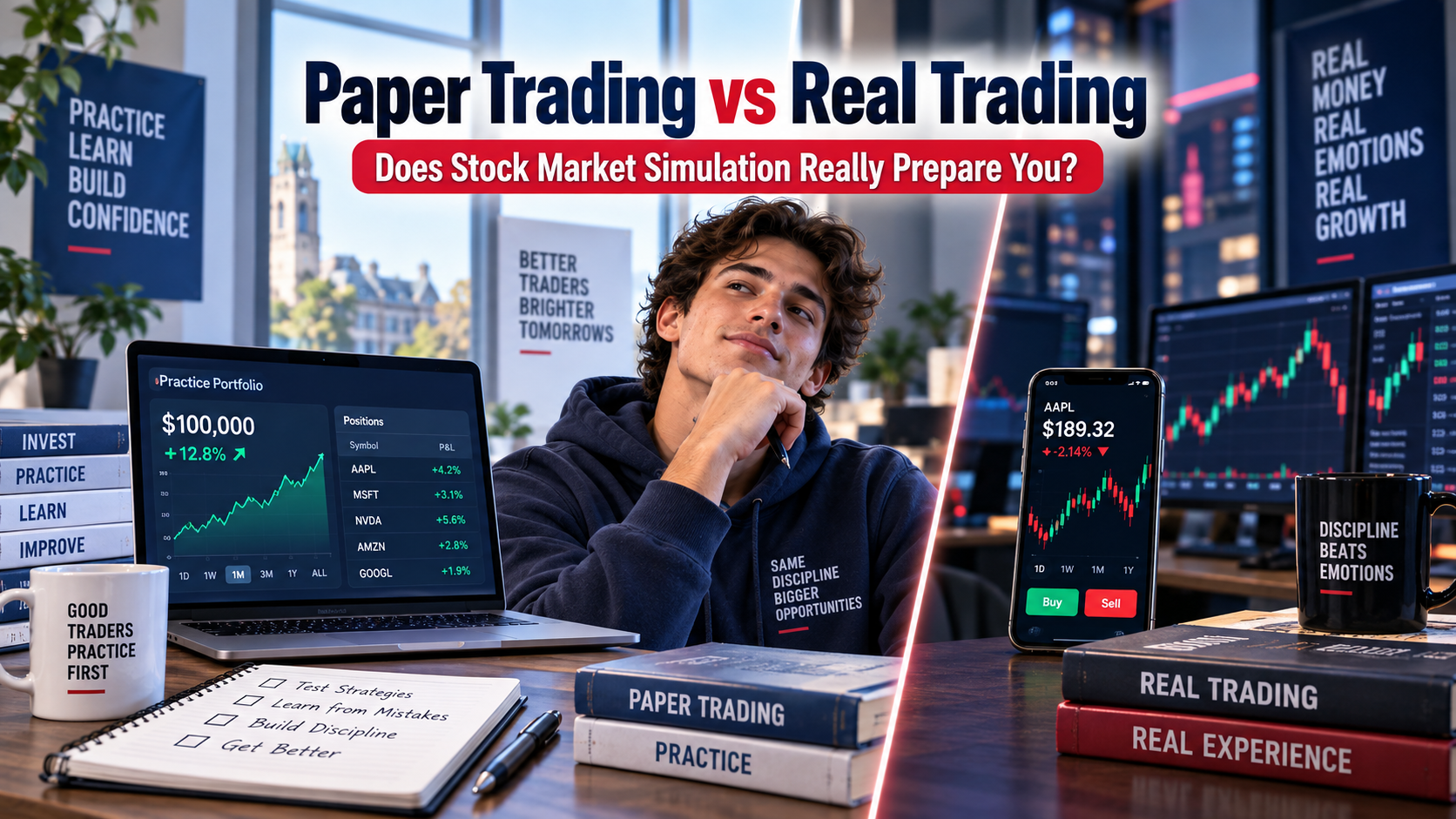
Paper trading vs real trading, side by side
| Dimension | Paper Trading | Real Trading |
|---|---|---|
| Cost of a mistake | Zero, virtual money only | Real, comes straight out of your account |
| Order fills | Usually at or near the quoted price | Can be worse than quoted, especially in options or thinner stocks |
| Transaction costs | Rarely included unless you add them yourself | Brokerage, taxes, and exchange fees on every trade, win or lose |
| Emotional pressure | Minimal, losses don't actually hurt | Real, loss aversion kicks in the moment money's genuinely at risk |
| Data | Live or delayed market prices, depending on the platform | Always live, since it's the actual market |
| Capital required | None | Real money, however much you choose to risk |
| Learning speed for mechanics | Fast, no consequences slowing you down | Slower, since mistakes carry weight and hesitation creeps in |
| Learning speed for psychology | Doesn't really happen here | Only place this actually gets tested |
Look at that table for a second and the pattern's pretty clear. Everything mechanical, fills aside, transfers reasonably well. Everything psychological basically doesn't transfer at all, and that's not a small gap, it's arguably the whole game once you're actually trading for real.
Where the two genuinely match up
Order mechanics are identical, full stop. A limit order works the same way whether it's backed by real rupees or virtual ones, and there's no meaningful difference in learning how market orders, stop-losses, or bracket orders function between the two environments.
Price movement itself matches too, assuming you're on a platform running live data rather than something delayed or synthetic. A stock that breaks out on rising volume behaves the same whether you're watching it in a simulator or with real capital riding on it, since the market itself doesn't know or care which one you're using. Strategy testing genuinely works here as a result, if a setup performs consistently across enough simulated trades and varied conditions, that's real, useful information about the setup itself.
Where the two genuinely diverge
Execution quality is the first crack. Simulators tend to assume your order fills close to the price you saw, while real markets, particularly in options or less liquid stocks, regularly hand you a worse fill than expected. That gap, called slippage, quietly erodes strategies that look fine on paper but were never actually testing for this.
Costs are the second crack, and it's a big one. SEBI's own research found that loss-making intraday equity traders paid transaction costs equal to an additional 57% of their losses in FY23, costs that simply don't show up in most simulated results unless you're deliberately subtracting them. A strategy that looked marginally profitable in a paper account can turn negative the moment real brokerage and taxes enter the picture.
And then there's the one that actually decides most outcomes: psychology. A simulated loss doesn't trigger the same response a real one does, so the hesitation, the early profit-taking, the refusal to honor your own stop-loss, none of that gets tested until money that actually matters is on the line. This is why a trader can run a genuinely solid paper trading record and still struggle once real capital enters the picture. The strategy didn't necessarily fail. The person executing it changed the moment the stakes became real.
So, does simulation really prepare you?
Partially, and that's the honest, useful answer rather than a flat yes or no. It prepares you thoroughly for mechanics, order types, position sizing math, and testing whether a strategy holds up across different market conditions. It does not prepare you for the emotional weight of real financial risk, and pretending otherwise sets people up for a rough surprise the first time a real loss actually stings.
Use paper trading for what the comparison table above shows it's actually good at. Then treat your first stretch of real trading, at minimum position size, as a separate, necessary phase, one specifically designed to reveal the gap this comparison just laid out, before you scale up any further.
Neostox's paper trading runs on live NSE and BSE market conditions across equities, futures, and options, which keeps the mechanical side of this comparison as close to real as a simulator can get. It won't close the psychological gap, nothing fully can, but a proper trade log and realistic practice give you the strongest possible starting point before that gap becomes something you have to manage with actual money on the line.