
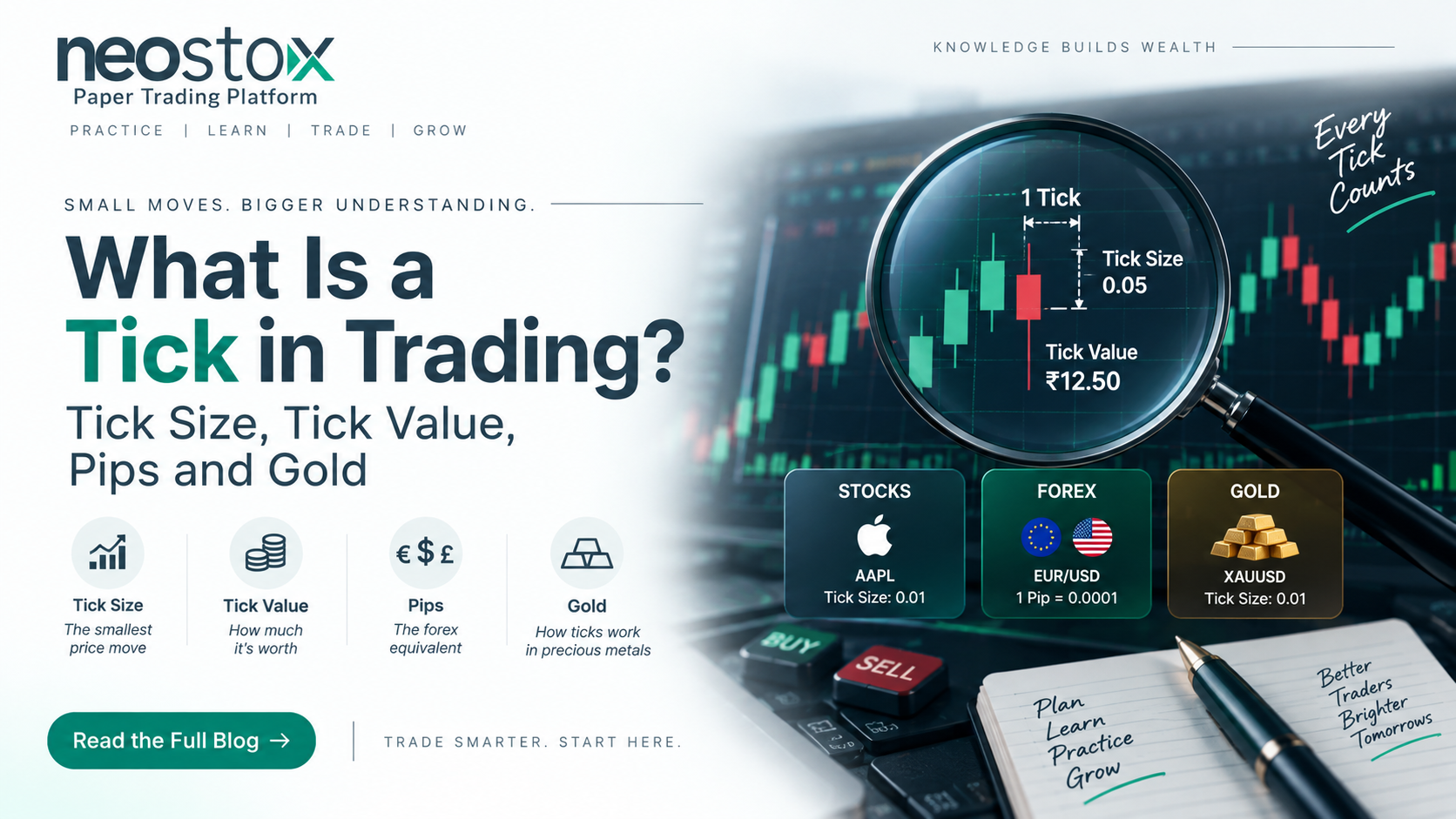
What does one tick mean in trading?
A tick is the minimum amount a price can move, up or down, for a given instrument. The exchange sets this number, not the trader, and it's baked into how that specific stock, future, or contract trades.
Think of it like currency has paise. You can't quote a price in half-paise increments, the smallest unit is fixed. A tick works the same way for a tradeable instrument. Price can only move in whole multiples of that instrument's tick size, never in between.
What is tick size?
Tick size is the specific number, the minimum price increment itself. A stock might have a tick size of ₹0.05. A futures contract might have a completely different one. There's no single tick size across all of trading, it's set instrument by instrument, exchange by exchange.
This is where a lot of confusion starts. People hear "tick" and assume it means the same thing everywhere. It doesn't. Always check the specific contract specifications for whatever you're actually trading.
What is tick value, and how do I calculate it?
Tick value is what one tick move is actually worth in money.
The formula is simple:
tick value = tick size × lot size (or contract multiplier, depending on the instrument).
Here's a clean example using round numbers. Say a futures contract has a lot size of 100 units and a tick size of ₹0.10. One tick move, then, is worth ₹10, since 100 units × ₹0.10 comes out to ₹10. Move up five ticks and you've gained ₹50 on that position. Move down five ticks and you've lost the same amount. The lot size is what turns a tiny price increment into a real number that actually matters to your account.
Is one tick equal to one dollar or one rupee?
No, and this assumption trips up more beginners than almost anything else in this topic. Tick value depends entirely on the specific instrument's tick size and lot size, and those two numbers vary enormously across different contracts. A tick in one instrument might be worth a few rupees. A tick in another might be worth several hundred.
Never assume a fixed rupee or dollar value per tick without actually checking that specific instrument's contract specifications first. Treating one tick as automatically worth one unit of currency is a fast way to badly misjudge your actual risk on a trade.
What's the difference between a tick and a pip?
Tick is the general term, used across stocks, futures, and most other exchange-traded instruments. Pip is more specific, it's forex terminology, referring to the standardized smallest meaningful price move in a currency pair, typically the fourth decimal place for most pairs, or the second decimal place for pairs involving the Japanese yen.
Functionally, they're doing the same job, describing the smallest price increment for whatever you're trading. The word just changes depending on which market you're in. Stocks and futures traders say "tick." Currency traders say "pip."
How much is one pip worth in rupees?
It depends on your position size and the specific currency pair, the same underlying logic as tick value. Larger position sizes make each pip worth more in absolute currency terms, smaller positions make each pip worth less.
One important note for Indian traders specifically: legal currency trading here is limited to specific INR-paired contracts, like USD/INR, EUR/INR, GBP/INR, and JPY/INR, traded through SEBI-registered exchanges such as NSE or BSE. Global forex trading through offshore, unregistered platforms isn't permitted for Indian residents under FEMA rules, worth keeping in mind before assuming general forex "pip" content applies directly to what you're legally able to trade from India.
How much is one tick in gold? What is gold's tick size on MCX?
Gold futures trade on MCX, India's commodity exchange, and the exchange sets a specific tick size for each gold contract, Gold, Gold Mini, and Gold Petal all have their own contract specifications, including their own tick sizes and lot sizes. These get periodically revised by the exchange, so rather than quoting a specific number here that could be outdated by the time you read this, check MCX's current official contract specifications directly before trading.
The calculation method stays the same regardless of the exact current figures: multiply the contract's tick size by its lot size to get the tick value in rupees. Once you have both numbers from the current contract specs, the math itself takes seconds.
What does 30 ticks mean?
It means the price moved 30 times the instrument's tick size, up or down depending on direction. Traders often talk in ticks rather than rupees specifically because it's a cleaner, more consistent way to describe price movement across different price levels and instruments.
Say a trade moved 30 ticks in your favor, and each tick is worth ₹10 on that specific contract. Your position gained ₹300. Talking in "ticks" instead of rupee amounts also makes it easier to compare movement across different contracts with wildly different price levels, since tick counts strip out the actual price and focus purely on how much the instrument moved relative to its own minimum increment.
What does 0.01 lot mean when trading gold?
This specific phrase, "0.01 lot," usually comes from CFD or forex-style trading platforms, not from MCX's regulated exchange-traded gold futures. On those platforms, a "standard lot" represents a set unit size, and 0.01 lots means a micro-lot, one-hundredth of that standard size, letting traders take much smaller positions than a full lot would allow.
Worth being direct here: MCX's actual gold futures contracts, Gold, Gold Mini, Gold Petal, use fixed, standardized contract sizes rather than this fractional "lot" system. If you're seeing "0.01 lot gold" terminology, you're likely looking at a CFD or forex-style broker rather than India's regulated commodity exchange, and as covered in a companion guide on this site, offshore CFD and forex platforms carry real regulatory concerns for Indian residents. For regulated gold trading in India, MCX's own contract specifications, not lot-fraction terminology, are what actually apply.
Understanding tick size and tick value properly, before you're calculating them under pressure with a live position open, makes a real difference to how accurately you judge risk on any trade. Neostox's paper trading runs on live NSE and BSE market conditions across equities, futures, and options, letting you get comfortable with contract specifications and position math using virtual money before any of it involves real capital.