
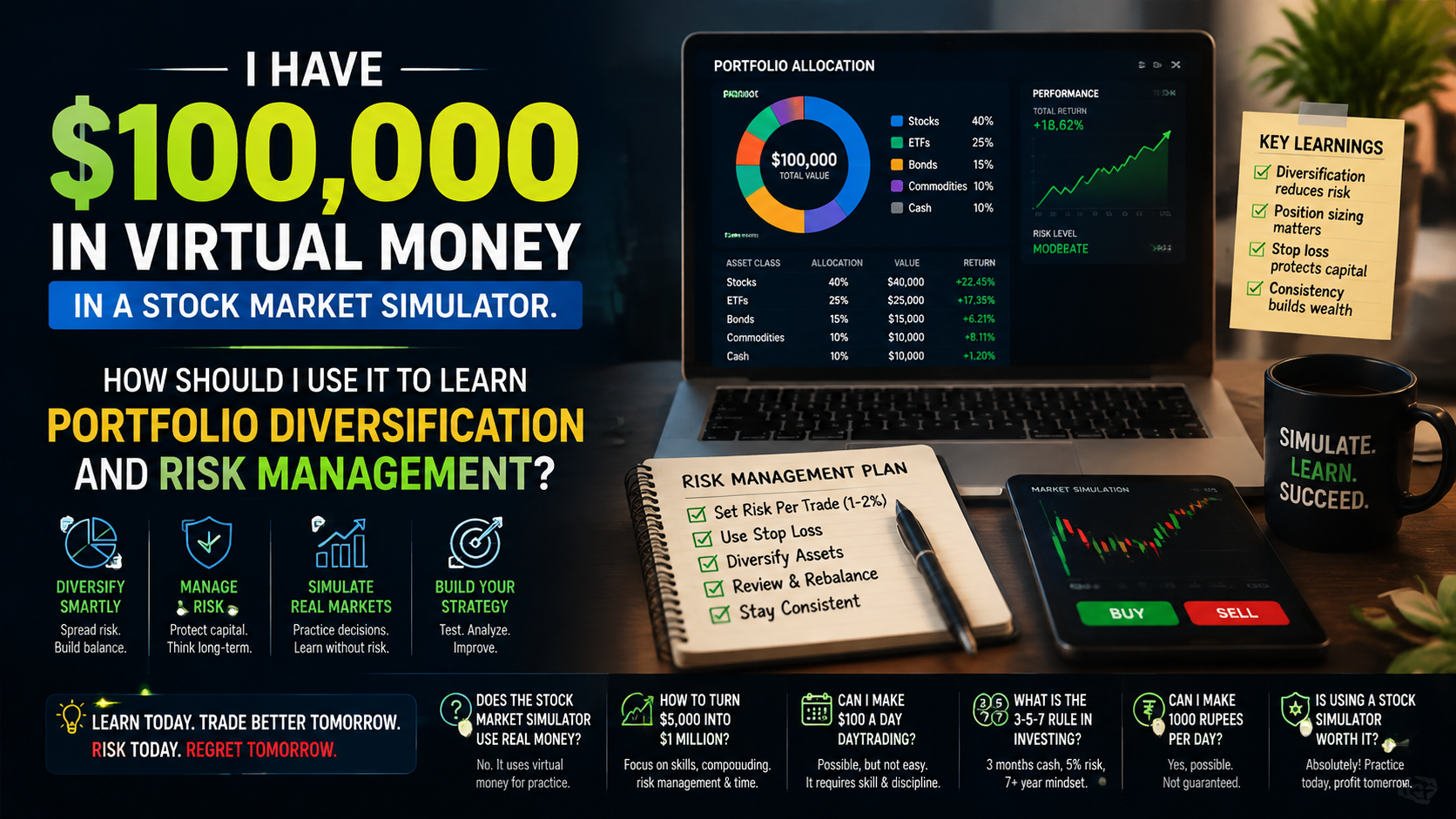
Use your $100,000 in virtual money the same way you'd use real capital: split it across a limited number of positions, cap how much you risk on any single trade, and cap how much sits in any one sector. Treating a large virtual balance casually teaches you nothing about diversification. Treating it with real constraints teaches you almost everything.
A big virtual number tempts people to buy anything that looks interesting, since a loss doesn't actually hurt. That instinct is exactly what a diversification exercise is supposed to train you out of. The value of this practice depends entirely on whether you apply real rules to it.
Does a stock market simulator actually use real money?
No. A stock market simulator, sometimes called a paper trading platform, uses entirely virtual funds while tracking real market prices. Your $100,000 is not real money at any point, and any gains inside the simulator can't be withdrawn or converted to cash.
What is real, or should be treated as real, is the price data behind your trades, at least on a platform that runs on live market conditions. That's what makes the practice useful. The prices are genuine even though the capital isn't.
Step 1: Decide how many positions you'll actually hold
Diversification isn't about owning as many stocks as possible. Spreading $100,000 across 40 different positions doesn't necessarily reduce your risk, and it makes the portfolio hard to actually manage or understand.
A common, workable range for a beginner learning diversification is somewhere between 8 and 15 positions. That's enough to avoid having any single stock dominate your outcome, without spreading yourself so thin that you can't reasonably track what each position is doing and why you hold it. Pick a number in that range before you place a single trade, and stick to it.
Step 2: Set a fixed risk limit per trade
Decide what percentage of your total capital you're willing to risk on any one position, and apply that number to every trade without exception. A common starting point is risking 1% to 2% of total capital per trade, meaning $1,000 to $2,000 of your $100,000 on any single position if it hits your stop-loss.
This single rule does more for risk management than almost anything else you can practice. It prevents one bad call from meaningfully damaging your overall portfolio, and it forces you to size positions based on where your stop-loss sits, not on how confident you feel about a particular stock.
Step 3: Apply the 3-5-7 rule to your virtual portfolio
The 3-5-7 rule is a commonly cited risk management guideline, not a regulatory requirement, but it's a useful framework for practicing with a large virtual balance. The general idea:
- No more than 3% of your capital at risk on any single trade: This overlaps with your per-trade risk limit above.
- No more than 5% of your capital concentrated in a single sector or group of closely related positions: If four of your holdings are all IT stocks, they don't behave like four separate risks. They behave more like one larger, concentrated bet.
- No more than 7% of your total capital at risk across all open positions at any given time: This caps how much damage a broad market downturn could do to your account all at once.
Different sources describe slightly different versions of this rule, so treat the exact numbers as a reasonable starting framework rather than a fixed law. What matters is the underlying habit: capping risk at the trade level, the sector level, and the portfolio level, all at the same time.
Step 4: Understand that diversification isn't just "more stocks"
Real diversification depends on how your positions actually move in relation to each other, not how many tickers appear in your account. Two banking stocks and a financial services company will often move together during the same market events, which means holding all three doesn't reduce your risk nearly as much as it appears to on paper.
Try building your $100,000 portfolio across genuinely different sectors, such as banking, IT, consumer goods, pharmaceuticals, and energy, rather than concentrating in whichever sector has been performing well recently. The goal is a portfolio where a bad month for one sector doesn't automatically mean a bad month for your entire account.
Step 5: Track the metrics that actually show you're managing risk, not just the total return
A portfolio can go up over time while quietly carrying dangerous concentration risk that only shows up during a downturn. Track these alongside your overall gain or loss:
- Maximum drawdown, the largest peak-to-trough decline your portfolio experiences, which tells you how much pain the strategy involves even if it's ultimately profitable.
- Sector concentration, meaning what percentage of your capital sits in each sector at any given time.
- Position size distribution, checking whether one or two positions have grown to dominate the portfolio simply because they performed well, which quietly increases your concentration risk without you deciding to take it on.
A trade log or portfolio report makes this far easier to see than trying to track it in your head. Neostox gives you trade reports so you can review exactly how your virtual portfolio's composition and risk have shifted over time, not just whether the total number went up.
Common mistakes people make with a large virtual balance
- Going all-in on one exciting stock: A large virtual number makes it tempting to put a big chunk of it into a single stock that's getting attention. This defeats the entire purpose of a diversification exercise and teaches you the opposite habit you're trying to build.
- Never holding cash: Beginners often deploy all $100,000 immediately, leaving nothing in reserve. Professional portfolio management usually involves holding some percentage in cash, both as a buffer and as flexibility to act when a genuinely good opportunity appears.
- Ignoring rebalancing: If one position doubles while others stay flat, it now represents a much larger share of your portfolio than you originally intended, and your risk profile has shifted without any new decision on your part. Periodically review your allocations and trim positions that have grown disproportionately large.
- Confusing a large virtual balance with real financial stakes: It's easy to treat $100,000 in virtual money casually specifically because it's virtual. The entire value of this exercise depends on applying the same discipline you'd use if it were real.
Can this virtual money teach me how to turn $5,000 into $1 million?
No, and it's worth being direct about that. Turning $5,000 into $1 million requires either an extraordinarily long compounding timeline at realistic returns, or a level of risk that would almost certainly wipe out the capital first if attempted quickly. Neither path is something a diversification and risk management exercise is designed to teach, and neither is a realistic near-term goal for a retail trader.
What a $100,000 simulator portfolio can teach you is something more useful long term: how to size positions, spread risk across genuinely different exposures, and avoid the concentration mistakes that wipe out otherwise sound trading accounts. That skill set is what allows steady compounding to work in your favor over years, rather than chasing a single outsized bet.
💡 Before you continue: You might want to read How Can I Use a Stock Market Simulator to Test.
What about making $100 a day, or ₹1,000 a day, from trading?
Daily income targets depend on deployed capital and realistic return expectations, not on the size of your simulator account alone. Making $100 a day consistently, or ₹1,000 a day, requires enough capital generating a realistic daily return after costs, and a tested, repeatable process, not just a large virtual balance sitting in a simulator.
A $100,000 diversification exercise is a different kind of practice entirely. It's about learning to protect capital and manage risk across many positions, which is a foundation for sustainable trading, rather than a direct path to a specific daily income number.
Is using a stock market simulator worth it for this kind of practice?
Yes, specifically because portfolio-level mistakes are expensive to learn with real money and free to learn with virtual money. Concentration risk, poor diversification, and lack of rebalancing don't usually show up as a single bad day. They show up as a portfolio that looks fine until one sector or one stock drags the whole account down at once.
Practicing this with $100,000 in virtual capital lets you make that mistake, see exactly how it happened by reviewing your trade and portfolio history, and correct the habit before it costs you anything real. Neostox supports paper trading across equities, futures, and options on live NSE/BSE market conditions, with trade reports and charting tools that make it possible to actually see how your diversification and risk decisions play out over time.