
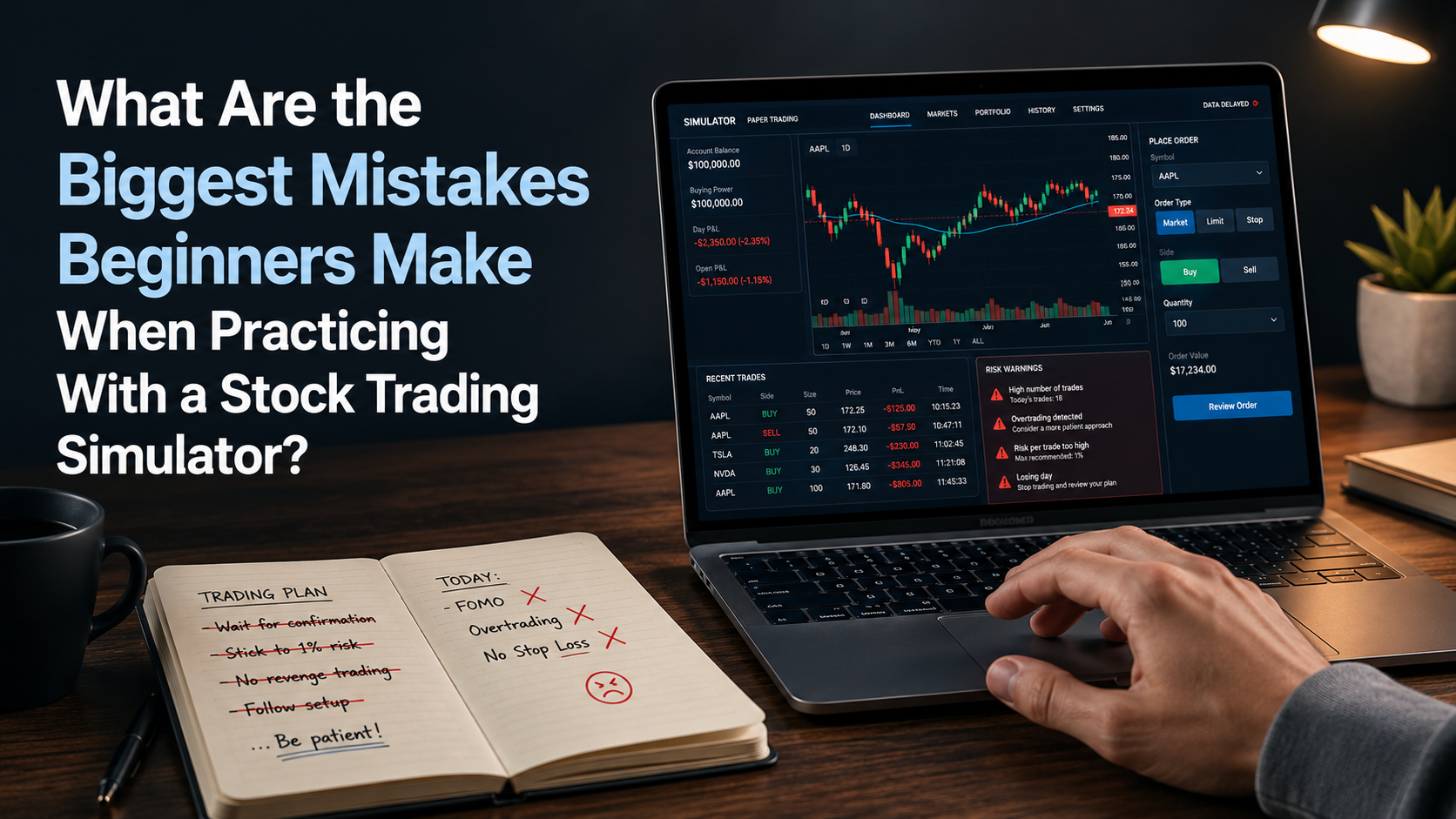
The biggest mistakes beginners make on a stock trading simulator are treating the practice too casually. They use an unrealistic virtual balance, skip the trade journal, click through trades with no defined strategy, and ignore the real-world costs that would eat into their profits. Each of these turns useful practice into a habit that won't transfer when real money is involved.
A simulator is only as valuable as the discipline you bring to it. Most beginners don't fail because the simulator is flawed. They fail because they use it the same way they'd play a video game, and the lessons that stick are the wrong ones.
Mistake 1: Using a virtual balance that doesn't match reality
Plenty of simulators let you start with an unrealistic amount, sometimes ₹50 lakh or more, just to make the interface feel exciting. The problem is that trading with ₹50 lakh and trading with ₹30,000 involve completely different decisions.
Position sizing, risk per trade, and even which stocks feel "safe enough" to buy all change based on how much capital you're working with. If your virtual balance doesn't resemble what you'll actually start with, you're training habits you'll have to unlearn later. Set your virtual balance to match your real starting capital as closely as possible.
Mistake 2: Overtrading because nothing feels at stake
When a loss costs you nothing, there's no natural brake on how often you trade. Beginners often place far more simulated trades in a day than any real strategy would call for, chasing every small move just because they can.
This builds a habit of trading out of boredom or impulse rather than trading when a real setup appears. In live markets, that same impulse leads to overtrading real capital, and overtrading is one of the fastest ways to lose money through fees and poor entries alone. Set a rule for yourself: only take trades that match your defined criteria, and skip the rest, even in simulation.
Mistake 3: Never keeping a trade journal
This is probably the single most common mistake, and it's the easiest one to fix. Clicking buy and sell without writing down why you entered, what your plan was, and what actually happened means you're not building anything you can learn from later.
A journal doesn't need to be complicated. Date, instrument, entry price, exit price, your reasoning, and a short note on what you'd do differently next time is enough. Without this, ten simulated trades and a hundred simulated trades teach you roughly the same amount, which is very little.
Mistake 4: Trading without any actual strategy
A lot of beginners open a simulator and just start buying stocks that look interesting, with no defined entry rule, no exit plan, and no sense of how much they're risking per trade. This isn't practice. It's random clicking with extra steps.
Before you place a single trade, write down what would make you enter a position, what would make you exit with a profit, and what would make you exit with a loss. If you can't answer those three questions in advance, you're not testing a strategy. You're testing luck, and luck doesn't teach you anything repeatable.
Mistake 5: Ignoring transaction costs and slippage
Most simulators assume you get filled exactly at the price you see, and none of them automatically subtract brokerage, Securities Transaction Tax, exchange charges, or GST from your results. That makes simulated profits look better than what you'd actually see live.
SEBI's own research shows how much this matters. A 2024 SEBI study found that loss-making intraday equity traders paid transaction costs equal to an additional 57% of their losses in FY23, and even profitable traders gave up 19% of their gains to costs. If you never account for this in your simulator results, you're carrying an inflated sense of how well your strategy actually performs.
Mistake 6: Quitting after one bad streak, or getting overconfident after a good one
Both of these come from the same root problem: judging a strategy off too small a sample. A beginner hits five losing trades in a row and decides the whole approach is broken, or hits five winners and starts increasing position size because they feel like they've figured it out.
Neither reaction is based on enough data. A short losing streak inside a genuinely solid strategy is normal, and a short winning streak doesn't prove an edge exists. Give any strategy at least 30 to 50 trades before you draw real conclusions, in both directions.
Mistake 7: Jumping into options and futures before understanding equity
Options and futures move faster, carry more moving parts, and can wipe out a simulated account in a single bad decision. Beginners who skip straight to derivatives because they look more exciting usually end up confused about basic mechanics that plain stock trading would have taught them first.
Get comfortable with order types, position sizing, and reading price action on regular equity trades before adding leverage and time decay into the mix. Neostox supports paper trading across equities, futures, and options, so there's no need to rush the sequence. You can move to options chain analysis and pre-built options strategies once the fundamentals feel automatic.
Mistake 8: Mistaking simulator profit for real skill
A profitable virtual portfolio feels like proof you're ready for real money. It isn't, not on its own. Simulated results don't include the psychological pressure of real capital, and they often don't include realistic costs either, which means a profitable simulator record can still fail once both of those enter the picture.
Treat simulator profit as one input, not a verdict. The real test is whether you followed your own rules consistently, across enough trades and enough market conditions, not just whether the final number went up.
How to avoid these mistakes going forward
Most of these problems trace back to one habit: not being strict about the practice. Here's a short set of principles that fix the majority of them at once.
- Match your virtual balance to your real starting capital.
- Write your entry, exit, and risk rules down before you trade, not while you're in the trade.
- Log every single trade, win or lose, with a short reflection.
- Manually subtract an estimated cost (brokerage, taxes, slippage) from every simulated result.
- Set a minimum sample size, such as 30 to 50 trades, before judging whether a strategy works.
- Practice through more than one type of market, not just a strong trending week.
None of these require more time. They require doing the same practice with more intention.
What actually makes a good trader
Beginners often assume good traders are the ones who pick the most winning stocks. In practice, the traders who last longest usually share a few habits that have nothing to do with stock picking.
- Consistency over excitement: Professional traders tend to follow the same process on every trade, rather than getting more aggressive when they feel confident or more cautious when they're scared. The process stays fixed. Only the market changes.
- Risk defined before reward: Before asking how much a trade could make, disciplined traders ask how much they're willing to lose if it doesn't work out. Position size gets set from that answer, not from how good the setup looks.
- Review as a habit, not an afterthought: Regularly looking back at what worked and what didn't, using a journal or trade log, is one of the most consistent traits among traders who improve over time. It's also the step most beginners skip.
- Comfort with being wrong: No strategy wins every trade. Traders who last treat a loss that followed their rules as a normal cost of doing business, not a signal to panic or abandon the plan.
None of this is complicated, but it is uncomfortable to practice, since it asks you to be patient in a market that constantly tempts you to act fast.
A simple discipline checklist for simulator practice
Use this as a quick reference before and after each practice session.
Before you trade:
- I have a written entry rule for this trade.
- I know my exit point if the trade goes against me.
- I know my exit point if the trade goes in my favor.
- My position size follows my fixed risk-per-trade rule.
After you trade:
- I logged this trade with entry, exit, and reasoning.
- I noted whether I followed my rules or deviated from them.
- I estimated real transaction costs for this trade.
- I reviewed whether this trade fits a pattern from previous trades.
Print this, save it, or rebuild it in a notes app. The format matters less than actually using it every time.
Is a stock trading simulator safe to use?
Financially, yes. Any simulator, including widely known ones like Investopedia's Stock Simulator, uses entirely virtual funds, so there's no real money at risk in any trade. What varies between platforms is realism, not financial safety.
Some simulators run on delayed or dummy price data, which limits how well the practice transfers to live trading, especially for options or intraday strategies where prices move quickly. Before relying on a platform for serious practice, check whether it states clearly that it tracks live market conditions. Neostox is built on live NSE/BSE conditions across equities, futures, and options, specifically so the mistakes and lessons from practice actually mean something when you eventually trade for real.
Neostox gives you the tools to practice properly instead of casually: live market conditions, a trade log to build a real journal, NeoScreener to study different market conditions, and options chain analysis once you're ready to move past plain equity. Start with virtual money, and start treating the practice like it matters, because the habits you build here are the ones you'll carry into real trading.