
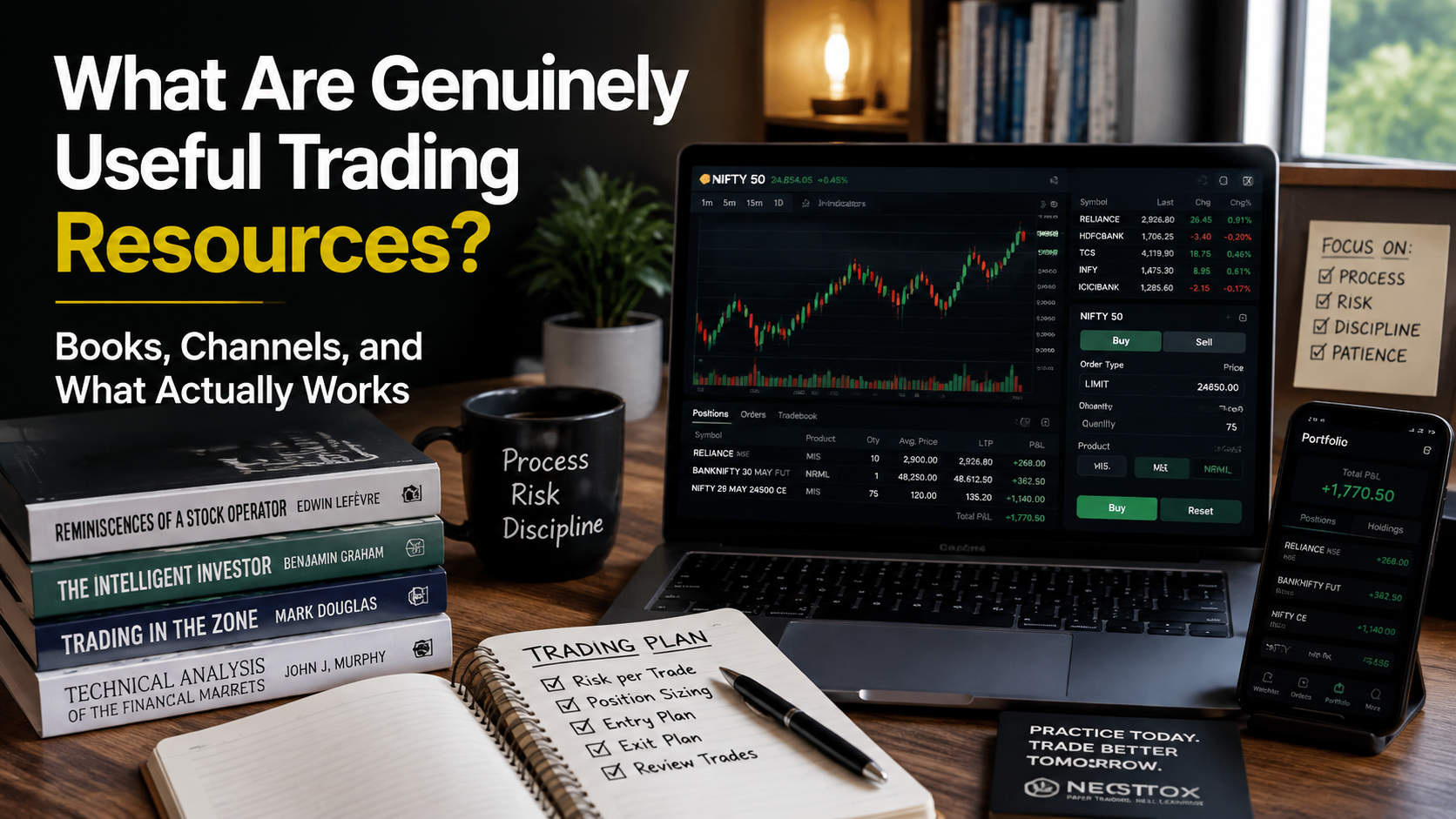
A genuinely useful trading resource teaches process and risk management instead of promising quick profits. Its source can be verified, and it gives you something to practise rather than passively read or watch.
Books that have remained relevant for decades qualify. So do official investor education material and hands on practice. Most guru content that promises guaranteed daily returns does not.
Trading content is easy to find. Sorting useful material from content designed to sell a course, signal service, or subscription takes more work.
What actually makes a resource genuinely useful?
Before you choose a book, channel, or course, run it through this checklist. A resource deserves your time if it meets most of these points:
- It teaches process rather than predictions: Useful education explains risk, position sizing, and strategy. It does not depend on stock tips or guaranteed setups.
- Fixed returns are never promised: A claim of a specific daily or monthly profit percentage is a red flag because no legitimate trading method can guarantee it.
- You can identify the source: Find out who created the content. If that person offers advice, check whether they are registered with SEBI as an investment adviser or research analyst.
- Check whether it has survived more than one market cycle: A strategy that worked during a strong bull run may fail badly in a downturn. That is usually when the expensive lessons arrive.
- There is something you can practise: Reading and watching rarely turn into skill unless you apply the idea, preferably with virtual money first.
Use the same checklist before spending money or several hours on any of the resources discussed below.
Helpful Resource: How to Start Day Trading: A Beginner’s Step by Step Guide
Which books should I read?
A few trading books have remained useful because they focus on behaviour, risk, and decision making. They do not depend on one market condition.
“Reminiscences of a Stock Operator” by Edwin Lefèvre
Originally published in 1923, this fictionalised account of trader Jesse Livermore’s career still holds up. It captures greed, fear, and overconfidence with uncomfortable accuracy.
This is less of a trading manual and more of a study of trader behaviour. You will not finish it with a ready made setup, but you may recognise several mistakes before repeating them with your own money.
“The Intelligent Investor” by Benjamin Graham
Graham wrote this book for long term investors rather than day traders. It explains how to value a company and think about risk.
Those ideas still apply if you trade over shorter periods. A trader who understands the business behind a stock has more context than someone reacting to a chart alone.
“Trading in the Zone” by Mark Douglas
Douglas focuses on psychology, discipline, and the mental habits behind consistent execution. Many beginners find this more useful than another book full of entry setups.
Knowing a strategy is one problem. Following it after three losing trades is a different one, and that is where this book spends its time.
“Technical Analysis of the Financial Markets” by John J. Murphy
Murphy’s book is a broad reference for chart patterns, indicators, and technical analysis fundamentals. It makes more sense once you understand basic chart reading and want a structured reference beside you.
None of these books explains SEBI regulations or Indian market structure in detail. Pair them with official Indian sources.
Which videos and channels teach trading well?
Specific channels can change in quality over time. A creator who once published careful educational videos may later move towards paid signals or aggressive course sales. The source matters more than the subscriber count.
Official material is the safest place to begin. SEBI runs investor education and awareness initiatives that explain markets and risk for retail participants. NSE and BSE also publish educational material on basic market mechanics, order handling, and settlement.
It will rarely look exciting. It is accurate, free, and has no reason to sell you a guaranteed options strategy.
NISM offers a more structured route. The National Institute of Securities Markets was established by SEBI and runs certification programmes for equity, derivatives, and other market segments. These programmes include formal material and assessments, unlike most informal video courses.
Independent creators can still teach well. Look for someone who explains the reasoning behind a trade and discusses losses as openly as profits.
Be wary when the content revolves around lifestyle displays or profit screenshots with no verifiable context. Repeated promises of guaranteed returns deserve the same response. Leave.
If a creator sells a course or signal service, check the registration and disclosures before treating the educational material as unbiased.
Red flags that separate education from hype
Guaranteed or fixed returns
Claims like “guaranteed 5% monthly” or “never lose a trade with this strategy” belong in marketing copy, not serious trading education. A monthly return of 5% may sound modest in a video title, but promising it every month ignores losses, volatility, and changing market conditions.
No source can guarantee market returns, regardless of how polished the screenshots look.
Pressure to act immediately
Real education does not need a countdown timer. Limited time offers and fear of missing out usually indicate that someone wants a quick purchase rather than a careful decision.
You should have enough time to verify the instructor, course details, and refund terms before paying.
No transparency about losses
Every real trader has losing trades. Losing periods happen too.
A resource that shows winning outcomes alone gives you a curated record. It tells you little about drawdowns, risk, or whether the method can survive a poor run.
Vague or unverifiable credentials
Treat claimed expertise with proportional scepticism when you cannot verify the person’s registration, background, or track record.
A large audience is not a credential. Neither is a screenshot from a trading account.
Reading and watching are not enough
Even an excellent book or an official course gets you only part of the way. Trading is a practical skill, and practice with real money can become expensive very quickly.
Take one rule at a time. If a book discusses position sizing, apply that exact rule to simulated trades. When a video explains order types, place a limit order and a stop loss in a simulator, then watch how each behaves.
Neostox supports this kind of practice across equities, futures, and options using live NSE and BSE market conditions. It gives you a place to test what you read before actual capital enters the trade.