
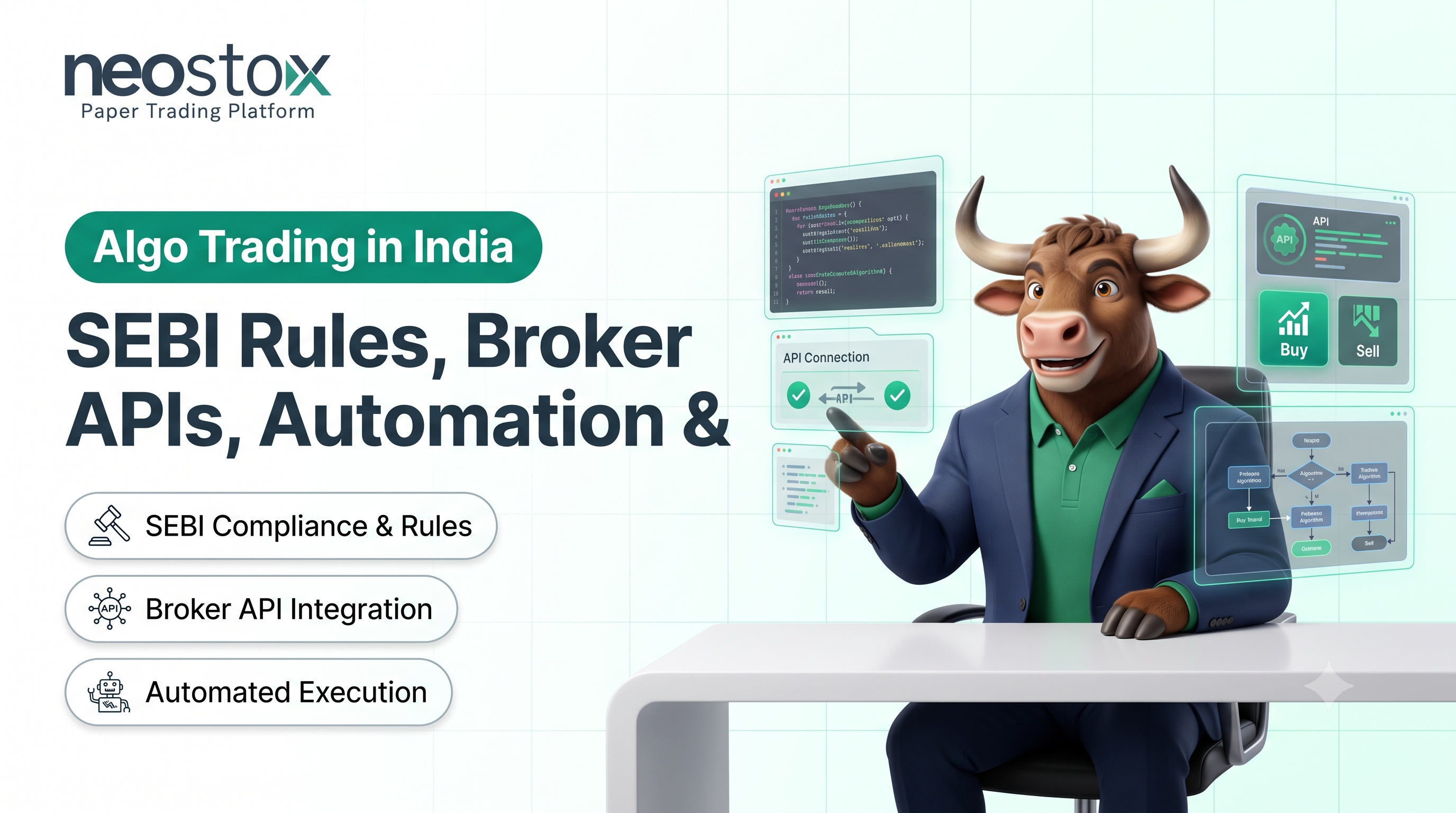
Algo trading sounds like it belongs to hedge funds and institutions, not someone trading from a laptop. That's less true than it used to be, broker APIs have genuinely opened this up to retail traders, but "possible" and "simple" aren't the same thing. This guide covers what algo trading actually is, how retail access works through broker APIs, what regulatory oversight applies and why it's been tightening, and a practical checklist before you automate a single order.
What is algo trading?
Algorithmic trading means using a computer program to automatically generate and place orders based on predefined rules, without a person manually clicking buy or sell for each individual trade. The rules can be simple, buy when price crosses above a moving average, or considerably more complex, but the defining feature is automation, the decision and execution happen without manual intervention once the logic is running.
Algorithmic vs manual trading?
Manual trading means you're personally deciding and clicking to place every order, watching charts, applying your own judgment in real time. Algorithmic trading removes that manual step, a program executes predefined rules consistently, at a speed and consistency no person can match, but with no judgment beyond whatever logic was actually coded into it.
Manual trading adapts to context a person notices intuitively, algo trading executes exactly what it was told, for better and for worse, covered more under what can go wrong.
Can retail traders use algorithmic trading in India?
Yes, retail access has genuinely expanded through broker-provided APIs in recent years, no longer limited to institutional desks. That said, this is an area SEBI has been actively working to formalize regulatory oversight around specifically because retail algo access has grown, moving toward requirements that bring more structure and accountability to how individual traders deploy automated strategies.
What regulatory requirements apply?
This is genuinely a moving target, worth treating with real care rather than trusting a fixed answer here. SEBI has been developing a formal regulatory framework specifically for retail algorithmic trading, generally moving in the direction of requiring algorithms to be registered or approved through your broker before deployment, and order-level tagging so trades placed by an algorithm can be identified and audited distinctly from manual orders.
The exact current requirements, what needs broker approval, what documentation or testing is expected, shift as SEBI's framework develops. Check directly with your specific broker's compliance team and SEBI's most recent circulars before deploying any automated strategy, rather than relying on a general description that may not reflect the current, specific requirements by the time you're reading this.
What is a broker API? How does API-based algo trading work?
A broker API (Application Programming Interface) is a technical interface that lets external software, a script you've written, a third-party platform, connect directly to your trading account and place orders programmatically, without you manually clicking through the broker's own app or website. Most major Indian brokers now offer this, typically requiring separate activation and sometimes additional charges beyond your standard account.
Once connected, your algorithm sends buy and sell instructions through the API based on whatever logic it's running, and the broker's system executes them the same way it would a manually placed order, just without a person clicking the button for each one.
Do I need to code to automate a trading strategy?
Not necessarily, though it depends on how custom your strategy needs to be. Some platforms offer no-code or low-code strategy builders, letting you select conditions and rules through a visual interface rather than writing actual code, and some offer a marketplace of pre-built, pre-vetted strategies you can deploy without building anything yourself.
Building genuinely custom logic, beyond what a no-code builder's preset options allow, typically does require actual coding, commonly in Python given its strong ecosystem for this kind of work, covered in more depth in a companion guide on this site about using data and machine learning for market analysis.
Is automated trading the same as an AI trading bot?
No, and this distinction matters more than people realize. Algorithmic trading broadly just means rule-based automation, and most algo trading is genuinely simple, straightforward if-then logic, with no machine learning or AI involved at all. An "AI trading bot" specifically implies the use of machine learning models to generate trading decisions, a more specific and considerably more complex subset of algo trading generally, not a synonym for it.
Most retail algo trading, buying on a moving average crossover, selling at a fixed profit target, falls into the simple, rule-based category, not the AI category, regardless of how it gets marketed.
How are algorithms tested?
Two stages, both necessary, neither sufficient alone. Backtesting runs your algorithm's logic against historical data to see how it would have performed in the past, useful for an initial read but prone to overfitting if you tune the rules too closely to that specific historical period. Forward testing, running the algorithm live against real-time data but with virtual money rather than real capital, catches issues backtesting can't, since live market conditions behave differently than historical data replayed after the fact.
A companion guide on this site covers how to properly test a trading strategy, including the specific pitfalls of backtesting, in real depth, worth reading before trusting any backtest result on its own.
What can go wrong with automated orders?
Several distinct failure modes, worth knowing before you're relying on one. Technical failures, a lost internet connection, an API outage, can leave a position unmanaged exactly when it needs attention. Logic errors, a bug in the code, can place wrong order sizes or fail to exit a losing position the way it was supposed to, sometimes repeatedly before anyone notices.
Runaway algorithms, a poorly coded stop condition that doesn't actually trigger, can keep placing erroneous orders faster than a person could catch and stop manually. And regime risk, a strategy tested and tuned for one type of market condition can behave unpredictably once conditions genuinely shift, since the algorithm has no judgment beyond the rules it was given, and won't recognize on its own that conditions have changed in a way its logic wasn't built for.
A retail algo trading checklist
- Understand exactly what your strategy's logic does, in plain language, not just as code you copied from somewhere
- Backtest across varied historical conditions, not just one favorable stretch
- Forward test with virtual money before connecting real capital to any automated strategy
- Check current SEBI requirements and your broker's specific compliance process directly, since this framework has been actively developing
- Build in a genuine kill switch, a way to manually stop the algorithm immediately if something looks wrong
- Monitor actively, especially early on, rather than assuming "automated" means "unattended"
Testing a strategy's actual logic, manually, before ever automating it, is where real understanding gets built. Neostox's paper trading lets you manually test the exact rules you'd eventually want to automate, entry conditions, exit conditions, position sizing, on live NSE and BSE market conditions with virtual money, a solid foundation before layering automation on top of a strategy you've actually validated yourself first.