
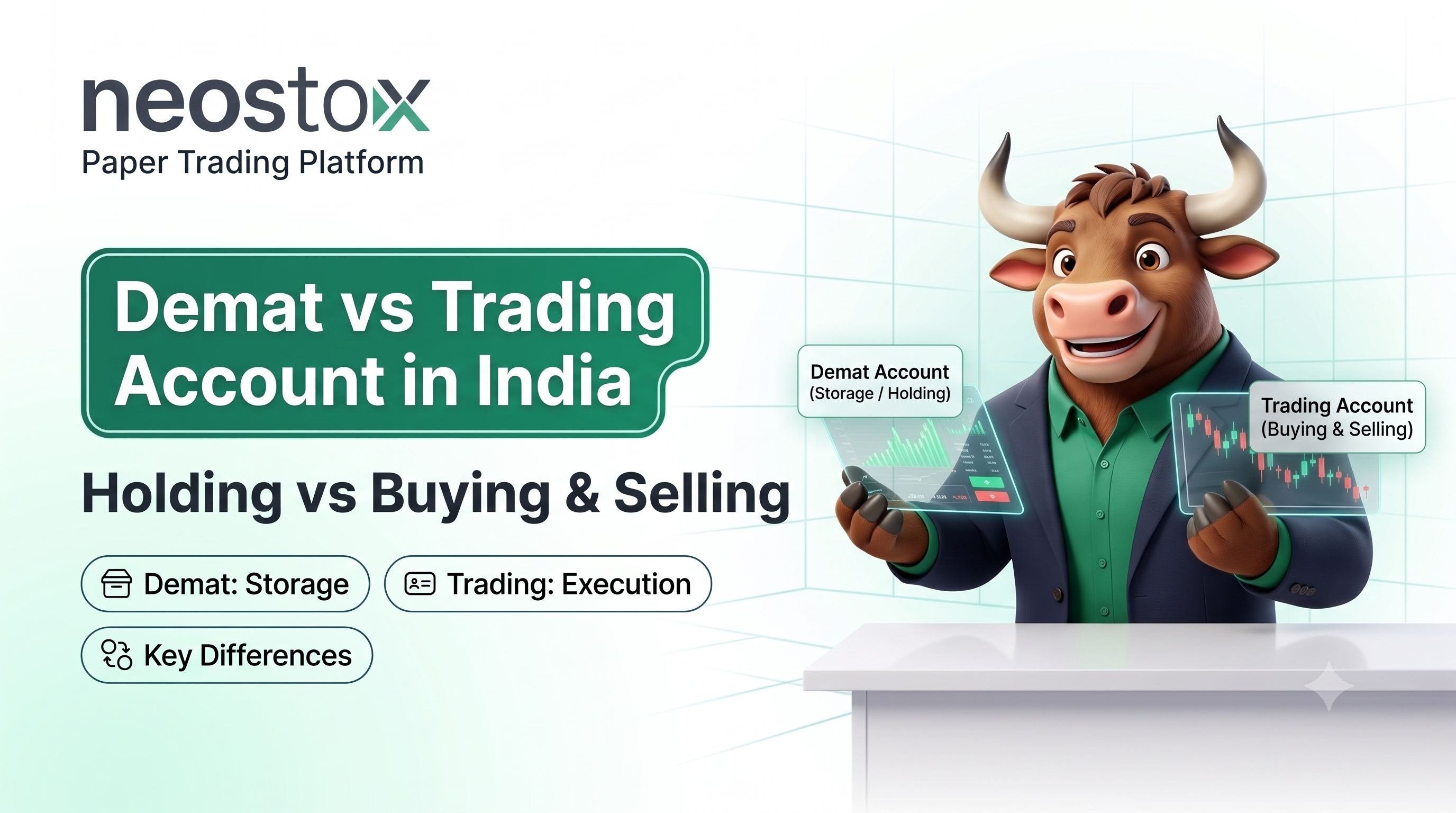
What is a demat account?
A demat account holds your shares and other securities electronically, the modern replacement for physical paper share certificates. It's maintained through a Depository Participant (DP), typically your broker, who's registered with one of India's two depositories, NSDL or CDSL. Every share you buy gets credited into this account, and every share you sell gets debited out of it.
Think of it as a digital locker specifically for what you own, not for placing orders, that's a different account entirely, covered next.
What is a trading account?
A trading account is what you actually use to place buy and sell orders on the stock exchange. It's the account connected to your broker's platform, linking to both your bank account, for funds, and your demat account, for the shares themselves, letting the whole transaction flow through automatically once an order executes.
Without a trading account, you have no way to actually place an order in the first place, regardless of what's sitting in your demat account.
How are the two different?
| Demat account | Trading account | |
|---|---|---|
| Purpose | Holds your shares and securities electronically | Used to place buy and sell orders |
| Maintained by | A Depository Participant, registered with NSDL or CDSL | Your broker |
| What moves through it | Shares, bonds, ETF units, mutual fund units | Buy and sell orders, linked to funds and the demat account |
| Charges | Annual maintenance charge (AMC), DP charges on sell transactions | Brokerage per trade, transaction charges |
They work as a pair, not substitutes for each other. A trading account with nowhere to actually hold purchased shares, or a demat account with no way to place an order, both leave you unable to actually trade.
Do I need both a demat and trading account in India?
Yes, both are required, there's no way around needing either one. You can't legally hold Indian equities without a demat account, and you can't place an order without a trading account. Most brokers open both together as a single onboarding process, since they're designed to work in tandem, but they remain two distinct accounts underneath, each with its own charges and function.
Can a beginner open a demat account online?
Yes, most brokers now offer a fully digital opening process, Aadhaar-based e-KYC, a video-based in-person verification (IPV) step, and a digital signature, letting you complete the whole process from home without physical paperwork in most cases. The process typically takes anywhere from a few minutes to a day or two, depending on the broker and how quickly your documents get verified.
Some specific situations, certain F&O segment activations or edge-case documentation issues, may still require additional steps or physical verification, but for a standard equity demat and trading account, online opening is now the norm rather than the exception.
What documents are required for demat KYC?
A few standard documents cover most cases. PAN card, mandatory and non-negotiable, it's your primary identity document for any financial account in India. Address proof, commonly Aadhaar, passport, voter ID, or a recent utility bill. A cancelled cheque or bank statement, linking your bank account for fund transfers. A photograph, and your signature, usually captured digitally during the online process now.
If you're planning to trade futures and options specifically, some brokers request additional income proof, a salary slip, ITR, or bank statement showing sufficient balance, as part of activating that specific segment, beyond the standard equity account documents.
What charges should I check before opening a demat account?
Three separate charges matter here, and conflating them is a common source of confusion. Account opening charges, a one-time fee some brokers charge, though many now offer free account opening as a standard offering. Annual maintenance charges (AMC), a recurring yearly fee for maintaining the demat account itself, charged regardless of how much or little you trade.
DP charges, a separate, transaction-based fee, covered in more detail below, since it's commonly the least understood of the three and catches people off guard specifically because it doesn't show up until you actually sell something.
What are DP charges specifically?
DP (Depository Participant) charges apply specifically when you sell shares, a debit transaction out of your demat account, and they're charged per transaction, distinct from your broker's brokerage fee on the trade itself. This charge exists regardless of which broker you use, since it's tied to the underlying depository infrastructure, NSDL or CDSL, not the broker's own pricing.
Because it only applies on the sell side, and only shows up separately from brokerage, it's genuinely easy to overlook when comparing brokers purely on advertised brokerage rates. Check a broker's specific DP charge amount directly, since it varies by broker even though the underlying mechanism is the same across the industry.
Is there an annual maintenance charge?
Generally yes, most demat accounts carry an AMC, charged yearly for maintaining the account regardless of your trading activity. Some brokers waive it for the first year as a promotional offer, and a smaller number offer genuinely free, zero-AMC accounts as their standard model, so this is worth checking and comparing directly rather than assuming it's a fixed, unavoidable cost across every broker.
Can I have multiple demat accounts?
Yes, there's no regulatory limit preventing you from holding multiple demat accounts, whether with the same broker, different brokers, or a mix. Some traders do this deliberately, using different brokers for different purposes, one for long-term holdings, another for active trading, taking advantage of different platform strengths.
Worth factoring in though, each additional demat account carries its own AMC and charges, so multiple accounts mean multiple recurring fees. Unless you have a specific reason for splitting across accounts, consolidating into one or two tends to be more cost-efficient than spreading holdings across several.
How do I close or transfer a demat account?
To close a demat account, you'll typically need to submit a closure request to your DP, after ensuring the account is empty, either by selling your holdings or transferring them to another demat account first, since most DPs won't close an account still holding securities. Check for and clear any pending charges or dues before submitting the closure request too.
To transfer holdings between demat accounts, rather than closing one outright, you can submit a Delivery Instruction Slip (DIS) or use your DP's online transfer facility, moving specific securities from one account to another without needing to sell and rebuy them, which would trigger unnecessary transaction costs and potential tax implications.
Once your accounts are set up, the mechanics of actually placing an order and managing a position are worth practicing before real money's involved. Neostox's paper trading runs on live NSE and BSE market conditions across equities, futures, and options, and doesn't require a demat account to get started, a genuinely useful way to build comfort with order types and mechanics while you're still deciding on a broker or completing account opening.