
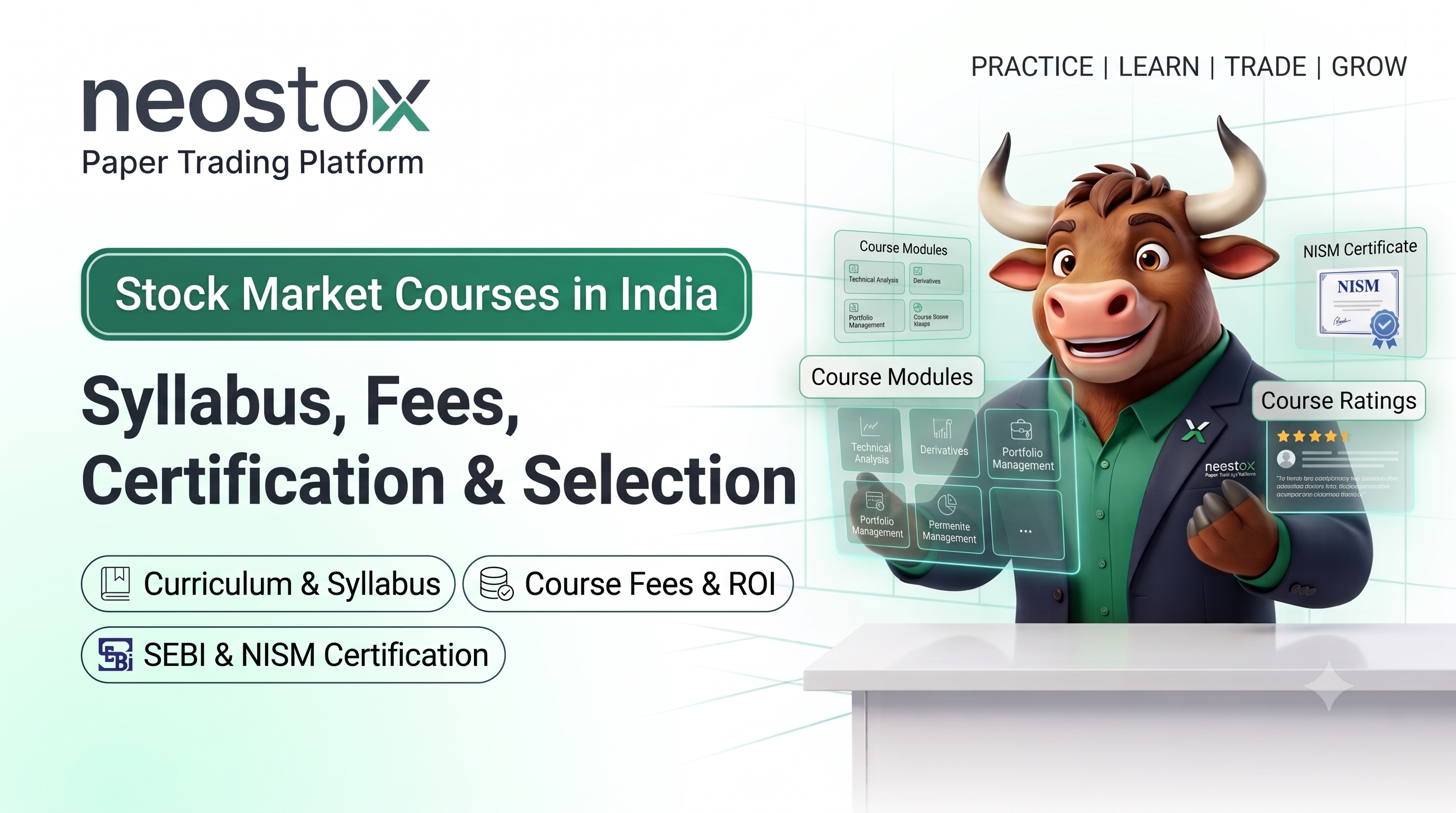
Most course comparisons focus on price and reviews. Two things matter more and get skipped constantly, what the syllabus actually covers, and whether any certificate you walk away with means anything beyond your own personal record. This guide covers both in real depth, alongside the fee, credibility, and format questions dedicated companion guides on this site already cover in full.
What should a good stock market course in India teach? What should the syllabus include?
A genuinely complete syllabus covers six areas, in roughly this sequence. Market mechanics first, how orders work, what a demat account does, basic exchange structure, the foundation everything else builds on. Technical analysis, chart reading, support and resistance, indicators, covered in more depth below. Risk management, position sizing, stop-losses, portfolio-level risk, which should be substantial content, not a single afternoon squeezed in near the end.
A practical, hands-on component, applying what's taught through paper trading or simulated exercises, not just watching lectures. Trading psychology and discipline, since execution under real pressure is a documented gap even for well-informed traders. And coverage matching your actual goals, a course focused on options should actually teach options mechanics in depth, not just mention them in passing while spending most of its time on equity basics you may already know.
If a course's syllabus is vague on any of these, or worse, not visible at all before you pay, that's worth treating as a real gap, not a minor omission.
Beginner vs advanced course?
Match the course to your actual starting point honestly, a course pitched too basic wastes your time, one pitched too advanced leaves you lost without the foundation it assumes you already have. A companion guide on choosing a trading course covers matching course level to your experience in real depth, worth reading if you're unsure which category you actually fall into.
Should technical analysis be included?
Yes, it's core content for most trading-focused courses, covering chart reading, support and resistance, and indicators at minimum. A dedicated hub on this site covers online versus offline formats directly, useful as a benchmark for checking whether a course's technical analysis coverage is actually comprehensive or just a surface-level overview.
Should risk management be mandatory?
Yes, unambiguously, and its absence or thinness is one of the clearest quality signals available. A course that spends most of its time on strategies and setups while treating risk management as an afterthought is teaching you how to find trades, not how to survive being wrong about some of them, which is the actual skill that determines whether you're still trading a year from now.
Are certificates important?
This deserves a more careful answer than most course marketing gives it. A completion certificate from a private trading course is generally a personal record that you finished the material, it doesn't carry regulatory recognition or professional weight the way a credential like NISM certification does. NISM, the National Institute of Securities Markets, was established by SEBI and offers structured, tested certifications recognized within the industry, a genuinely different category from a private course's own completion certificate.
Neither type is worthless, a private course's certificate can still reflect real learning if the course itself was substantive, and NISM certification is worth pursuing specifically if you want industry-recognized credentials. Just don't confuse the two, or assume a private course's certificate carries external weight it doesn't actually have.
How can I check whether a trading trainer is credible? What claims should students be wary of?
Look for a track record or background you can verify independently, outside the course's own marketing materials, and check whether the instructor is SEBI-registered if they're providing specific investment advice rather than general education, since that registration is legally required for advice but not for education itself. Be genuinely wary of guaranteed or fixed-return claims, aggressive urgency tactics, and a curriculum you can't see until after paying, all covered in more detail in a companion guide's full ten-point checklist for evaluating any course.
Online or classroom stock-market course, which is better?
Neither universally, it depends on whether you need external accountability and direct interaction, which offline generally provides, or flexibility and lower cost, which online generally provides. A dedicated companion guide on this site covers this specific tradeoff, including a hybrid option, in full depth.
How should course fees be evaluated? Are stock market courses worth paying for?
Compare the fee against what's actually delivered, curriculum depth, practice opportunities, instructor credibility, not against price alone in either direction. A cheap course with a real curriculum and genuine practice component can beat an expensive one built mostly on marketing, and a course's price alone tells you very little without checking the substance behind it.
Whether it's "worth paying for" depends entirely on that same substance check, a well-structured course with verifiable content and a practice component is a reasonable investment in a genuine skill. A course you can't evaluate properly before paying, regardless of price, is a harder case to justify.
Want to go deeper?
This page covers syllabus content and certification in depth. Dedicated guides on this site cover the rest: a full framework for matching a course to your goals, experience, and trading style, a detailed comparison of online versus offline formats including a hybrid approach, and a complete ten-factor checklist for evaluating any course before you pay.
Whatever course you choose, the syllabus checklist above should end in genuine practice, not just lectures. Neostox's own trading course pairs directly with paper trading on live NSE and BSE market conditions across equities, futures, and options, one example of what a syllabus that actually includes a hands-on component looks like in practice.