
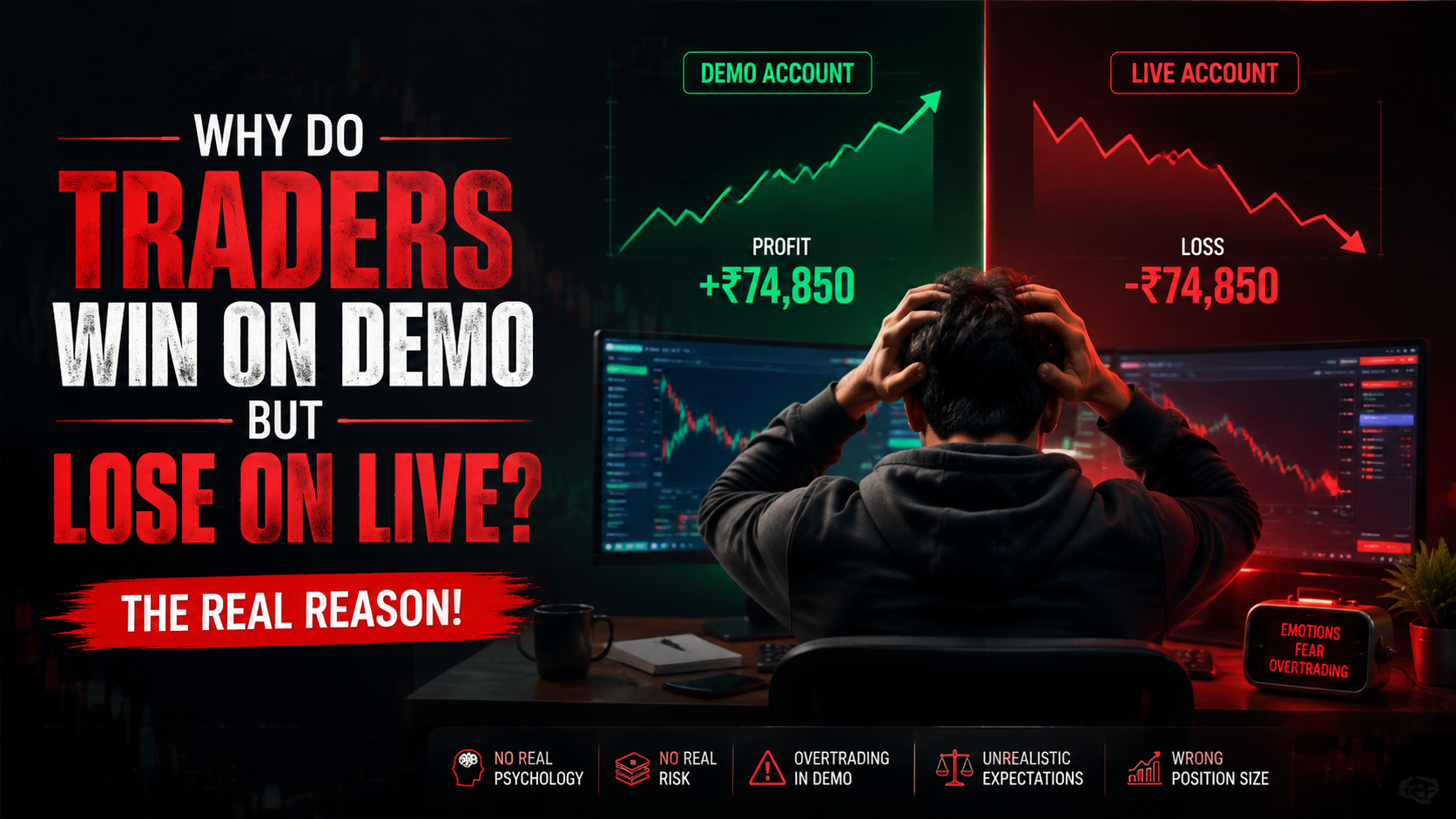
You're profitable in a simulator but struggling with real money because a demo account removes the three things that actually decide most trading outcomes. Realistic transaction costs, real order fills, and the psychological pressure of losing money you can't afford to lose. Your strategy might be fine. What changed is everything around it.
This is one of the most common experiences among beginner traders, and it isn't a sign that you're bad at trading. It's a sign that a simulator, by design, tests something narrower than real trading actually requires.
Reason 1: Your fills aren't as good as you think
In a simulator, you usually get filled at the exact price you saw on screen, or close to it. In live trading, especially with options or mid-cap stocks, your actual fill can land several ticks worse than the quoted price. That gap is called slippage, and it applies to every single trade, not just the occasional one.
If your strategy runs on tight margins, meaning small differences between winning and losing trades, slippage alone can flip a profitable-looking system into a losing one. This is easy to miss in a simulator because there's usually nothing showing you the difference between the price you wanted and the price you would have actually gotten.
Reason 2: Costs quietly eat your edge
Most simulators don't subtract brokerage, Securities Transaction Tax, exchange charges, or GST from your results. Real trading involves all of them, on every trade, whether you win or lose.
SEBI's own research shows how large this effect actually is. A 2024 SEBI study found that loss-making intraday equity traders paid transaction costs equal to an additional 57% of their losses in FY23. Even profitable traders gave up 19% of their gains to costs in the same period. If your simulator results never accounted for this, your real edge is smaller than what the demo showed you, sometimes small enough to disappear entirely.
Reason 3: Real money changes your decisions, not just your account balance
This is usually the biggest factor, and the hardest one to see in yourself. When a loss is simulated, there's no real consequence, so you follow your rules easily. When a loss is real, your brain treats it as an actual threat, and that changes what you do in the moment.
Traders who execute perfectly in a demo account often hesitate on entries they'd take instantly in simulation, close winning trades early out of fear the gain will disappear, or hold a losing trade past their stop-loss hoping it comes back. None of these are signs of a bad strategy. They're signs of loss aversion, a well-documented tendency to feel losses more strongly than equivalent gains, and it only shows up once money is genuinely at risk.
Reason 4: A short winning streak in a simulator doesn't prove much
If you tested your strategy for a week or two and it looked great, that's not necessarily evidence of a real edge. A strategy that follows the trend will look excellent during a strong trending stretch and can lose money just as consistently during a choppy, sideways one.
Ten or fifteen trades simply isn't enough data to separate genuine skill from a lucky run. This applies whether you're trading equities, options, or even forex. Skill and luck look identical over a small sample, and the only way to tell them apart is by testing across a larger number of trades and different market conditions before trusting the result.
Are stock market simulators accurate?
Partly. Simulators are generally accurate for price movement, since a good one tracks live NSE and BSE data and shows you real market behavior as it happens. Where they fall short is in execution realism and psychology, since fills, costs, and the emotional weight of real capital are difficult or impossible to fully replicate.
Some simulators also run on delayed or dummy data rather than live prices, which makes them even less accurate for time-sensitive strategies like intraday trading or options. Before trusting any simulator's results, check whether it explicitly states it's using live market conditions. Neostox runs on live NSE/BSE data across equities, futures, and options, which makes the price behavior part of the test genuinely reliable, even though the cost and psychology gaps still apply the way they would on any platform.
Is trading skill, or is it luck?
Both play a role, and the honest answer is that you usually can't tell which one you're seeing until you've traded enough times to let the pattern show itself. This applies across markets, including forex, options, and equities.
Over a small number of trades, a skilled trader and a lucky one can look identical. Over 50 or more trades, tested across different market conditions with realistic costs applied, genuine skill tends to show up as consistency, meaning a positive result that holds up across varied conditions rather than one that depended entirely on a specific, favorable stretch. If your simulator results only reflect a handful of trades or a single type of market, you haven't actually separated skill from luck yet.
Why do 98% of traders fail? What the real numbers say
The 98% figure gets repeated often, but it isn't a number backed by SEBI's actual research. The real figures are already serious enough without exaggeration.
SEBI's September 2024 study found that 93% of individual F&O traders in India incurred net losses between FY22 and FY24, with aggregate losses exceeding ₹1.8 lakh crore over three years. A separate SEBI study from July 2024 found that more than 70% of individual intraday equity traders lost money in FY 2022-23. Both figures come from actual retail trading data across India's largest brokers, not estimates.
The reasons line up closely with everything above: transaction costs that compound over many trades, strategies that were never properly tested before going live, and decision-making that breaks down under real financial pressure. Most traders who lose money aren't doing something exotic wrong. They're running into the same three gaps that separate demo performance from live performance.
🚀 Want to learn more? Don't miss our complete guide to [I'm New to Investing and Don't Want to Risk Money Yet] →
Don't benchmark yourself against viral trading stories
Stories about a trader turning a small amount into millions in minutes circulate constantly online, and they're built to spread precisely because they're extreme outliers, not typical outcomes. Even when a story like that is genuinely true, it usually involved either extreme leverage, extreme risk, or extreme luck, often all three, and it says nothing about what a repeatable, sustainable trading process looks like.
Using an outlier story as your benchmark sets an expectation that essentially no consistent trader ever meets. A far more useful comparison is your own results over time: are you sticking to your rules, is your process holding up across different market conditions, and is your account growing steadily rather than swinging wildly based on one big bet.
What to actually do about the demo-to-live gap
You can't fully close this gap before trading real money, but you can shrink it considerably with a few specific habits.
- Add a manual cost estimate to your simulator results: Subtract a realistic amount for brokerage, taxes, and slippage from every simulated trade before judging whether the strategy is genuinely profitable.
- Start live trading at the smallest possible position size: The goal of your first live trades isn't income. It's observing how your decisions change when the money is real, while any losses stay small enough to be useful information rather than a setback.
- Keep the exact same rules from your simulator practice: If you followed a specific entry, exit, and risk rule in the demo, follow the identical rule live. This is where most people quietly drift, tightening stops out of fear or taking profits early, without realizing they've changed the strategy.
- Journal your live trades the same way you journaled your simulator trades: Compare the two records side by side. If you notice your live behavior consistently deviating from your simulator behavior, that gap is now your main problem to solve, more so than the strategy itself.
- Scale up slowly, based on evidence: Increase position size only after your live results, over a real sample size, start to resemble what you saw in the simulator.
A brief note on daily income expectations
If part of what's driving frustration is an expectation of consistent daily profit, such as making ₹1,000 a day, it helps to remember that simulator results without realistic costs and without psychological pressure tend to overstate what's achievable. A strategy that looked capable of steady daily profit in a demo account often needs meaningfully more capital, tighter risk control, and a longer track record before it produces that kind of consistency live. Treat early live trading as proving the process, not hitting a specific income number.
Neostox gives you live NSE/BSE market conditions across equities, futures, and options, so the price behavior in your practice is genuinely reliable. It won't remove the psychological gap between demo and live trading, since nothing fully can, but a trade log, realistic live-market pricing, and tools like options chain analysis and NeoScreener give you a proper foundation to test on before you find out the hard way what changes once real money is involved.