
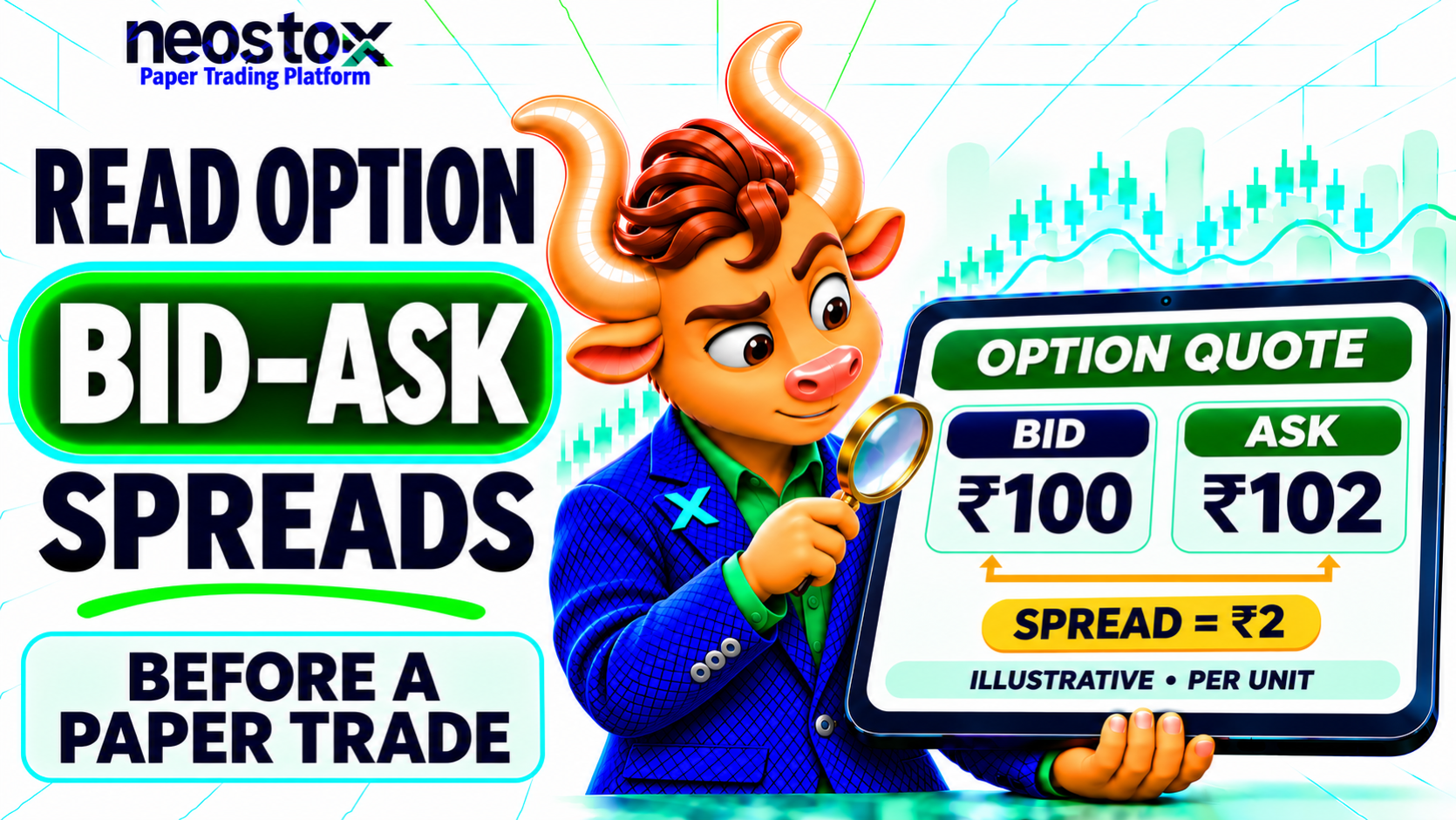
This guide covers the meaning, the formula, worked order-book examples and the effect on trading costs. All prices and amounts are hypothetical illustrations, not live quotes or recommendations.
What Are the Bid and Ask Prices?
Bid and ask prices are the best quotes waiting in the order book at a particular moment. The bid is the highest price a buyer is willing to pay. The ask, also called the offer, is the lowest price a seller is willing to accept. Both change as orders arrive, so a quote is a snapshot, not a fixed price.
| If you want to... | You trade against the... | At the... |
|---|---|---|
| Buy now (market order) | Sellers | Ask |
| Sell now (market order) | Buyers | Bid |
Bid Price
The bid is the best price at which someone is ready to buy. If you sell with a market order, you generally receive the bid, or a lower price if the bid quantity runs out. Each bid comes with a size, the quantity wanted at that price. A bid of ₹149.90 with a size of 250 means 250 shares are wanted there.
Ask Price
The ask is the best price at which someone is ready to sell. If you buy with a market order, you generally pay the ask, or a higher price if the ask quantity runs out. The ask also has a size. An ask of ₹150.00 with a size of 200 means only 200 shares are offered at that price. The bid, ask and LTP guide explains how these differ from the last traded price.
What Is the Bid-Ask Spread and Why Does It Exist?
The bid-ask spread is the gap between the best bid and the best ask. It exists because buyers want to pay as little as possible and sellers want to receive as much as possible, so their resting orders do not meet. When a buyer and seller agree on a price, their orders match and a trade happens.
Here is a simple order book:
| Bid size | Bid price | Ask price | Ask size |
|---|---|---|---|
| 250 | ₹149.90 | ₹150.00 | 200 |
| 300 | ₹149.80 | ₹150.10 | 300 |
| 500 | ₹149.70 | ₹150.25 | 400 |
The best bid is ₹149.90 and the best ask is ₹150.00, so the spread is ₹0.10. The spread is a feature of the market's quotes. It is not a fee your broker charges. Brokerage and other charges are separate costs.
How Do You Calculate the Bid-Ask Spread?
To calculate the spread, subtract the best bid from the best ask. To compare instruments, divide the spread by the midpoint, the average of bid and ask, and multiply by 100. To estimate the cost for an order, multiply the spread by the quantity. Quoted spreads are not the same as what you actually pay.
Absolute and Percentage Spread
Spread (₹) = best ask − best bid
Midpoint = (best ask + best bid) ÷ 2
Spread (%) = spread ÷ midpoint × 100
Crossing cost (₹) = spread × quantity (buy at ask, sell at bid, quotes unchanged)
| Step | Working | Result |
|---|---|---|
| Spread | 150.00 − 149.90 | ₹0.10 |
| Midpoint | (150.00 + 149.90) ÷ 2 | ₹149.95 |
| Spread (%) | 0.10 ÷ 149.95 × 100 | about 0.067% |
| Round-trip cost, 100 shares | 0.10 × 100 | ₹10 |
A percentage lets you compare a ₹150 share with a ₹5 option. The ₹10 figure assumes you buy at the ask and sell at the bid while the quotes stay unchanged, and it excludes brokerage and other charges.
Options Contract Cost
For options, the premium is quoted per unit, and your quantity is the number of units in your position (lots multiplied by the lot size). Check the current lot size on the exchange or your platform. Suppose a hypothetical option shows a bid of ₹80.00 and an ask of ₹80.50. The spread is ₹0.50, or about 0.62% of the ₹80.25 midpoint. For 100 units, buying at the ask and selling at the bid costs ₹50 in spread.
Bid-Ask Spread Examples Using a Live-Style Order Book
The examples reuse the order book above. They are illustrative, not an actual snapshot. No exchange or feed data was collected for this guide.
Quote-Level Example
You place a market order to buy 100 shares. The ask is ₹150.00 with 200 shares available, so the order fills entirely at ₹150.00 and costs ₹15,000. If you sell the same 100 shares straight away at the unchanged bid of ₹149.90, you receive ₹14,990. The ₹10 difference is the spread cost of the round trip, before fees.
Multi-Level Fill and Market Depth
The top-of-book spread covers only the first quantity. A larger order consumes several price levels. Say you buy 600 shares at the market and the book is unchanged:
| Price level | Quantity filled | Cost |
|---|---|---|
| ₹150.00 | 200 | ₹30,000 |
| ₹150.10 | 300 | ₹45,030 |
| ₹150.25 | 100 | ₹15,025 |
| Total | 600 | ₹90,055 |
The weighted-average price is ₹90,055 ÷ 600 = ₹150.0917, or about ₹150.09. Against the best ask of ₹150.00, the extra cost is ₹55. Against the midpoint of ₹149.95, it is ₹85, which is ₹30 of half-spread plus ₹55 of depth. This assumes the quotes and sizes do not change while the order executes, which real markets rarely guarantee.
What Do Narrow and Wide Bid-Ask Spreads Mean?
A narrow spread means the best bid and ask are close together, so crossing them costs less per unit. A wide spread means they are far apart, so crossing costs more. Narrow spreads often go with active trading, but a tight quote with a small size can still be hard to trade at scale.
| Narrow spread | Wide spread | |
|---|---|---|
| Cost to cross | Lower per unit | Higher per unit |
| Often goes with | Competitive quoting and active trading | Thinner trading or more uncertainty |
| Check | Is the displayed size enough for your order? | Is a limit order a better fit? |
| Limitation | A narrow quote can disappear quickly | A wide spread may narrow later |
Volume, Open Interest and Order-Book Depth
Volume counts trades that happened. Open interest counts outstanding derivative contracts. Depth is the quantity waiting at the quoted prices. Volume and open interest describe past activity or positions; neither guarantees an executable quote now. Compare the quote's age, size, spread and depth before you trade.
What Causes Bid-Ask Spreads to Widen or Narrow?
Spreads move with the risk and competition that those quoting prices face. The table shows common drivers. Treat each as a tendency, not a rule, because the effect differs by instrument and market, and this guide gives no typical spread values.
| Driver | Effect on the spread | Why |
|---|---|---|
| Volatility | Often widens | Quoting prices becomes riskier |
| News or events | Can widen | Fair value is uncertain |
| Time of session | Can differ near the open and close | Orders and information cluster there |
| More competing quotes | Tends to narrow | Participants undercut each other |
| Order size and depth | Larger orders move through levels | The top-of-book spread understates the cost |
| Tick size | Sets a floor | The minimum price step limits how narrow a spread can be |
How Does the Spread Affect Trading Costs?
The spread is an implicit cost you pay when you trade at the market. You buy near the ask and sell near the bid, so a round trip costs about one spread, plus any depth effect, slippage, brokerage and charges. The quoted spread is an estimate, not your actual fill.
Spread vs Slippage vs Brokerage
| Spread | Slippage | Brokerage and charges | |
|---|---|---|---|
| What it is | Gap between best bid and best ask | Gap between a chosen reference price and your actual fill | Fees and taxes on the trade |
| Shown as | A quote | A result after execution | An itemised charge |
| Example (100 shares) | ₹0.10 | ₹0.05 if the ask moved to ₹150.05 before you bought | Depends on your plan and the rules |
A full round trip: you buy at ₹150.05 after the ask moves, then sell at ₹149.90. The loss is ₹0.15 × 100 = ₹15, of which ₹10 is the spread and ₹5 is slippage against the ask. Brokerage and other charges come on top. The intraday charges guide explains how they are built up.
Market Orders vs Limit Orders
| Market order | Limit order | |
|---|---|---|
| Price | Not fixed; you take what is available | You set the worst price you accept |
| Fill | Likely, if the market has quantity | Not guaranteed |
| Spread | You generally cross it | You may trade inside it, or not at all |
| Risk | Poorer price in thin or fast markets | A missed trade or partial fill |
A buy limit at ₹149.95, between the bid and the ask, might fill if a seller accepts that price. It might also wait, partly fill or never fill. A limit order sets your worst price; it does not remove the spread. The stop-loss market vs stop-loss limit guide covers a similar trade-off for stops.
In paper trading, the simulator's fill rule decides what price you get, which may not match a live fill. Check how your platform prices orders.
How to Reduce Bid-Ask Spread Costs
You cannot remove the spread, but you can control how much of it you pay. None of these steps promises savings, and each has an exception.
- Check the quote before ordering. Look at the bid, ask, sizes and timestamp. Exception: quotes can change before your order arrives.
- Measure the spread as a percentage. Compare cost across prices. Exception: rupees matter more for a small order.
- Prefer instruments with tight spreads and real depth. Exception: a tight spread with a tiny size can still disappoint.
- Use a limit order when price matters. Exception: it may not fill.
- Size to the displayed depth, or split the order. Exception: splitting adds time and may leave you partly filled.
- Be careful when spreads widen. Fast markets and news are examples. Exception: waiting may cost you the move.
Bid-Ask Spread in Options Trading
Options often show wider percentage spreads than shares, because premiums can be small and some strikes trade rarely. Each strike has its own quote, so compare bid, ask, size and quote age for the exact strike you want.
| Quote | Near-the-money strike (illustrative) | Far out-of-the-money strike (illustrative) |
|---|---|---|
| Bid | ₹80.00 | ₹1.05 |
| Ask | ₹80.50 | ₹2.50 |
| Spread | ₹0.50 | ₹1.45 |
| Spread (% of midpoint) | about 0.62% | about 81.7% |
| Last trade | Recent | Earlier session |
| Depth | Large | Thin |
The far strike's spread is smaller in rupees but huge in percentage. The options paper trading guide is a good place to rehearse.
Why LTP and Far-OTM Premiums Can Mislead
The last traded price (LTP) is the price of a past trade, which may be old. A far out-of-the-money premium can look cheap while its bid and ask are wide apart and almost nothing is displayed. Do not treat LTP, volume or open interest as proof that you can trade there now. Before ordering, run this checklist:
| Check | Question to ask | Warning sign |
|---|---|---|
| Quote age | When did the bid, ask and last trade update? | A last trade far older than the quote |
| Size | Is the displayed quantity enough for your order? | A bid or ask smaller than your quantity |
| Spread | How large is it as a percentage of the midpoint? | A gap that is large relative to the premium |
| Depth | What waits behind the best price? | Prices stepping away quickly after the first level |
Markets also differ. Some, such as US options, publish a consolidated best quote across venues. An Indian exchange order book shows its own quotes. Do not mix rules from one market with the other.