
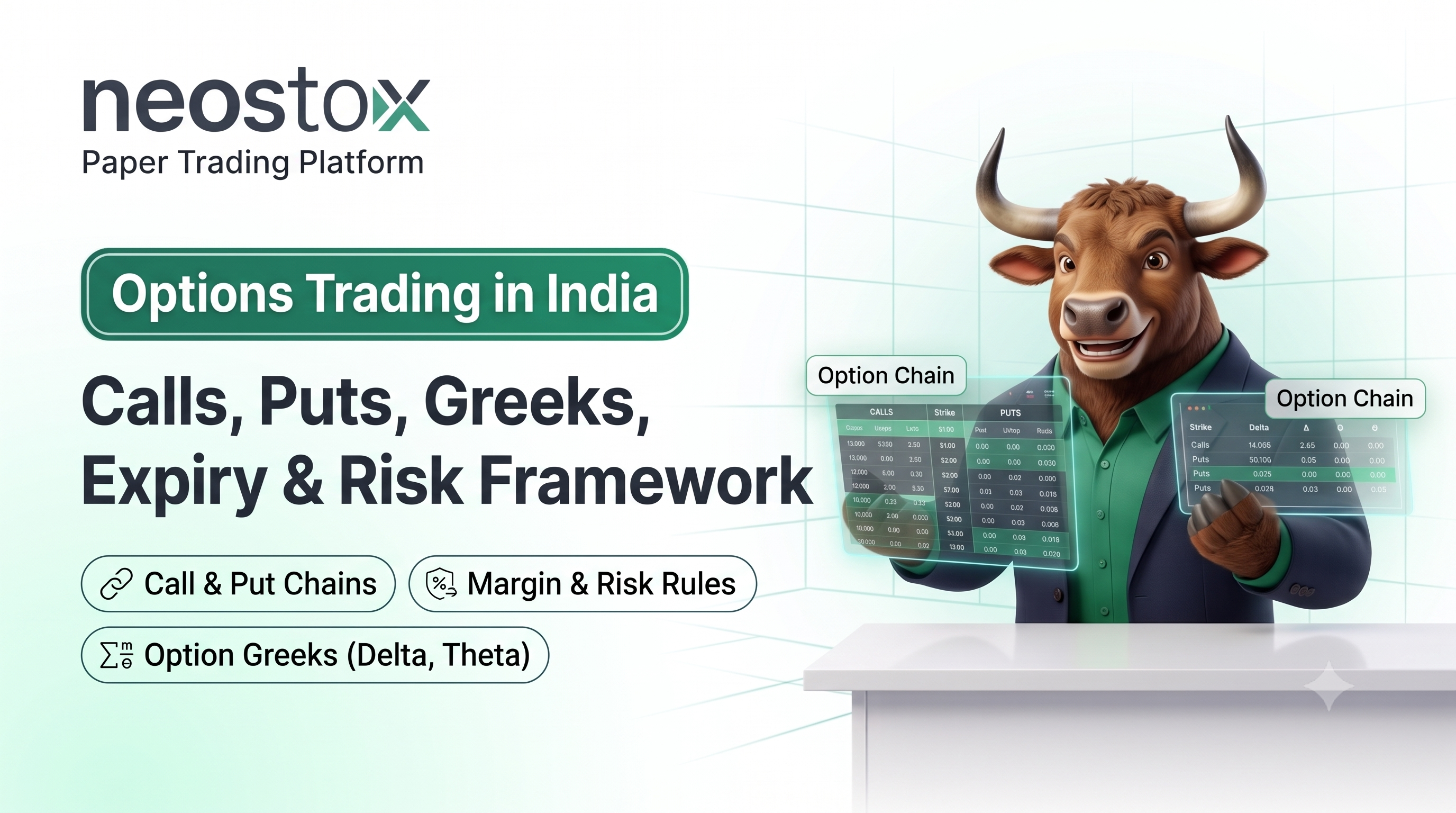
Options confuse beginners because so many pieces move at once, price, time, volatility, all affecting what a contract's actually worth simultaneously. This guide untangles that, starting with what an option contract actually is, working through calls, puts, strike price, premium, and expiry, then into the Greeks, and finally the honest reason options carry more risk than plain stock ownership, for buyers and sellers both, in different ways.
What is an option contract? How do call and put options work in India?
An option contract gives you the right, not the obligation, to buy or sell a specific stock or index at a predetermined price, called the strike price, within or by a specific expiry date, in exchange for paying a premium upfront. That word "right, not obligation" is the whole foundation of how options differ from something like a futures contract, which is a firm commitment, options give the buyer a choice.
A call option gives the buyer the right to buy the underlying at the strike price, generally used when you expect the price to rise. A put option gives the buyer the right to sell at the strike price, generally used when you expect the price to fall. Both trade on NSE for a wide range of stocks and indices.
Call vs put?
Buy a call, and you profit if the underlying rises above your strike price by more than the premium you paid, since you can then buy at the lower strike price and the position is worth the difference. If the price stays below your strike, the call simply expires worthless, and your loss is capped at the premium you paid, nothing more.
Buy a put, and the logic flips, you profit if the underlying falls below your strike by more than the premium paid, since you can sell at the higher strike price even though the market price is lower. If the price stays above your strike, the put expires worthless, same capped loss, limited to your premium.
What is strike price?
The strike price is the specific price at which an option contract lets you buy (for a call) or sell (for a put) the underlying asset, fixed at the time the contract is created. It's one of the key factors determining how expensive the option's premium is, a strike price close to the current market price generally costs more than one further away, since it's more likely to end up profitable.
What is premium?
Premium is the price you pay to buy an option contract, determined by the market based on several factors, how far the strike is from the current price, how much time remains until expiry, and how volatile the underlying is expected to be. For the buyer, premium paid is also your maximum possible loss, you can't lose more than what you paid upfront, regardless of how far the trade moves against you.
What is expiry?
Expiry is the date an option contract stops trading and settles, based on however it's positioned at that point, in the money or worthless. Indian index and stock options commonly use weekly and monthly expiry structures, though specific expiry days have been revised by exchanges over time, so check the current contract specifications directly for the exact expiry schedule of whatever you're trading, rather than assuming a fixed day that may have since changed.
Time until expiry matters enormously for how an option's value behaves, covered next under Theta.
What are Delta, Theta, Gamma and Vega?
Four measures, each capturing a different factor affecting an option's price, worth understanding by what they actually measure rather than memorizing formulas.
- Delta measures how much an option's price moves for a one-point move in the underlying. A delta of 0.5 means the option's price moves roughly half a rupee for every one-rupee move in the stock, giving you a rough sense of how sensitive your position is to the underlying's price.
- Theta measures time decay, how much value an option loses purely from time passing, holding everything else constant. Theta works against option buyers constantly, since every day that passes without a favorable move erodes some of the premium's value, and works in favor of option sellers for the same reason.
- Gamma measures how much delta itself changes as the underlying moves, essentially the rate of change of delta. High gamma means your position's sensitivity to price moves can shift quickly, which matters especially for options close to their strike price near expiry.
- Vega measures how sensitive an option's price is to changes in implied volatility, how much movement the market expects going forward. Rising expected volatility generally increases option premiums, falling expected volatility generally decreases them, independent of which way the underlying actually moves.
Option buying vs selling? How is option selling different from buying?
Buying an option means paying a premium upfront for a defined, capped risk, you can never lose more than what you paid, with theoretically large profit potential if the trade moves strongly in your favor. Selling, or writing, an option flips this entirely, you receive the premium upfront, with your maximum profit capped at that premium, but your potential loss can be significantly larger, in the case of a call, theoretically unlimited, since there's no cap on how high the underlying could rise.
This asymmetry is exactly why margin requirements differ so much between the two. Buyers simply pay the premium and nothing more. Sellers must post margin, similar in spirit to futures margin, since their risk profile is open-ended rather than capped, and the exchange needs assurance they can cover a potentially large loss.
Why can option buyers lose the entire premium?
Because that's structurally how a capped-risk position works, and it happens often, not rarely. If the underlying doesn't move favorably enough by expiry, the option simply expires worthless, and the entire premium you paid is gone, not partially, entirely. This isn't a malfunction or bad luck specifically, it's the defined tradeoff for having limited, known risk in exchange for needing the underlying to actually move enough, in the right direction, within the time remaining, for the position to pay off.
A large share of option contracts, across markets generally, do expire worthless, worth internalizing before treating options as a low-risk way to speculate simply because the loss is "capped."
Why are options considered high risk?
For buyers, the risk is a high probability of losing the entire premium, since time decay works against you constantly and the underlying needs to move enough, in the right direction, within a specific window, for the position to actually profit. For sellers, the risk runs the opposite direction, capped profit potential against a loss that can be considerably larger than the premium collected, in some cases effectively unbounded.
Layer on top of both sides the fact that multiple factors, price, time, volatility, are all affecting the position simultaneously, unlike plain stock ownership where price is essentially the only variable, and you get an instrument that's genuinely harder to reason about correctly than it might first appear, regardless of which side of the trade you're on.
What margin is required for options trading?
If you're buying an option, no margin beyond the premium itself, that's your full payment and your full possible loss, nothing further gets called for. If you're selling an option, you'll need to post margin, typically a combination similar to futures margin, SPAN and exposure margin, since your potential loss isn't capped the way a buyer's is, and the exchange requires collateral proportional to that open-ended risk.
Margin requirements for option selling can also increase during volatile periods, since the potential loss the exchange needs to cover grows alongside market volatility, worth factoring into position sizing if you're writing options rather than simply buying them.
Options genuinely reward careful study before real capital's involved, given how many factors interact at once. Neostox's options chain analysis, AI options assistant, and pre-built options strategies give you real tools to study strike selection, premium behavior, and the Greeks directly, and paper trading lets you practice both buying and selling options on live NSE market conditions with virtual money before any real premium or margin is on the line.