
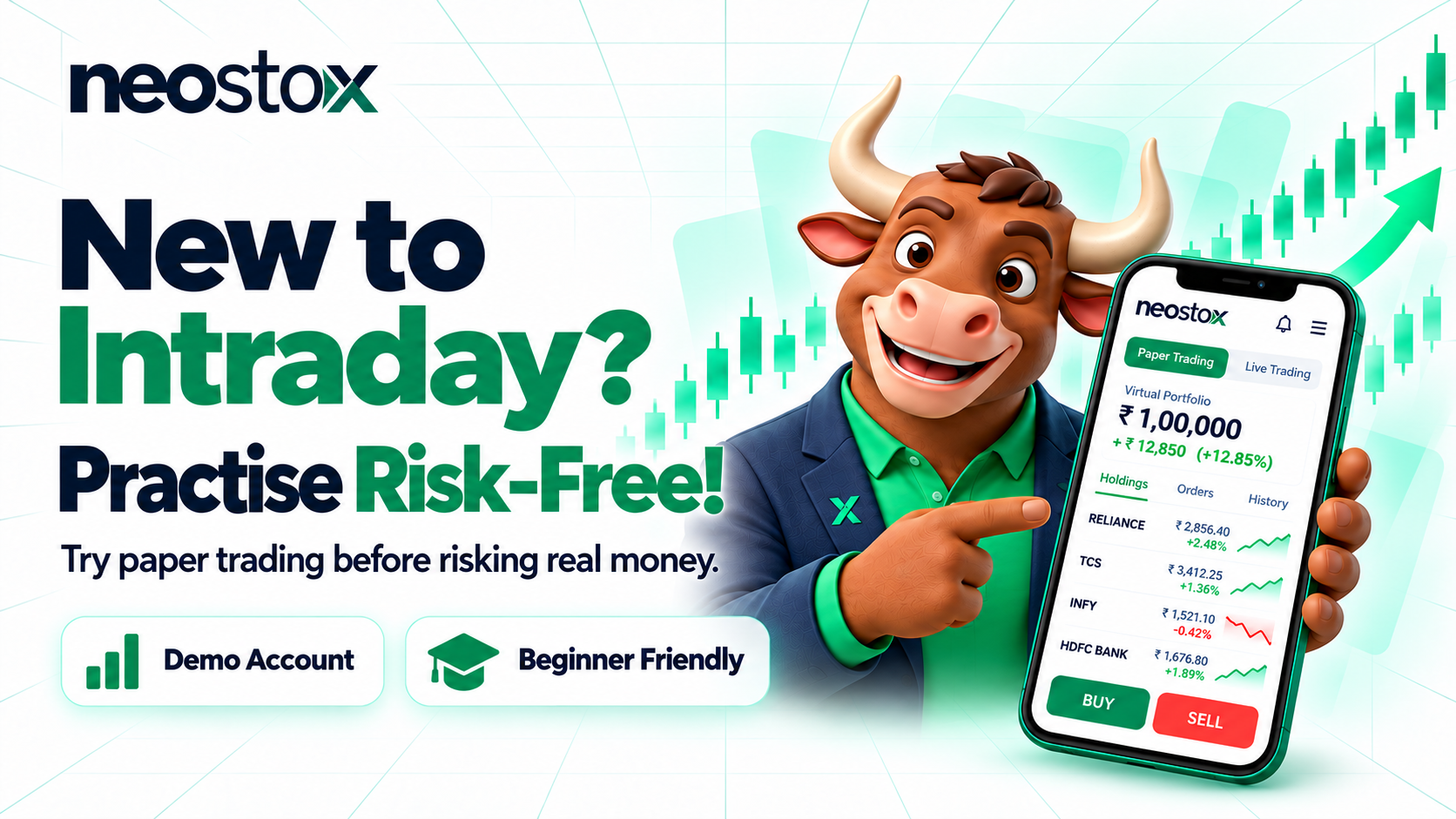
You practise intraday trading risk-free through a demo account, also called a paper trading or virtual trading account, offered by individual brokers and trading platforms, not by SEBI or the exchanges themselves. You place simulated buy and sell orders on real NSE and BSE instruments using virtual capital, so nothing you win or lose is actual money. It's a genuinely useful way to learn mechanics before risking anything real, though it has real limits too, covered below.
What does practising on a demo account actually involve?
A demo account mirrors a live trading screen closely, order entry, a watchlist, charts, position tracking, except the money attached to it is virtual. You pick a stock or index, place an order the same way you would with real capital, and watch how the position behaves. If it moves against you, nothing happens to your actual finances. If it works out, you don't walk away with real profit either. The entire point is repetition without consequence.
Where can you actually find one?
Through a trading platform or broker that offers it as a built-in feature, not through SEBI or the exchange directly, since neither NSE nor BSE runs demo accounts themselves. Availability, instrument coverage, and how closely the simulation matches real conditions all vary from one provider to another, so this is worth checking directly rather than assuming every platform's version works the same way.
Neostox includes a paper trading feature covering equities, futures, and options, letting you place simulated intraday orders on NSE and BSE instruments with virtual capital. It's one option among several, and the same evaluation questions below apply regardless of which platform you end up choosing.
What should a decent demo account actually include?
A few things separate a genuinely useful demo setup from one that just looks the part.
It should run on real exchange instruments and real market pricing, not a simplified or made-up version of the market. It should support the same order types you'd eventually use, market, limit, stop-loss, so the muscle memory actually transfers. And ideally, it should sit on the same interface you'd use for real trading later, so switching from practice to the real thing doesn't mean relearning a whole new screen.
What a demo account can't actually teach you
Worth being honest about this part, since it's where overconfidence usually creeps in. A demo account removes financial risk, which is exactly why it's useful for learning mechanics. But it also removes the pressure that comes with real money, and that pressure changes how people actually behave. Watching a position move against you calmly, with virtual rupees attached, feels nothing like watching the same move happen with your actual savings on the line.
Use demo trading to get comfortable with the process, order placement, timing, reading how price actually moves. Don't treat a good run on a demo account as proof you're ready to trade the same way with real capital. Those are two different tests.
How do you avoid picking up bad habits while practising?
Two things matter more than people expect. First, trade with a virtual balance close to what you'd actually use once you go live, not an inflated number the platform hands you by default, since position sizing feels completely different depending on account size. Second, keep a short record of every trade, what you did and why, since a demo account you never review is just screen time, not practice.