
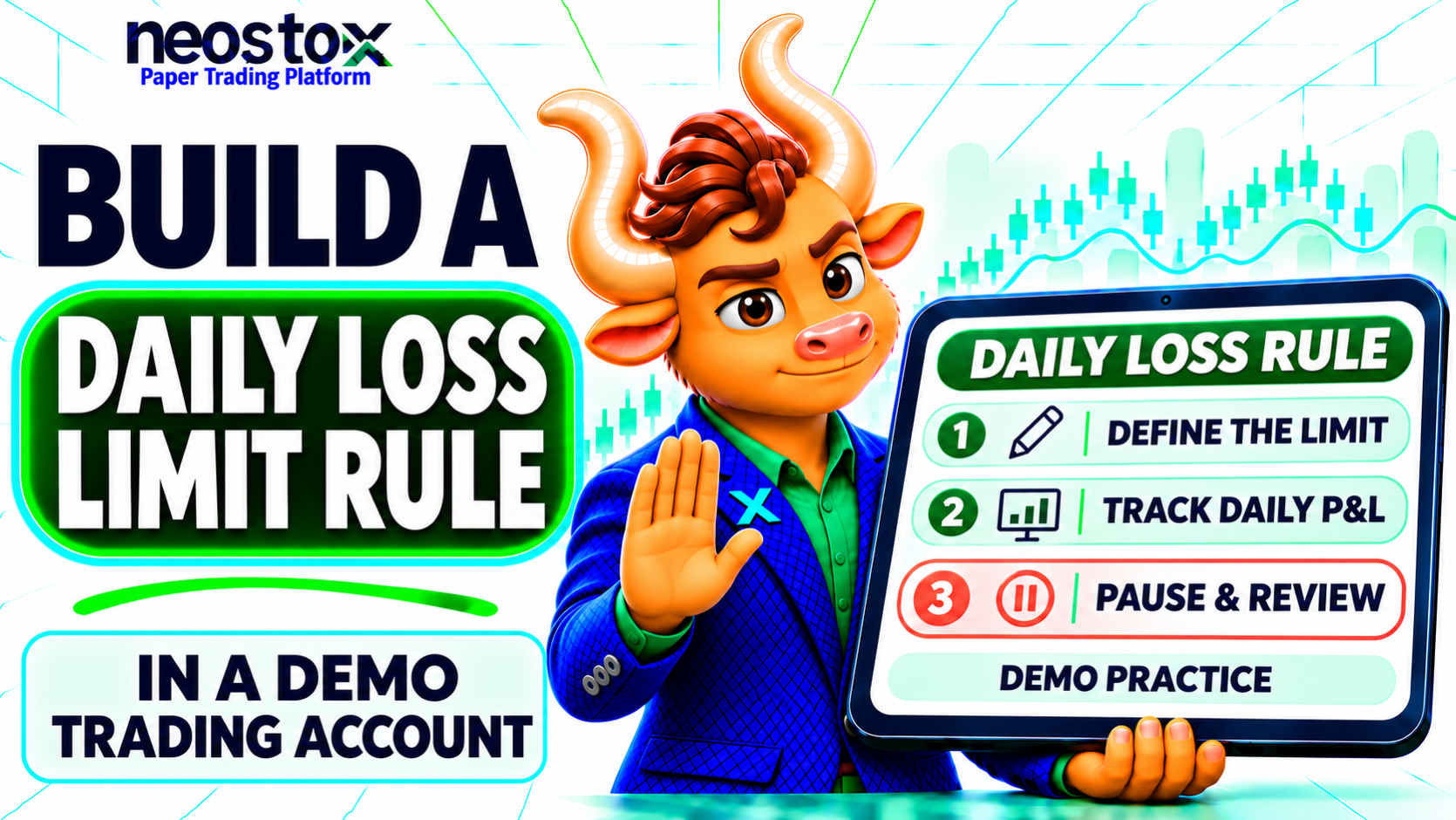
This guide explains the rule, how to calculate the threshold, what happens at a breach and when a limit resets. It also shows how to test a limit yourself. All rupee amounts and percentages are hypothetical illustrations, not recommendations.
What Is the Daily Loss Limit Rule in Paper Trading?
The daily loss limit rule caps how much a simulated account may lose in one trading day. It has three parts: a threshold (a rupee amount or a percentage), a measurement (what counts as loss) and a window (when the day starts and ends). A rule that leaves any of these vague cannot be applied the same way twice.
The rule can be optional or mandatory. A trader can set it as a personal habit. A simulated evaluation can require it. A tool can enforce it automatically. These are different things with different consequences, and a practice account does not enforce a cap unless it says so.
What Counts as a Daily Loss?
A daily loss is the fall in your account value over the window, measured against a stated starting point. Depending on the rule, it may include:
- Realised loss: closed trades that ended below their entry
- Floating (unrealised) loss: open trades currently below their entry
- Fees: simulated brokerage and charges, if the account models them
A mini example: you start the day at ₹1,00,000, close a trade for −₹800 and hold an open trade that is currently −₹300. An equity-based rule sees a ₹1,100 loss. A rule that counts only closed results sees ₹800. Realised vs unrealised P&L explains the two terms.
Do All Paper Trading Accounts Have Daily Loss Limits?
No. Many practice accounts have no daily loss limit at all. A limit exists only where you set it, where a programme requires it or where software enforces it. Always check which of the three applies and read the written rule for that account.
| Type | Who sets it | What usually happens at the limit |
|---|---|---|
| Demo or practice account | You, or nobody | Nothing automatic; you decide whether to stop |
| Simulated evaluation | The programme provider | The provider's written rule decides, which can include failing the evaluation |
| Automated control | A tool or script you configure | It may block new entries or request closures, within its scope |
Demo Accounts
A plain practice account usually lets you keep trading however much you lose. Treat a daily loss limit here as a personal rule. Write it down before the session and track it yourself. This guide does not claim that Neostox has a built-in daily loss limit setting. If you want one there, set it as your own rule and record it in your journal. The Neostox reports page says the Detailed Trading Report can be downloaded to Excel, which helps you total a day's results.
Simulated Prop Evaluations
Some third-party programmes run simulated evaluations with fixed loss rules. Their baseline, cutoff and breach handling differ from one provider and plan to another. Never assume one provider's rule applies to another. Use the current written rulebook for the exact programme and account tier.
Automated Controls
A strategy script, a platform feature or a broker control can sometimes enforce a limit. Its scope matters. A rule inside one script may not cover orders placed by hand or by another script. Do not treat an automated control as guaranteed protection.
How Is a Paper Trading Daily Loss Limit Calculated?
Convert the limit into a rupee loss allowance from a reference balance. Subtract the allowance to get an equity floor. Then compare current equity with that floor. Equity is the account balance plus open profit and loss, less fees. The rule is breached when equity touches or falls below the floor, under the rule's own settings.
B0 = start-of-day reference value
p = permitted daily loss, in %
L = B0 × p ÷ 100 (loss allowance, in ₹)
Floor = B0 − L (equity floor)
Equity = balance + floating P&L − fees
Daily loss = B0 − Equity
Breach when Equity ≤ Floor
| Symbol | Meaning | Example |
|---|---|---|
| B0 | Start-of-day reference value | ₹1,00,000 |
| p | Permitted daily loss, in % | 2% |
| L | Loss allowance in ₹ | ₹2,000 |
| Floor | Lowest equity before a breach | ₹98,000 |
| Equity | Balance + floating P&L − fees | ₹98,050 |
A limit can also be a fixed rupee amount. In that case L is the amount itself and no percentage is needed. This is one illustrative convention. It is not a universal formula for every provider.
Starting Balance vs. Equity
The reference value B0 changes the answer. Some rules use start-of-day balance (closed results only). Others use start-of-day equity, which includes any open trades carried in. Say you start the day with a ₹1,00,000 balance and an open position that is already −₹1,000. Equity is ₹99,000.
| Baseline | B0 | 2% allowance | Floor |
|---|---|---|---|
| Start-of-day balance | ₹1,00,000 | ₹2,000 | ₹98,000 |
| Start-of-day equity | ₹99,000 | ₹1,980 | ₹97,020 |
The same 2% rule gives floors ₹980 apart. State which baseline you use.
Equity Formula
Equity moves with every price tick while a trade is open. That means equity can cross the floor before any position closes. A balance-only rule moves only when a trade closes. For a tight limit, this difference decides when the limit trips.
Open Losses, Fees and Deposits
Check three adjustments. First, whether floating losses count. Second, whether fees are deducted. Third, how deposits, withdrawals or a balance reset are treated, since adding virtual funds could hide a loss if the rule does not adjust for it. Where the rule is silent, assume nothing and test it.
Paper Trading Daily Loss Limit Examples
These examples are hypothetical. Fees and cash adjustments are ignored unless stated.
₹1,00,000 at 2%
The limit is 2% × ₹1,00,000 = ₹2,000, so the floor is ₹98,000. The day unfolds like this:
| Step | Event | Equity | Loss so far | Status |
|---|---|---|---|---|
| 1 | Trade 1 closed at −₹700 | ₹99,300 | ₹700 (0.7%) | Within limit |
| 2 | Trade 2 closed at −₹600 | ₹98,700 | ₹1,300 (1.3%) | Within limit |
| 3 | Trade 3 closed at −₹500 | ₹98,200 | ₹1,800 (1.8%) | Within limit |
| 4 | Trade 4 open, floating −₹150 | ₹98,050 | ₹1,950 (1.95%) | Within limit |
| 5 | Trade 4 floating −₹350 | ₹97,850 | ₹2,150 (2.15%) | Breached |
Closed losses alone reached only ₹1,800. The floating loss on the open trade pushed equity through the floor. A balance-only rule would not have flagged it until the trade closed.
₹5,00,000 at 4%
The limit is 4% × ₹5,00,000 = ₹20,000, so the floor is ₹4,80,000.
| Component | Amount |
|---|---|
| Starting reference value | ₹5,00,000 |
| Realised loss | −₹11,000 |
| Fees | −₹600 |
| Floating loss | −₹7,500 |
| Current equity | ₹4,80,900 |
| Result | ₹900 above the floor |
Later, the floating loss widens to −₹9,200. Equity becomes ₹4,79,200, which is ₹800 below the floor, and the rule is breached.
Now see overshoot. Suppose the closure is triggered when equity touches ₹4,80,000, but the exit fills ₹1,500 worse in total than the price at the trigger. The day's loss ends at ₹21,500, or 4.3%. A limit marks the point where a rule fires. It does not guarantee the loss will stop there.
Daily Loss Limit vs. Max Drawdown vs. Stop-Loss
These are three different controls. A daily limit covers one day. A maximum drawdown covers the fall from a peak or a starting level over a longer period. A stop-loss covers one trade.
| Control | Scope | Measured against | Typical action |
|---|---|---|---|
| Daily loss limit | One day, whole account | Start-of-day reference | Pause, block or breach |
| Maximum drawdown | Longer period, whole account | A peak or the starting balance | Breach or review |
| Stop-loss | One trade | That trade's entry | Exit that trade |
Some evaluations use a trailing drawdown that moves up as equity rises. That is another variation to read in the rulebook. A tight stop-loss on every trade does not replace a daily cap, because several small stopped trades still add up. Trading drawdown explained shows why recovering from a fall takes a larger gain, and how to practice stop loss in paper trading covers the per-trade control.
What Happens When You Hit the Daily Loss Limit?
Reaching a paper trading daily loss threshold does not always have the same result. A personal rule may simply tell the trader to stop, while an automated circuit breaker may block entries or request position closures. A simulated evaluation may treat the event as an account breach. Check the written rules.
Alerts, Blocks and Closures
Software can respond in several ways, each with a different effect:
- Alert: a warning only; trading continues unless you stop.
- Entry block: new orders are rejected; open positions stay open.
- Closure request: the system asks to close positions. A request is not the same as an executed fill, since the exit can fill later or at a worse price.
- Account breach: the programme records a failure under its rules.
Read which of these your tool or programme uses.
What Is a Breach?
A breach is the event the rule defines as crossing the limit. Some rules count the moment equity touches the floor. Others count only when it is below it, or when a closed result ends below it. Whether touching counts, and whether a breach is judged at a tick or at the end of the day, depends on the rule's wording.
When Does the Daily Loss Limit Reset?
A paper trading daily loss limit usually resets at a specified session boundary, but there is no universal reset time. Some evaluations use a provider-defined cutoff. Personal rules may follow your own calendar day or the platform's. Confirm any time zone, daylight-saving effect and how overnight positions affect the next day's starting value.
Times and Time Zones
Find out the exact cutoff and its time zone before you rely on it. A reset at midnight in one zone is a different moment in another. In India there is no daylight saving, but a platform or provider based abroad may use one. Only state a cutoff if the current rule documents it.
Overnight Positions
An open position can carry across the reset. Here is a hypothetical two-day timeline:
| Day 1 | Day 2 starts | |
|---|---|---|
| Realised result | −₹1,000 | Balance ₹99,000 |
| Open position floating | −₹500 | Equity ₹98,500 |
With a 2% rule, a balance baseline gives an allowance of ₹1,980 and a floor of ₹97,020. An equity baseline gives ₹1,970 and a floor of ₹96,530. The overnight position changes the starting point, so check which baseline applies.
How to Set and Test a Daily Loss Limit
Set the limit in writing, then test whether it behaves as you expect. Do not assume your tool enforces it.
Choose Scope
Decide what the limit covers. Is it one script, one strategy, one account or all accounts? Is the threshold a rupee amount or a percentage? Which baseline and which cutoff apply? A personal rule needs a written answer to each question. For a provider's rule, copy the answers from its current rulebook.
Configure and Verify
- Write the rule. Example: ₹1,00,000 account, ₹2,000 limit, equity-based, resets at your chosen cutoff. Pass: all five fields are filled in.
- Record the baseline. Note start-of-day balance, equity and the floor. Pass: floor = baseline − allowance.
- Place a small trade and log it. Note entry, exit, fees and equity after each step. Pass: your equity matches the platform's figure.
- Move toward the floor. Use small hypothetical losses and watch equity, including floating loss. Pass: you can see when the floor is crossed.
- Observe the action. Note whether the tool warns, blocks, requests closure, breaches or does nothing. Pass: the result matches the written rule.
- Repeat across a reset. Check the next day's baseline. Pass: the starting value follows the documented rule.
This is a method you can run. It is not a test we have run, and this article reports no test results. Add observations only from a real test, with the platform, version and date.
Common Daily Loss Limit Mistakes
- Counting only closed trades. Floating losses can breach an equity-based rule first. Check which measure your rule uses.
- Ignoring fees. Costs add to the loss. Include them if your account models them.
- Assuming the loss stops at the limit. Slippage, gaps and delayed fills can push the final loss past it. Bid, ask and LTP explains why a fill can differ from the screen price.
- Wrong baseline. Using balance when the rule uses equity changes the floor. Write the baseline down.
- Trusting a script to cover everything. A script's limit may not cover manual orders.
- Revenge trading after a bad day. A limit is a rule to follow, not a target to push against. Stopping for the day and reviewing the journal is the point of having one.
- Presenting one percentage as right for everyone. A 1%, 2% or 4% limit is an illustration only.