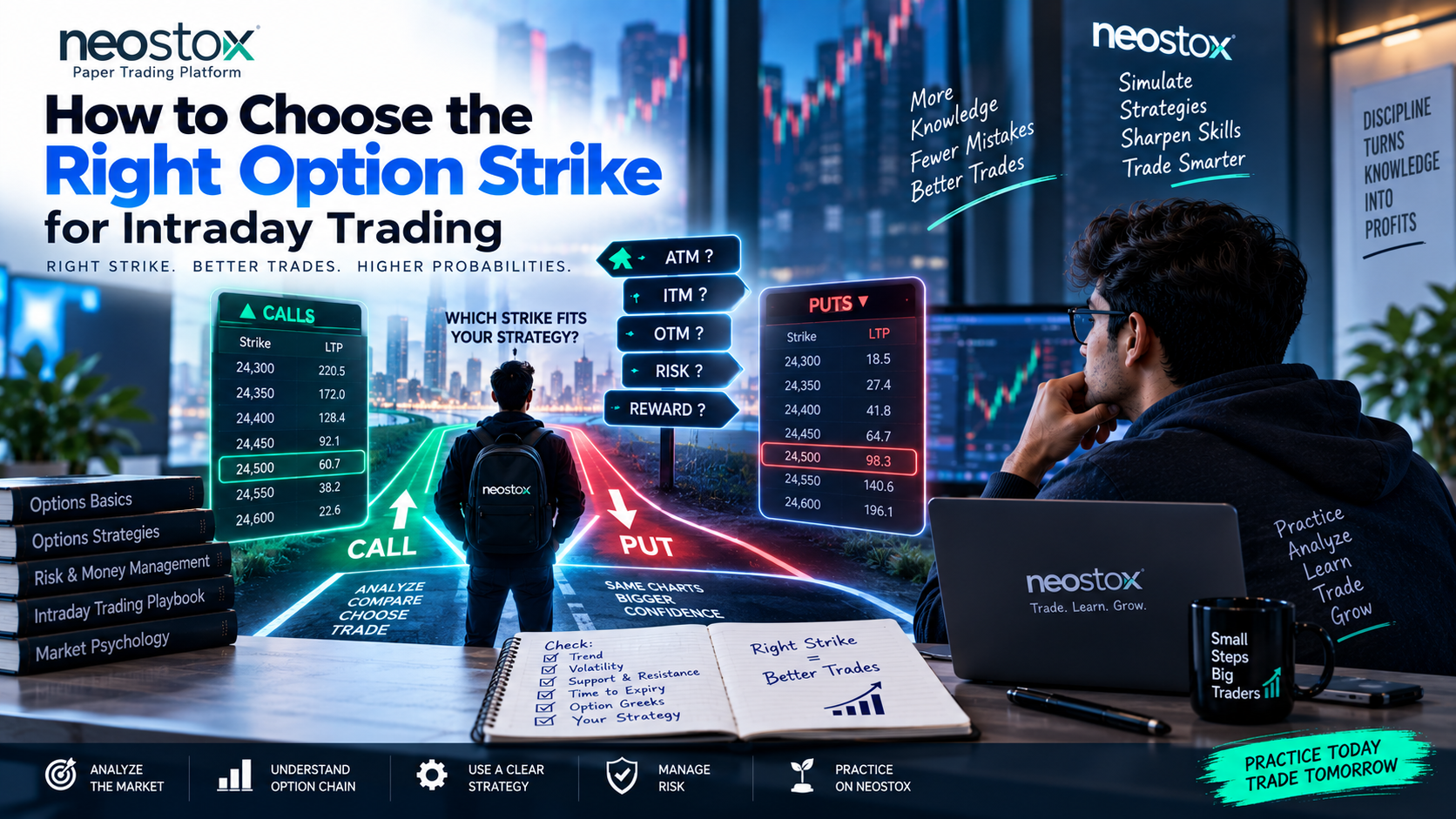


Choosing the market direction is only one part of an options trade. This article explains why different strikes can behave differently even when the underlying moves as expected, what traders should consider before buying a Call or Put, and how Neostox can help identify options that are moving in line with their underlying stock or index.
Learn how price, volume, order flow, and other market data can be represented quantitatively and tested through backtesting, statistical analysis, and out of sample validation.
Developing a feel for market mechanics requires deliberate chart practice, written predictions, and honest review. Learn how chart replay, observation checklists, journaling, and simulated trading build pattern recognition.
A practical explanation of how AI and data science can help traders analyze market information, identify patterns, and assess risk without guaranteeing future prices.
Learn how to trade stocks using a repeatable process built around research, planning, position sizing, disciplined execution and review. The guide also explains how to turn market observations into testable strategies.
Learn how liquidity, order books, settlement, and market makers affect trade execution. The guide also explains spreads, market depth, slippage, and India’s T+1 settlement cycle.
Learn how to identify genuinely useful trading books, channels, courses, and official education resources. Discover the warning signs that separate practical trading education from hype.
Learn how shares are traded in India, how orders reach NSE and BSE, and what happens during clearing and settlement. The guide also covers liquidity, trading terminology, derivatives and beginner risk.
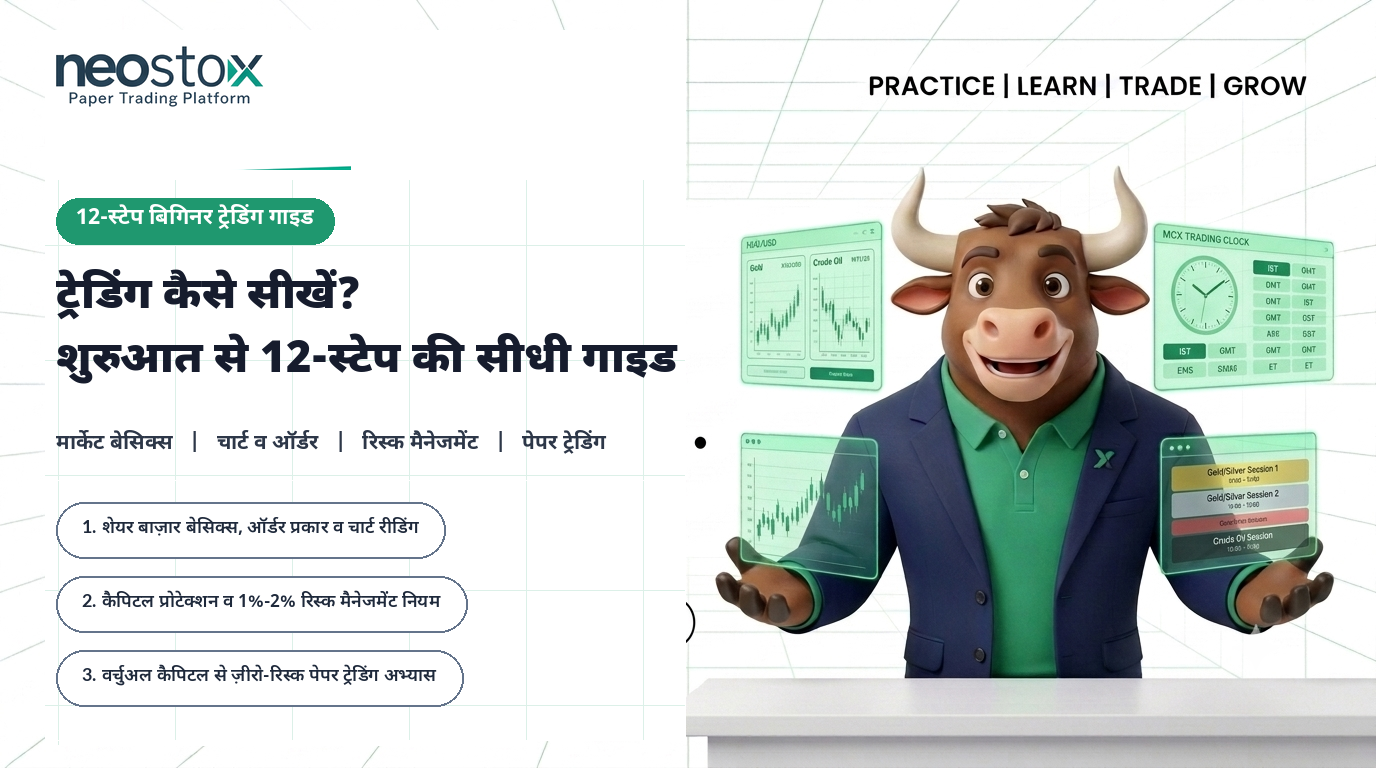
A practical guide to the order types, chart basics, position sizing, costs and risk rules beginners should understand before placing their first trade.
Learn how a long put uses defined risk to pursue profit from a falling market. The article covers payoff calculations, market conditions, strike selection, time decay, and exit decisions.
Learn how an iron condor works, including strike selection, expiry payoff, break even levels and maximum risk. The article also covers volatility, adjustments, execution and Indian settlement considerations.
Lays out a structured 30-day plan for beginners to learn trading on a simulator before risking real money, moving week by week from basic mechanics to strategy testing to focused day-trading practice to full portfolio management.
Sets realistic expectations upfront, offers a 30-minutes-a-day version for time-constrained readers, and closes with common mistakes plus Neostox as the platform to run the whole plan on live NSE/BSE conditions.
Learn how to actually use a $100,000 virtual simulator account to learn diversification and risk management, not just rack up a big number.
Walks through practical rules: holding 8-15 positions, capping risk per trade at 1-2%, applying the 3-5-7 risk framework, and diversifying by correlation across sectors rather than just stock count.
Debunks unrealistic expectations along the way (turning $5,000 into $1 million, daily income targets) and positions Neostox as the platform to practice these habits on real NSE/BSE price data before real capital is involved.
Learn how price zones, candle bodies, zigzag settings, swing ratios, and neckline confirmation can reduce guesswork when identifying double tops and bottoms.
Why traders profit in a simulator but struggle with real money: it's the missing real order fills, real transaction costs, and psychological pressure, not a flawed strategy.
Backs this with verified SEBI data (93% of F&O traders and 70%+ of intraday traders lost money recently, costs eating up to 57% of losses) and debunks viral "trader made millions" stories as outliers, not benchmarks.
Closes with practical fixes, manual cost adjustments, minimum-size live trading, matching journal discipline, and positions Neostox as a simulator built on live NSE/BSE conditions to narrow that gap.
This blog breaks down the biggest mistakes beginners make when practicing with virtual money on a stock trading simulator, arguing that most people fail not because the simulator is flawed but because they treat the practice too casually, using an unrealistic virtual balance, overtrading since nothing feels at stake, skipping the trade journal, clicking through trades without a defined strategy, ignoring real transaction costs and slippage, overreacting to short winning or losing streaks, rushing into options and futures before mastering equity basics, and mistaking a profitable simulated account for real trading skill.
It backs this up with SEBI's verified finding that loss-making intraday traders paid transaction costs equal to 57% of their losses in FY23, then offers a practical fix for each mistake, a section on what actually separates good traders from beginners (consistency, defined risk, disciplined review), an embedded before-and-after discipline checklist readers can use directly, and an honest answer to whether simulators like Investopedia's are safe to use (financially yes, though realism varies by platform), before closing with Neostox positioned as a simulator built on live NSE/BSE market conditions across equities, futures, and options for readers who want their practice habits to actually transfer to real trading.